Explainable Machine Learning for Predicting the Mental Health Impact of AI and Digital Platform Usage among Students
DOI:
https://doi.org/10.56705/ijaimi.v4i1.432Keywords:
Artificial Intelligence, Digital Platform Usag, Machine Learning, Mental Health, Student Well- Being, Sleep Behavior, Health InformaticAbstract
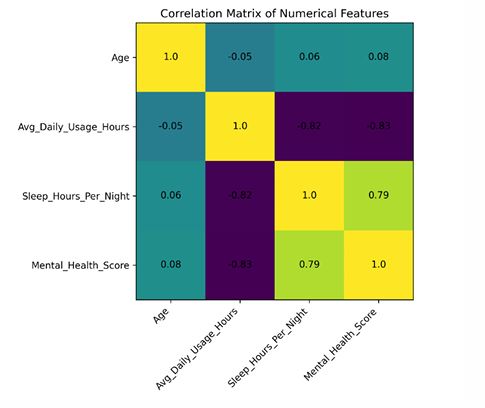
The increasing use of artificial intelligence and digital platforms among students has created new opportunities for learning support, academic assistance, and digital interaction. However, intensive platform usage may also be associated with mental health concerns, sleep disruption, and negative effects on students’ daily life. This study aims to develop and evaluate machine learning models for predicting the overall impact of AI and digital platform usage among students by integrating demographic, behavioral, sleep-related, and mental health-related variables. The dataset consisted of 1,705 student records with features including age, gender, academiclevel, country, average daily usage hours, most-used platform, sleep hours per night, and mental health score. The target variable was Overall_Impact, categorized into Negative, Neutral, and Positive classes. Six supervised machine learning algorithms were evaluated: Logistic Regression, Decision Tree, Random Forest, Support Vector Machine, K-Nearest Neighbors, and Gradient Boosting. Model performance was assessed using accuracy, precision, recall, F1-score, Cohen’s Kappa, MAE, RMSE, ROC-AUC, and confusion matrix. The results showed that Random Forest achieved the best performance, with an accuracy of 99.71%, F1-macro of 99.52%, Cohen’s Kappa of 0.9950, and ROC-AUC of 0.9994 on the testing set. Feature importance analysis revealed that Mental_Health_Score, Sleep_Hours_Per_Night, and Avg_Daily_Usage_Hours were the most influential predictors. The findings indicate that machine learning can effectively predict the impact of digital platform usage and provide useful insights for AI-driven health informatics and student well-being monitoring. However, further validation using longitudinal and clinically grounded datasets is recommended.
References
[1] A. P. Wibowo, M. Taruk, T. E. Tarigan, and ..., “Improving Mental Health Diagnostics through Advanced Algorithmic Models: A Case Study of Bipolar and Depressive Disorders,” Indones. J. …, 2024, [Online]. Available: https://jurnal.yoctobrain.org/index.php/ijodas/article/view/122.
[2] Z. Zhu, F. K. S. Chan, G. Li, M. Xu, M. Feng, and Y. G. Zhu, “Implementing urban agriculture as nature-based solutions in China: Challenges and global lessons,” Soil Environ. Heal., vol. 2, no. 1, p. 100063, 2024, doi: 10.1016/j.seh.2024.100063.
[3] M. U. Emon, M. S. Keya, T. I. Meghla, M. M. Rahman, M. S. Al Mamun, and M. S. Kaiser, “Performance Analysis of Machine Learning Approaches in Stroke Prediction,” Proc. 4th Int. Conf. Electron. Commun. Aerosp. Technol. ICECA 2020, no. January, pp. 1464–1469, 2020, doi: 10.1109/ICECA49313.2020.9297525.
[4] V. Chaurasia, “Prediction of Heart Disease Using Data Mining Technique,” Int. J. Adv. Eng. Res. Dev., vol. 3, no. 01, pp. 208–217, 2016, doi: 10.21090/ijaerd.030137.
[5] A. Naswin and A. P. Wibowo, “Performance Analysis of the Decision Tree Classification Algorithm on the Pneumonia Dataset,” … Artif. Intell. Med. …, 2023, [Online]. Available: https://jurnal.yoctobrain.org/index.php/ijaimi/article/view/83.
[6] E. Najwaini, T. E. Tarigan, and F. P. Putra, “Application of the K-Nearest Neighbors (KNN) Algorithm on the Brain Tumor Dataset,” … Artif. Intell. …, 2023, [Online]. Available: https://www.jurnal.yoctobrain.org/index.php/ijaimi/article/view/85.
[7] R. Setiawan and H. Oumarou, “Classification of Rice Grain Varieties Using Ensemble Learning and Image Analysis Techniques,” Indones. J. Data …, 2024, [Online]. Available: https://jurnal.yoctobrain.org/index.php/ijodas/article/view/129.
[8] F. T. Admojo and N. Rismayanti, “Estimating Obesity Levels Using Decision Trees and K-Fold Cross-Validation: A Study on Eating Habits and Physical Conditions,” Indones. J. Data …, 2024, [Online]. Available: https://www.jurnal.yoctobrain.org/index.php/ijodas/article/view/126.
[9] B. D. Finley, Optimizing Data Pre-Processing Transformations with Reinforcement Learning. search.proquest.com, 2022.
[10] K. N. Myint and Y. Y. Hlaing, “Predictive Analytics System for Stock Data: methodology, data pre-processing and case studies,” 2023 IEEE Conf. Comput. …, 2023, [Online]. Available: https://ieeexplore.ieee.org/abstract/document/10182047/.
[11] N. Rezova, L. Kazakovtsev, G. Shkaberina, and ..., “Data Pre-Processing for Ecosystem Behavior Analysis,” 2022 Int. …, 2022, [Online]. Available: https://ieeexplore.ieee.org/abstract/document/9897105/.
[12] A. Tuppad and S. D. Patil, “Data Pre-processing Issues in Medical Data Classification,” 2023 Int. Conf. …, 2023, [Online]. Available: https://ieeexplore.ieee.org/abstract/document/10275855/.
[13] V. R. Joseph and A. Vakayil, “SPlit: An Optimal Method for Data Splitting,” Technometrics, vol. 64, no. 2, pp. 166–176, Apr. 2022, doi: 10.1080/00401706.2021.1921037.
[14] E. K. Ampomah, Z. Qin, and G. Nyame, “Evaluation of Tree-Based Ensemble Machine Learning Models in Predicting Stock Price Direction of Movement,” Information, vol. 11, no. 6, p. 332, Jun. 2020, doi: 10.3390/info11060332.
[15] L. A. Al-Haddad, “An Intelligent Quadcopter Unbalance Classification Method Based on Stochastic Gradient Descent Logistic Regression,” 3rd Information Technology to Enhance e-Learning and Other Application, IT-ELA 2022. pp. 152–156, 2022, doi: 10.1109/IT-ELA57378.2022.10107922.
[16] S. Payabvash, “Machine Learning Decision Tree Models for Differentiation of Posterior Fossa Tumors Using Diffusion Histogram Analysis and Structural MRI Findings,” Front. Oncol., vol. 10, 2020, doi: 10.3389/fonc.2020.00071.
[17] X. Yu, “Random forest algorithm-based classification model of pesticide aquatic toxicity to fishes,” Aquat. Toxicol., vol. 251, 2022, doi: 10.1016/j.aquatox.2022.106265.
[18] D. Menaka, “A hybrid convolutional neural network-support vector machine architecture for classification of super-resolution enhanced chromosome images,” Expert Syst., vol. 40, no. 3, 2023, doi: 10.1111/exsy.13186.
[19] W. Xing and Y. Bei, “Medical Health Big Data Classification Based on KNN Classification Algorithm,” IEEE Access, vol. 8, pp. 28808–28819, 2020, doi: 10.1109/ACCESS.2019.2955754.
[20] S. Fafalios, P. Charonyktakis, and I. Tsamardinos, “Gradient Boosting Trees,” no. April, pp. 1–13, 2020.
[21] Y. Nie, “Deep Melanoma classification with K-Fold Cross-Validation for Process optimization,” IEEE Med. Meas. Appl. MeMeA 2020 - Conf. Proc., 2020, doi: 10.1109/MeMeA49120.2020.9137222.
[22] H. Azis, M. Abdullah, S. Ismail, and ..., “A Comparative Study of YOLO Models for Enhanced Vehicle Detection in Complex Aerial Scenarios,” 2025 19th Int. …, 2025, [Online]. Available: https://ieeexplore.ieee.org/abstract/document/10857527/.
[23] A. R. Manga, H. Azis, F. Fattah, Y. Salim, and ..., “ResNet-50 for Flower Image Classification: A Comparative Study of Segmentation and Non-Segmentation Approaches,” 2025 19th …, 2025, [Online]. Available: https://ieeexplore.ieee.org/abstract/document/10857520/.
[24] N. Rismayanti, D. D. Prasetya, T. Widiyaningtyas, and T. Hirashima, “Comparative Study of Random Forest and Ordinal Regression in Concept Map Quality Assessment: The Role of TF-IDF, BERT, and SMOTE-based Balancing,” Ilk. J. Ilm., vol. 17, no. 3, pp. 336–345, 2025, doi: http://dx.doi.org/10.33096/ilkom.v17i3.2906.336-345.