Analisis Performa Metode Gaussian Naïve Bayes untuk Klasifikasi Citra Tulisan Tangan Karakter Arab
DOI:
https://doi.org/10.56705/ijodas.v3i3.54Keywords:
Gaussian Naive Bayes, Analisis Performa, Akurasi, Presisi, Recall, F-MeasureAbstract
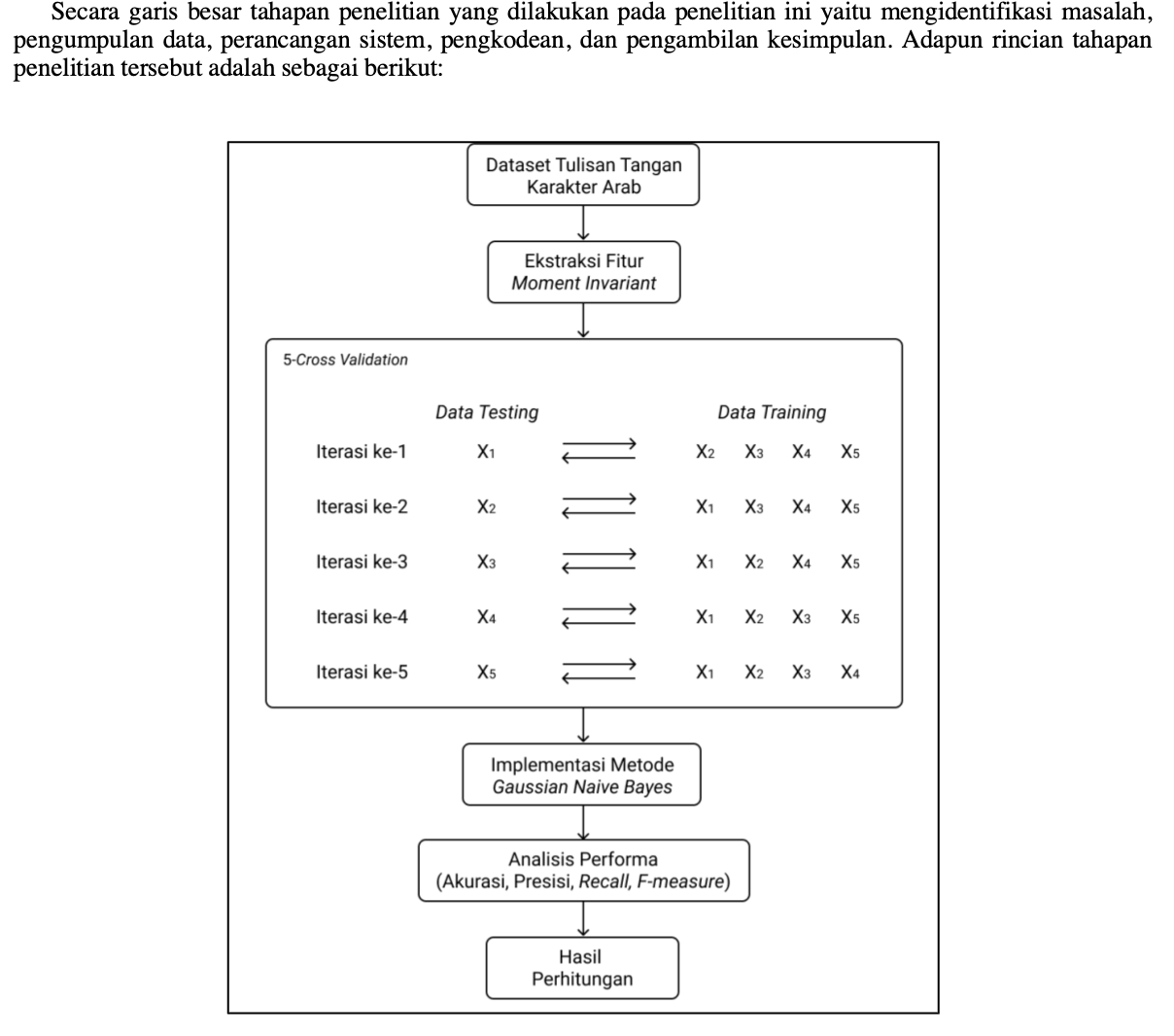
Berdasarkan penelitian yang dilakukan oleh Herman dkk., peneliti mencoba mengangkat kembali metode yang diterapkan dengan menggunakan dataset yang berbeda dan dengan jumlah yang lebih banyak. Penelitian ini bertujuan untuk menghitung performa metode (akurasi, presisi, recall, dan f-measure) Gaussian Naïve Bayes. Dataset yang digunakan adalah citra tulisan tangan karakter arab. Berdasarkan hasil perhitungan performa menunjukkan tingkat akurasi tertinggi sebesar 12%, presisi 10%, recall 12%, dan f-measure 8%.
Downloads
References
R. Akbar and E. A. Sarwoko, “Studi Analisis Pengenalan Pola Tulisan Tangan Angka Arabic (Indian) Menggunakan Metode K-Nearest Neighbors dan Connected Component Labeling,” vol. 12, no. 2, pp. 45–51, 2016.
A. Zahriyono, A. Suryan, and M. D. Suliiyo, “Implementasi Pembacaan Huruf Hijaiyyah Dan Karakter Angka Arab Dengan Menggunakan Jaringan Syaraf Tiruan LVQ (Learning Vector Quantization),” Universitas Telkom, 2013.
A. El-Sawy, M. Loey, and H. El-Bakry, “Arabic Handwritten Characters Recognition using Convolutional Neural Network,” 2019 10th Int. Conf. Inf. Commun. Syst. ICICS 2019, vol. 5, pp. 147–151, 2017, doi: 10.1109/IACS.2019.8809122.
R. D. Nurfita and G. Ariyanto, “Implementasi Deep Learning Berbasis Tensorflow untuk Pengenalan Sidik Jari,” Emit. J. Tek. Elektro, vol. 18, no. 01, pp. 22–27, 2018, doi: 10.23917/emitor.v18i01.6236.
Herman et al., “Comparison of Artificial Neural Network and Gaussian Naïve Bayes in Recognition of Hand-Writing Number,” Proc. - 2nd East Indones. Conf. Comput. Inf. Technol. Internet Things Ind. EIConCIT 2018, no. 1, pp. 276–279, 2018, doi: 10.1109/EIConCIT.2018.8878651.
H. Kamel, D. Abdulah, and J. M. Al-Tuwaijari, “Cancer Classification Using Gaussian Naive Bayes Algorithm,” Proc. 5th Int. Eng. Conf. IEC 2019, pp. 165–170, 2019, doi: 10.1109/IEC47844.2019.8950650.
Y. Mardi, “Data Mining : Klasifikasi Menggunakan Algoritma C4.5,” J. Edik Inform., vol. 2, no. 2, pp. 213–219, 2017.
R. Yanto and R. Khoiriah, “Implementasi Data Mining dengan Metode Algoritma Apriori dalam Menentukan Pola Pembelian Obat,” Creat. Inf. Technol. J., vol. 2, no. 2, pp. 102–113, 2015, doi: 10.24076/citec.2015v2i2.41.
G. Kesavaraj and S. Sukumaran, “A Study On Classification Techniques in Data Mining,” 2013.
N. A. Haryono, W. Hapsari, A. Angesti, and S. Felixiana, “Penggunaan Momen Invariant, Eccentricity, Dan Compactness Untuk Klasifikasi Motif Batik Dengan K-Nearest Neighbour,” J. Inform., vol. 11, no. 2, pp. 107–115, 2016, doi: 10.21460/inf.2015.112.411.
F. Tempola, M. Muhammad, and A. Khairan, “Perbandingan Klasifikasi Antara KNN dan Naive Bayes pada Penentuan Status Gunung Berapi dengan K-Fold Cross Validation,” J. Teknol. Inf. dan Ilmu Komput., vol. 5, no. 5, p. 577, 2018, doi: 10.25126/jtiik.201855983.
C. A. Sugianto, “Penerapan Teknik Data Mining Untuk Menentukan Hasil Seleksi Masuk SMAN 1 Gibeber Untuk Siswa Baru Menggunakan Decision Tree,” J. TEDC, vol. 9, no. 1, pp. 39–43, 2015, doi: 10.31227/osf.io/vedu7.
Published
Issue
Section
License
Authors retain copyright and full publishing rights to their articles. Upon acceptance, authors grant Indonesian Journal of Data and Science a non-exclusive license to publish the work and to identify itself as the original publisher.
Self-archiving. Authors may deposit the submitted version, accepted manuscript, and version of record in institutional or subject repositories, with citation to the published article and a link to the version of record on the journal website.
Commercial permissions. Uses intended for commercial advantage or monetary compensation are not permitted under CC BY-NC 4.0. For permissions, contact the editorial office at ijodas.journal@gmail.com.
Legacy notice. Some earlier PDFs may display “Copyright © [Journal Name]” or only a CC BY-NC logo without the full license text. To ensure clarity, the authors maintain copyright, and all articles are distributed under CC BY-NC 4.0. Where any discrepancy exists, this policy and the article landing-page license statement prevail.