Residual-Energy LEACH-PSO Extends Simulated WSN Lifetime under Uneven Node Density
DOI:
https://doi.org/10.56705/ijodas.v7i2.529Keywords:
Wireless Sensor Networks, LEACH-PSO, Residual-energy Cluster-head Selection, Network Lifetime, Topology-paired SimulationAbstract
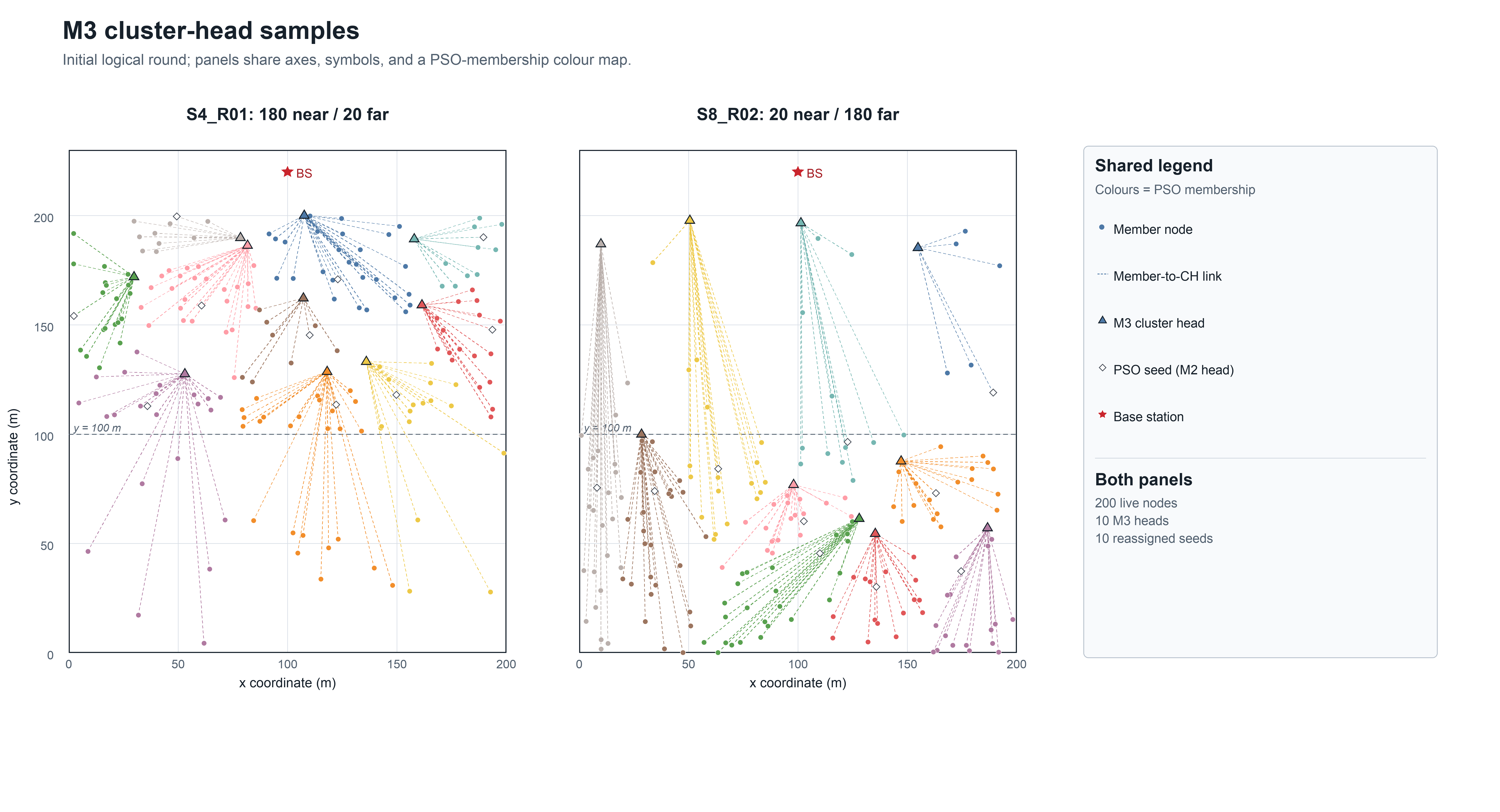
Introduction: Uneven spatial node density can concentrate communication burdens in wireless sensor networks (WSNs). This study evaluated the incremental effect of residual-energy cluster-head reassignment on simulated network lifetime. Method: LEACH (M1), particle swarm optimization (PSO) seed clustering (M2), and residual-energy LEACH-PSO (M3) were evaluated across 270 synthetic topologies covering nine near–far scenarios with 30 placements each, producing 810 method runs. Every topology contained 200 nodes in a fixed 200 m × 200 m field. M2 and M3 shared radio, traffic, and PSO settings. Within each logical round, M3 retained the PSO-derived membership and selected the member with the highest residual energy after status transmission as cluster head. The primary topology-paired M3–M2 comparison assessed first-node-dead (FND) and half-nodes-dead (HND) rounds using block-bootstrap confidence intervals. Results and Discussion: Mean FND and HND were 18.70 and 39.85 rounds for M3, compared with 8.84 and 32.84 for M2. Aggregate paired gains were 9.86 FND rounds (95% CI, 9.44–10.26) and 7.01 HND rounds (95% CI, 6.83–7.19). Both endpoints improved on average in all nine scenarios, with the largest gains when 180 nodes occupied the far zone. No endpoints were censored. Conclusion: Cluster-head reassignment based on residual energy extended simulated WSN lifetime under the specified radio and traffic model. Performance under realistic communication conditions and physical deployments requires further validation.
Downloads
References
[1] I. Akyildiz, Weilian Su, Y. Sankarasubramaniam, E. Cayirci, “A survey on sensor networks,” IEEE Communications Magazine, vol. 40, no. 8, pp. 102-114, 2002, doi: https://doi.org/10.1109/MCOM.2002.1024422.
[2] W. Heinzelman, A. Chandrakasan, H. Balakrishnan, “An application-specific protocol architecture for wireless microsensor networks,” IEEE Transactions on Wireless Communications, vol. 1, no. 4, pp. 660-670, 2002, doi: https://doi.org/10.1109/TWC.2002.804190.
[3] O. Younis, S. Fahmy, “HEED: a hybrid, energy-efficient, distributed clustering approach for ad hoc sensor networks,” IEEE Transactions on Mobile Computing, vol. 3, no. 4, pp. 366-379, 2004, doi: https://doi.org/10.1109/TMC.2004.41.
[4] J. Kennedy, R. Eberhart, “Particle swarm optimization,” in Proceedings of ICNN'95 - International Conference on Neural Networks, vol. 4, pp. 1942-1948, 1995, doi: https://doi.org/10.1109/ICNN.1995.488968.
[5] S. Lindsey, C. Raghavendra, “PEGASIS: Power-efficient gathering in sensor information systems,” in Proceedings, IEEE Aerospace Conference, vol. 3, pp. 3-1125-3-1130, 2002, doi: https://doi.org/10.1109/AERO.2002.1035242.
[6] L. Qing, Q. Zhu, M. Wang, “Design of a distributed energy-efficient clustering algorithm for heterogeneous wireless sensor networks,” Computer Communications, vol. 29, no. 12, pp. 2230-2237, 2006, doi: https://doi.org/10.1016/j.comcom.2006.02.017.
[7] T. SHIH, “Particle Swarm Optimization Algorithm for Energy-Efficient Cluster-Based Sensor Networks,” IEICE Transactions on Fundamentals of Electronics, Communications and Computer Sciences, vol. E89-A, no. 7, pp. 1950-1958, 2006, doi: https://doi.org/10.1093/ietfec/e89-a.7.1950.
[8] R. Kulkarni, G. Venayagamoorthy, “Particle Swarm Optimization in Wireless-Sensor Networks: A Brief Survey,” IEEE Transactions on Systems, Man, and Cybernetics, Part C (Applications and Reviews), vol. 41, no. 2, pp. 262-267, 2011, doi: https://doi.org/10.1109/TSMCC.2010.2054080.
[9] Y. Gu, Q. Wu, N. Rao, “Optimizing Cluster Heads for Energy Efficiency in Large-Scale Heterogeneous Wireless Sensor Networks,” International Journal of Distributed Sensor Networks, vol. 6, no. 1, pp. 961591, 2010, doi: https://doi.org/10.1155/2010/961591.
[10] N. Merabtine, D. Djenouri, D. Zegour, “Towards Energy Efficient Clustering in Wireless Sensor Networks: A Comprehensive Review,” IEEE Access, vol. 9, pp. 92688-92705, 2021, doi: https://doi.org/10.1109/ACCESS.2021.3092509.
[11] T. Behera, S. Mohapatra, U. Samal, M. Khan, M. Daneshmand, A. Gandomi, “Residual Energy-Based Cluster-Head Selection in WSNs for IoT Application,” IEEE Internet of Things Journal, vol. 6, no. 3, pp. 5132-5139, 2019, doi: https://doi.org/10.1109/JIOT.2019.2897119.
[12] J. Lee, S. Chim, H. Park, “Energy-Efficient Cluster-Head Selection for Wireless Sensor Networks Using Sampling-Based Spider Monkey Optimization,” Sensors, vol. 19, no. 23, pp. 5281, 2019, doi: https://doi.org/10.3390/s19235281.
[13] F. Hamzeloei, M. Dermany, “A TOPSIS Based Cluster Head Selection for Wireless Sensor Network,” Procedia Computer Science, vol. 98, pp. 8-15, 2016, doi: https://doi.org/10.1016/j.procs.2016.09.005.
[14] Lalit Kumar Tyagi, A. Kumar, “OEE-WCRD: Optimizing Energy Efficiency in Wireless Sensor Networks through Cluster Head Selection Using Residual Energy and Distance Metrics,” ICST Transactions on Scalable Information Systems, vol. 11, no. 5, 2024, doi: https://doi.org/10.4108/eetsis.4268.
[15] A. Jalili, M. Gheisari, J. Alzubi, C. Fernández-Campusano, F. Kamalov, S. Moussa, “A novel model for efficient cluster head selection in mobile WSNs using residual energy and neural networks,” Measurement: Sensors, vol. 33, pp. 101144, 2024, doi: https://doi.org/10.1016/j.measen.2024.101144.
[16] M. Eskandarpour, S. Pirahmadian, P. Soltani, H. Soleimani, “A Game‐Theoretic Reinforcement Learning Approach to Energy‐Balanced Cluster‐Head Selection in Wireless Sensor Networks,” IET Networks, vol. 15, no. 1, 2026, doi: https://doi.org/10.1049/ntw2.70036.
[17] E. Kaplan, P. Meier, “Nonparametric Estimation from Incomplete Observations,” Journal of the American Statistical Association, vol. 53, no. 282, pp. 457-481, 1958, doi: https://doi.org/10.1080/01621459.1958.10501452.
[18] S. Holm, “A Simple Sequentially Rejective Multiple Test Procedure,” Scandinavian Journal of Statistics, vol. 6, no. 2, pp. 65-70, 1979, [Online]. Available: https://www.jstor.org/stable/4615733. Accessed: 2026-11-04.
[19] B. Efron, “Bootstrap Methods: Another Look at the Jackknife,” The Annals of Statistics, vol. 7, no. 1, pp. 1-26, 1979, doi: https://doi.org/10.1214/aos/1176344552.
[20] W. Ye, J. Heidemann, and D. Estrin, “An energy-efficient MAC protocol for wireless sensor networks,” in Proc. IEEE INFOCOM 2002, vol. 3, pp. 1567-1576, 2002, doi: https://doi.org/10.1109/INFCOM.2002.1019408.
[21] J. Al-Karaki, A. Kamal, “Routing techniques in wireless sensor networks: a survey,” IEEE Wireless Communications, vol. 11, no. 6, pp. 6-28, 2004, doi: https://doi.org/10.1109/mwc.2004.1368893.
[22] C. Intanagonwiwat, R. Govindan, D. Estrin, “Directed diffusion,” in Proceedings of the 6th annual international conference on Mobile computing and networking, pp. 56-67, 2000, doi: https://doi.org/10.1145/345910.345920.
[23] W. R. Heinzelman, A. Chandrakasan, and H. Balakrishnan, “Energy-efficient communication protocol for wireless microsensor networks,” in Proc. 33rd Annu. Hawaii Int. Conf. Syst. Sci. (HICSS), vol. 2, p. 10, 2000, doi: https://doi.org/10.1109/HICSS.2000.926982.
[24] A. A. Abbasi and M. Younis, “A survey on clustering algorithms for wireless sensor networks,” Computer Communications, vol. 30, no. 14-15, pp. 2826-2841, 2007, doi: https://doi.org/10.1016/j.comcom.2007.05.024.
[25] G. Anastasi, M. Conti, M. Di Francesco, and A. Passarella, “Energy conservation in wireless sensor networks: A survey,” Ad Hoc Networks, vol. 7, no. 3, pp. 537-568, 2009, doi: https://doi.org/10.1016/j.adhoc.2008.06.003.
[26] N. M. Abdul Latiff, C. C. Tsimenidis, and B. S. Sharif, “Energy-aware clustering for wireless sensor networks using particle swarm optimization,” in Proc. 18th IEEE Int. Symp. Personal, Indoor and Mobile Radio Commun. (PIMRC), pp. 1-5, 2007, doi: https://doi.org/10.1109/PIMRC.2007.4394521.
[27] S. Soro and W. B. Heinzelman, “Prolonging the lifetime of wireless sensor networks via unequal clustering,” in Proc. 19th IEEE Int. Parallel and Distributed Processing Symp. (IPDPS), 2005, doi: https://doi.org/10.1109/IPDPS.2005.365.
[28] C. Li, M. Ye, G. Chen, and J. Wu, “An energy-efficient unequal clustering mechanism for wireless sensor networks,” in Proc. IEEE Int. Conf. Mobile Adhoc and Sensor Systems (MASS), pp. 597-604, 2005, doi: https://doi.org/10.1109/MAHSS.2005.1542849.
[29] P. C. S. Rao, P. K. Jana, and H. Banka, “A particle swarm optimization based energy efficient cluster head selection algorithm for wireless sensor networks,” Wireless Networks, vol. 23, no. 7, pp. 2005-2020, 2017, doi: https://doi.org/10.1007/s11276-016-1270-7.
[30] D. Ruan and J. Huang, “A PSO-based uneven dynamic clustering multi-hop routing protocol for wireless sensor networks,” Sensors, vol. 19, no. 8, Art. no. 1835, 2019, doi: https://doi.org/10.3390/s19081835.
[31] I. Dietrich and F. Dressler, “On the lifetime of wireless sensor networks,” ACM Transactions on Sensor Networks, vol. 5, no. 1, Art. no. 5, 39 pp., 2009, doi: https://doi.org/10.1145/1464420.1464425.
[32] “Dataset Simulasi WSN Lifespan v2.0,” Supplied synthetic input package (topologies, generator, and validator), 2026, [Online]. Available: https://wsn-density-benchmark-no7-v1.blackwinggoat.chatgpt.site/downloads/Dataset_Simulasi_WSN_Lifespan_v2.zip.
Downloads
Published
Issue
Section
License
Copyright (c) 2026 Ramdan Satra, Muhammad Hattah Fattah

This work is licensed under a Creative Commons Attribution-NonCommercial 4.0 International License.
Authors retain copyright and full publishing rights to their articles. Upon acceptance, authors grant Indonesian Journal of Data and Science a non-exclusive license to publish the work and to identify itself as the original publisher.
Self-archiving. Authors may deposit the submitted version, accepted manuscript, and version of record in institutional or subject repositories, with citation to the published article and a link to the version of record on the journal website.
Commercial permissions. Uses intended for commercial advantage or monetary compensation are not permitted under CC BY-NC 4.0. For permissions, contact the editorial office at ijodas.journal@gmail.com.
Legacy notice. Some earlier PDFs may display “Copyright © [Journal Name]” or only a CC BY-NC logo without the full license text. To ensure clarity, the authors maintain copyright, and all articles are distributed under CC BY-NC 4.0. Where any discrepancy exists, this policy and the article landing-page license statement prevail.