An IoT-Based Fuzzy Decision Support System for Rhizobium Inoculation to Improve Soybean Productivity
DOI:
https://doi.org/10.56705/ijodas.v7i2.458Keywords:
Decision Support System, Internet of Things, Fuzzy Logic, Mamdani, Rhizobium, Soybean, Highland AgroecosystemAbstract
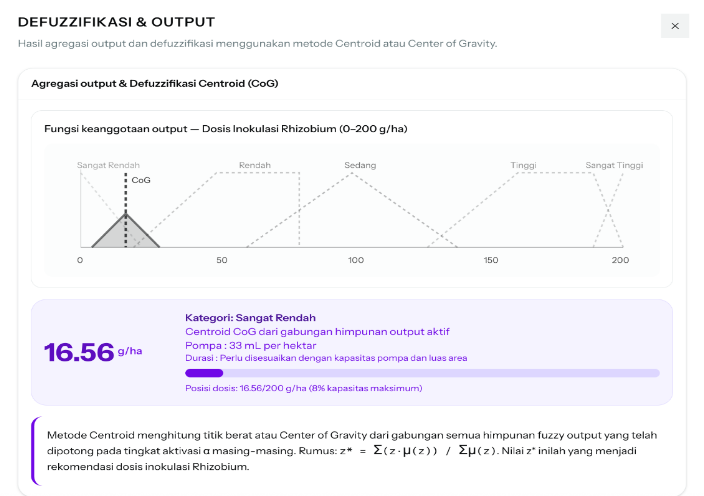
Introduction: Soybean productivity in Indonesia remains below national demand, while the effectiveness of Rhizobium inoculation depends strongly on dynamic soil conditions such as pH, moisture, temperature, and nitrogen availability. This study develops an Internet of Things (IoT)-based decision support system for adaptive Rhizobium inoculation in highland soybean cultivation. Method: The system integrates a Soil NPK RS485 Modbus sensor, ESP32-WROOM-32D microcontroller, MQTT communication, and the SMARTO web dashboard to monitor four environmental parameters in real time. A Mamdani Fuzzy Inference System was implemented using 17 membership functions and 25 expert-derived IF–THEN rules, with centroid defuzzification producing Rhizobium dose recommendations from 0 to 200 g/ha. Results and Discussion: Field readings of pH 7.5, soil moisture 55%, temperature 26°C, and nitrogen 155 mg/kg generated a recommendation of 16.56 g/ha, classified as Very Low, with a pump volume of 33 mL/ha. Expert validation across 30 simulated highland scenarios produced an overall agreement rate of 83.3%, demonstrating satisfactory consistency between system recommendations and agronomic judgment. Conclusion: The proposed IoT-Fuzzy DSS demonstrates the feasibility of location-specific, real-time, and interpretable Rhizobium inoculation support for highland soybean cultivation, providing a practical foundation for precision biological-input management.
Downloads
References
[1] Badan Pusat Statistik, "Statistik Tanaman Pangan 2023," Badan Pusat Statistik Indonesia, Jakarta, 2023.
[2] S. Diakite, A. Camara, and M. Diallo, "Precision agriculture as a viable means of enhancing sustainable agricultural production," Foods Raw Mater., pp. 357–376, Jun. 2025, doi: https://doi.org/10.21603/2308-4057-2026-2-680.
[3] P. H. Graham and C. P. Vance, "Nitrogen fixation in perspective: An overview of research and extension needs," Field Crops Res., vol. 65, no. 2–3, pp. 93–106, 2000, doi: https://doi.org/10.1016/S0378-4290(99)00080-5.
[4] K. E. Giller, Nitrogen Fixation in Tropical Cropping Systems, 2nd ed. Wallingford, UK: CABI Publishing, 2001.
[5] M. Mu'min, S. Numba, and M. Galib, "Pengaruh inokulasi rhizobium dan pupuk organik cair terhadap pertumbuhan dan hasil tanaman kedelai (Effect of Rhizobium inoculation and liquid organic fertilizer on soybean growth and yield)," Agrotekmas, 2022.
[6] J. Muangprathub, N. Boonnam, S. Kajorn, N. Lekbangpong, A. Wanichsombat, and P. Nillaor, "IoT and agriculture data analysis for smart farm," Comput. Electron. Agric., vol. 156, pp. 467–474, Jan. 2019, doi: https://doi.org/10.1016/j.compag.2018.12.011.
[7] T. Ojha, S. Misra, and N. S. Raghuwanshi, "Wireless sensor networks for agriculture: The state-of-the-art in practice and future challenges," Comput. Electron. Agric., vol. 118, pp. 66–84, Oct. 2015, doi: https://doi.org/10.1016/j.compag.2015.08.011.
[8] B. Sun, Y. Wang, M. Du, and H. Niu, "Spatial distribution of grain yield in the Songnen Plain agro-pastoral zone in Heilongjiang Province: A study using geostatistics and geographically weighted regression," Land, vol. 14, no. 9, Sep. 2025, doi: https://doi.org/10.3390/land14091705.
[9] L. A. Zadeh, "Fuzzy sets," Inf. Control, vol. 8, no. 3, pp. 338–353, 1965, doi: https://doi.org/10.1016/S0019-9958(65)90241-X.
[10] E. H. Mamdani and S. Assilian, "An experiment in linguistic synthesis with a fuzzy logic controller," Int. J. Man-Mach. Stud., vol. 7, no. 1, pp. 1–13, 1975, doi: https://doi.org/10.1016/S0020-7373(75)80002-2.
[11] K. G. Liakos, P. Busato, D. Moshou, S. Pearson, and D. Bochtis, "Machine learning in agriculture: A review," Sensors, vol. 18, no. 8, p. 2674, Aug. 2018, doi: https://doi.org/10.3390/s18082674.
[12] A. W. Hakis, A. Latief Arda, and A. Jalil, "IoT-based soil nutrient monitoring and control using fuzzy logic and multi-modal sensor integration," J. Appl. Informatics Comput. (JAIC), vol. 9, no. 5, pp. 2736–2745, 2025.
[13] A. U. Rahayu, I. Taufiqurrahman, and N. R. Mutiarasari, "Smart irrigation system with fuzzy logic on sunflower plants based on Internet of Things," J. Energy Electr. Eng., 2024.
[14] M. A. Miftahul Walid, "Smart drip irrigation system based on IoT using fuzzy logic," INTENSIF, vol. 1, Feb. 2024, doi: https://doi.org/10.29407/intensif.
[15] N. Adnan, S. M. Nordin, and M. A. Bahruddin, "A decision support system for sustainable fertilizer management using fuzzy logic in precision agriculture," J. Cleaner Prod., vol. 275, p. 122932, 2020, doi: https://doi.org/10.1016/j.jclepro.2020.122932.
[16] F. Irwanto, S. Wahyudi, A. Kurniawan, and R. Syamsiana, "IoT and fuzzy logic integration for improved substrate environment management in mushroom cultivation," Smart Agric. Technol., vol. 7, Mar. 2024, doi: https://doi.org/10.1016/j.atech.2024.100427.
[17] H. Arahman, R. Fahrurrozi, A. Syarifuddin, and M. Irwansyah, "Decision support system based on IoT and Mamdani fuzzy logic for nutrient management in hydroponic plants on urban rooftop farming," Smart Agric. Technol., vol. 10, 2025.
[18] K. Harshavardhini and S. Lakshmi Devi, "Fuzzy logic for automated irrigation system in agriculture," Int. J. Res. Publ. Rev. (IJRPR), vol. 6, no. 3, 2025.
[19] N. Naik, "Choice of effective messaging protocols for IoT systems: MQTT, CoAP, AMQP and HTTP," in Proc. 2017 IEEE Int. Syst. Eng. Symp. (ISSE), Vienna, Austria, 2017, pp. 1–7, doi: https://doi.org/10.1109/SysEng.2017.8088251.
[20] W. Wei, X. Zhang, Y. Liu, F. Chen, and Z. Wang, "Long-term fertilization coupled with rhizobium inoculation promotes soybean yield and alters soil bacterial community composition," Front. Microbiol., vol. 14, 2023, doi: https://doi.org/10.3389/fmicb.2023.1161983.
Downloads
Published
Issue
Section
License
Copyright (c) 2026 Andi Ulfah Tenripada

This work is licensed under a Creative Commons Attribution-NonCommercial 4.0 International License.
Authors retain copyright and full publishing rights to their articles. Upon acceptance, authors grant Indonesian Journal of Data and Science a non-exclusive license to publish the work and to identify itself as the original publisher.
Self-archiving. Authors may deposit the submitted version, accepted manuscript, and version of record in institutional or subject repositories, with citation to the published article and a link to the version of record on the journal website.
Commercial permissions. Uses intended for commercial advantage or monetary compensation are not permitted under CC BY-NC 4.0. For permissions, contact the editorial office at ijodas.journal@gmail.com.
Legacy notice. Some earlier PDFs may display “Copyright © [Journal Name]” or only a CC BY-NC logo without the full license text. To ensure clarity, the authors maintain copyright, and all articles are distributed under CC BY-NC 4.0. Where any discrepancy exists, this policy and the article landing-page license statement prevail.