An IoT-Based Precision Hydroponic Monitoring System and Long-Term Characterization of Low-Cost Temperature Sensor Drift
DOI:
https://doi.org/10.56705/ijodas.v7i2.456Keywords:
Data Quality, Internet of Things, Precision Hydroponics, Sensor Drift, Temperature SensingAbstract
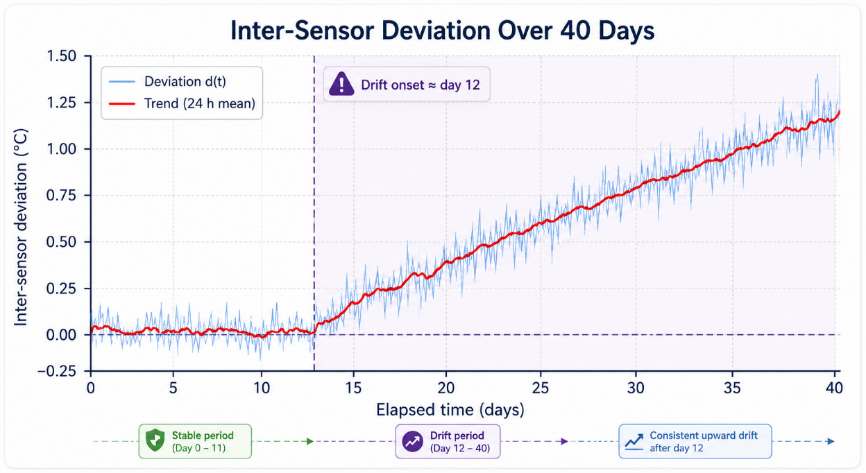
Introduction: Temperature monitoring is critical in hydroponic cultivation because it influences nutrient solubility, dissolved oxygen, and root uptake, yet low-cost digital sensors commonly used in Internet of Things (IoT) systems may experience accuracy degradation during long-term deployment. This study develops a low-cost IoT monitoring platform for nutrient film technique (NFT) hydroponics and characterizes temperature-sensor drift under continuous operating conditions. Method: The system employed two redundant temperature sensors in the nutrient channel and one ambient sensor, with measurements timestamped, filtered, stored locally at the edge, and visualized through a cloud dashboard. Temperature data were recorded hourly for 40 days, producing 960 observations per sensor. Drift was evaluated from the deviation between the primary and redundant channel sensors using mean absolute error, maximum absolute deviation, standard deviation, drift onset, and estimated drift rate. Results and Discussion: The primary sensor showed a mean absolute deviation of 0.82 °C over the full monitoring period and a maximum deviation of 1.47 °C. Sensor agreement remained close during the first 10 days but diverged after approximately day 12, with late-period MAE increasing to 1.18 °C and an estimated drift rate of about 0.04 °C/day. Conclusion: Long-term drift in low-cost temperature sensors can materially affect hydroponic monitoring accuracy, and redundant sensing provides a practical baseline for future adaptive edge-based calibration methods.
Downloads
References
[1] L. Atzori, A. Iera, and G. Morabito, “The Internet of Things: A survey,” Computer Networks, vol. 54, no. 15, pp. 2787–2805, 2010, doi: https://doi.org/10.1016/j.comnet.2010.05.010.
[2] J. Gubbi, R. Buyya, S. Marusic, and M. Palaniswami, “Internet of Things (IoT): A vision, architectural elements, and future directions,” Future Generation Computer Systems, vol. 29, no. 7, pp. 1645–1660, 2013, doi: https://doi.org/10.1016/j.future.2013.01.010.
[3] M. S. Farooq, S. Riaz, A. Abid, K. Abid, and M. A. Naeem, “A survey on the role of IoT in agriculture for the implementation of smart farming,” IEEE Access, vol. 7, pp. 156237–156271, 2019, doi: https://doi.org/ 10.1109/ACCESS.2019.2949703.
[4] A. L. Duguma and X. Bai, “How the internet of things technology improves agricultural efficiency,” Artificial Intelligence Review, vol. 58, Art. no. 63, 2025, doi: https://doi.org/ 10.1007/s10462-024-11046-0.
[5] T. Demir and I. Cicek, “A low-cost and reliable IoT-based NFT hydroponics system using ESP32 and MING stack,” Engineering Proceedings, vol. 122, no. 1, Art. no. 3, 2026, doi: https://doi.org/ 10.3390/engproc2026122003.
[6] L. Sitanayah, H. R. M. Joseph, and J. B. Sanger, “A low-cost hydroponic monitoring system with Internet of Things and fuzzy logic,” Journal of Computing Theories and Applications, vol. 2, no. 3, pp. 441–455, 2025, doi: https://doi.org/10.62411/jcta.12059.
[7] M. Alimussadad, D. Lestari, and W. M. Utomo, “Smart hydroponic nutrient monitoring and control system using fuzzy logic and IoT,” Jurnal ELTIKOM: Jurnal Teknik Elektro, Teknologi Informasi dan Komputer, vol. 9, no. 2, pp. 115–129, 2025, doi: https://doi.org/10.31961/eltikom.v9i2.1494.
[8] T. A. Farma, D. Palupi, and W. Sirait, “IoT based hydroponic water nutrient and pH monitoring with real-time notifications,” Journal of Innovation Information Technology and Application, vol. 7, no. 2, pp. 340–349, 2025, doi: https://doi.org/10.35970/jinita.v7i2.2940.
[9] F. Laia, F. H. Laia, S. M. Telaumbanua, H. P. Sitorus, and F. J. Hondro, “Development of an IoT-based smart hydroponic monitoring system as a modern agricultural solution in remote areas,” Journal of Intelligent Decision Support System, vol. 8, no. 4, pp. 208–217, 2025, doi: https://doi.org/10.35335/idss.v8i4.318.
[10] A. R. Manga’, D. Atmajaya, and A. Faradibah, “Design and build an automatic spraying system for shallot plants using soil moisture and air temperature sensors with the fuzzy method,” Indonesian Journal of Data and Science, vol. 6, no. 2, pp. 343–355, 2025, doi: https://doi.org/10.56705/ijodas.v6i2.213.
[11] A. F. Shimbun, M. A. Alfian, A. S. Jati, and E. Faizal, “An optimization strategy for reducing CO2 in livestock farming with IoT integration and decision support system approach using linear programming,” Indonesian Journal of Data and Science, vol. 6, no. 1, pp. 46–54, 2025, doi: https://doi.org/10.56705/ijodas.v6i1.204.
[12] M. Misbahuddin, N. Cokrowati, M. S. Iqbal, O. Farobie, A. Amrullah, and L. Ernawati, “Kalman filter-enhanced data aggregation in LoRaWAN-based IoT framework for aquaculture monitoring in Sargassum sp. cultivation,” Computers, vol. 14, no. 4, Art. no. 151, 2025, doi: https://doi.org/10.3390/computers14040151.
[13] A. Kamilaris and F. X. Prenafeta-Boldu, “Deep learning in agriculture: A survey,” Computers and Electronics in Agriculture, vol. 147, pp. 70–90, 2018, doi: https://doi.org/10.1016/j.compag.2018.02.016.
[14] F. Nan, C. Zeng, H. Shen, and L. Lin, “Calibration of integrated low-cost environmental sensors for urban air temperature based on machine learning,” Sensors, vol. 25, no. 11, Art. no. 3398, 2025, doi: https://doi.org/10.3390/s25113398.
[15] Y. Wang, A. Yang, X. Chen, P. Wang, Y. Wang, and H. Yang, “A deep learning approach for blind drift calibration of sensor networks,” IEEE Sensors Journal, vol. 17, no. 11, pp. 3432–3442, 2017, doi: https://doi.org/10.1109/JSEN.2017.2703885.
[16] B. Maag, Z. Zhou, and L. Thiele, “In situ calibration algorithms for environmental sensor networks: A review,” IEEE Sensors Journal, vol. 19, no. 13, pp. 4924–4938, 2019, doi: https://doi.org/10.1109/JSEN.2019.2905910.
[17] J. A. Abdinoor, Z. K. Hashim, B. Horvath, S. Zsebo, D. Stencinger, G. Hegedus, L. Bede, A. Ijaz, and I. M. Kulmany, “Performance of low-cost air temperature sensors and applied calibration techniques — A systematic review,” Atmosphere, vol. 16, no. 7, Art. no. 842, 2025, doi: https://doi.org/10.3390/atmos16070842.
[18] M. Naloufi, T. Abreu, S. Souihi, C. Therial, N. Angelotti de Ponte Rodrigues, A. Guillot Le Goff, M. Saad, B. Vincon-Leite, P. Dubois, M. Delarbre, P. Kennouche, and F. S. Lucas, “Long-term stability of low-cost IoT system for monitoring water quality in urban rivers,” Water, vol. 16, no. 12, Art. no. 1708, 2024, doi: https://doi.org/10.3390/w16121708.
[19] H. Y. Teh, A. W. Kempa-Liehr, and K. I.-K. Wang, “Sensor data quality: a systematic review,” Journal of Big Data, vol. 7, Art. no. 11, 2020, doi: https://doi.org/10.1186/s40537-020-0285-1.
[20] L. Zhang, D. Jeong, and S. Lee, “Data quality management in the Internet of Things,” Sensors, vol. 21, no. 17, Art. no. 5834, 2021, doi: https://doi.org/10.3390/s21175834.
[21] A. F. Y. Mohammed, S. M. Sultan, J. Lee, and S. Lim, “Deep-reinforcement-learning-based IoT sensor data cleaning framework for enhanced data analytics,” Sensors, vol. 23, no. 4, Art. no. 1791, 2023, doi: https://doi.org/10.3390/s23041791.
[22] W. Shi, J. Cao, Q. Zhang, Y. Li, and L. Xu, “Edge computing: Vision and challenges,” IEEE Internet of Things Journal, vol. 3, no. 5, pp. 637–646, 2016, doi: https://doi.org/10.1109/JIOT.2016.2579198.
[23] M. Satyanarayanan, “The emergence of edge computing,” Computer, vol. 50, no. 1, pp. 30–39, 2017, doi: 10.1109/MC.2017.9.
[24] W. Shi and S. Dustdar, “The promise of edge computing,” Computer, vol. 49, no. 5, pp. 78–81, 2016, doi: https://doi.org/10.1109/MC.2016.145.
Downloads
Published
Issue
Section
License
Copyright (c) 2026 Dedy Atmajaya, Abdullah Basalamah, Nia Kurniati, Muhammad Iqbal, Thalita Sherly Putri Jasmin

This work is licensed under a Creative Commons Attribution-NonCommercial 4.0 International License.
Authors retain copyright and full publishing rights to their articles. Upon acceptance, authors grant Indonesian Journal of Data and Science a non-exclusive license to publish the work and to identify itself as the original publisher.
Self-archiving. Authors may deposit the submitted version, accepted manuscript, and version of record in institutional or subject repositories, with citation to the published article and a link to the version of record on the journal website.
Commercial permissions. Uses intended for commercial advantage or monetary compensation are not permitted under CC BY-NC 4.0. For permissions, contact the editorial office at ijodas.journal@gmail.com.
Legacy notice. Some earlier PDFs may display “Copyright © [Journal Name]” or only a CC BY-NC logo without the full license text. To ensure clarity, the authors maintain copyright, and all articles are distributed under CC BY-NC 4.0. Where any discrepancy exists, this policy and the article landing-page license statement prevail.