Sentiment Classification of TikTok Comments on The Free Nutritious Meal Program Using Multinomial Naïve Bayes
DOI:
https://doi.org/10.56705/ijodas.v7i2.448Keywords:
Sentiment Classification, Multinomial Naive Bayes, IndoBERT, Free Nutritious Meal Program, TikTok, TF-IDFAbstract
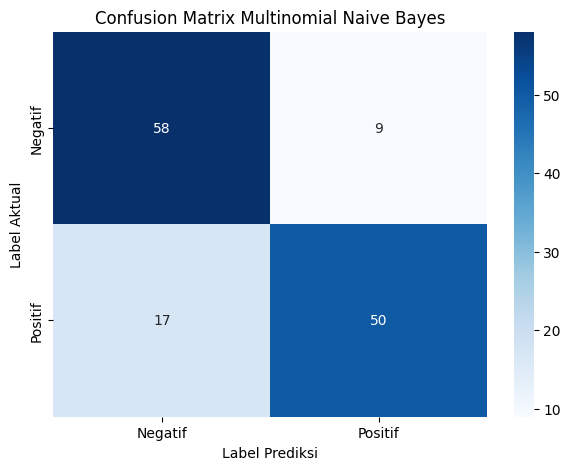
Introduction: TikTok has become an important platform for public discussion of government programs, including Indonesia’s Free Nutritious Meal (MBG) Program, while the large volume of comments makes manual sentiment analysis inefficient. This study evaluates Multinomial Naïve Bayes for classifying public sentiment toward the MBG Program using TikTok comments. Method: A total of 1,048 comments were collected from the official National Nutrition Agency TikTok account using Apify, with 1,028 comments remaining after preprocessing. Sentiment pseudo-labels were generated using IndoRoBERTa, producing 333 positive and 695 negative comments. Undersampling balanced the dataset to 666 comments, followed by an 80:20 stratified train–test split. TF-IDF feature extraction and Multinomial Naïve Bayes classification were integrated in a Scikit-learn Pipeline, while GridSearchCV with 5-fold cross-validation optimized model parameters. Results and Discussion: The optimized model achieved 80.60% accuracy, 81.04% precision, 80.60% recall, and an 80.53% F1-score on 134 test comments. Negative sentiment dominated the original post-preprocessing dataset at 67.61%. However, these results primarily indicate agreement with IndoRoBERTa-generated pseudo-labels rather than human-verified sentiment labels. Conclusion: The TF-IDF–Multinomial Naïve Bayes pipeline provides a useful baseline for MBG-related TikTok sentiment classification, but manual label validation and comparison with alternative classifiers are required to establish stronger reliability and generalizability.
Downloads
References
[1] W. F. Satrya, R. Aprilliyani, and E. H. Yossy, “Sentiment analysis of Indonesian police chief using multi-level ensemble model,” Procedia Comput. Sci., vol. 216, no. 2022, pp. 620–629, 2022, doi: https://doi.org/10.1016/j.procs.2022.12.177.
[2] M. Rodríguez-Ibánez, A. Casánez-Ventura, F. Castejón-Mateos, and P. M. Cuenca-Jiménez, “A review on sentiment analysis from social media platforms,” Expert Syst. Appl., vol. 223, no. August 2022, 2023, doi: https://doi.org/10.1016/j.eswa.2023.119862.
[3] Z. Yao, J. Yang, J. Liu, M. Keith, and C. H. Guan, “Comparing tweet sentiments in megacities using machine learning techniques: In the midst of COVID-19,” Cities, vol. 116, no. July 2020, p. 103273, 2021, doi: https://doi.org/10.1016/j.cities.2021.103273.
[4] F. Guo, Z. Liu, Q. Lu, S. Ji, and C. Zhang, “Public Opinion About COVID-19 on a Microblog Platform in China: Topic Modeling and Multidimensional Sentiment Analysis of Social Media,” J. Med. Internet Res., vol. 26, no. 1, 2024, doi: https://doi.org/10.2196/47508.
[5] M. Isnan, G. N. Elwirehardja, and B. Pardamean, “Sentiment Analysis for TikTok Review Using VADER Sentiment and SVM Model,” Procedia Comput. Sci., vol. 227, pp. 168–175, 2023, doi: https://doi.org/10.1016/j.procs.2023.
[6] D. F. M. Dina, T. Haryanti, and M. A. Haq, “Analisis Sentimen Terhadap Komentar Pada Media Sosial Tiktok Yang Berpotensi Menyebabkan Depresi Menggunakan Metode Naive Bayes,” Comput. Insight J. Comput. Sci., vol. 7, no. 1, pp. 1–9, 2025, doi: https://doi.org/10.30651/comp_insight.v7i1.26327.
[7] R. Haque, N. Islam, M. Tasneem, and A. K. Das, “Multi-class sentiment classification on Bengali social media comments using machine learning,” Int. J. Cogn. Comput. Eng., vol. 4, no. December 2021, pp. 21–35, 2023, doi: https://doi.org/10.1016/j.ijcce.2023.01.001.
[8] N. Puspitasari, R. Rosmasari, F. W. Pratama, and H. Sulastri, “Quality Classification of Palm Oil Varieties Using Naive Bayes Classifier,” Digit. Zo. J. Teknol. Inf. dan Komun., vol. 13, no. 1, pp. 11–23, 2022, doi: https://doi.org/10.31849/digitalzone.v13i1.9773.
[9] D. G. Pradana, M. L. Alghifari, M. F. Juna, and D. Palaguna, “Klasifikasi Penyakit Jantung Menggunakan Metode Artificial Neural Network,” Indones. J. Data Sci., vol. 3, no. 2, pp. 55–60, 2022, doi: https://doi.org/10.56705/ijodas.v3i2.35.
[10] M. R. Ananda et al., “Implementasi Support Vector Machine Dalam Analisis Sentimen Netizen Terhadap Program Makan Bergizi Gratis,” J. Mhs. Tek. Inform., vol. 10, no. 2, pp. 3594–3601, 2026.
[11] W. Maharani, H. Daud, N. Muhammad, and E. A. Kadir, “Leveraging Social Media Data for Forest Fires Sentiment Classification: A Data-Driven Method,” J. Inf. Syst. Eng. Bus. Intell., vol. 10, no. 3, pp. 392–407, 2024, doi: https://doi.org/10.20473/jisebi.10.3.392-407.
[12] W. N. Mergianti, N. Khudin, A. Afandi, N. A. Shofah, and D. C. R. Novitasari, “Analisis Sentimen Pengguna Aplikasi X Terhadap Pelaksanaan Makan Bergizi Gratis Menggunakan Metode Adaptive Neuro-Fuzzy Inference System,” Sains Data J. Stud. Mat. dan Teknol., vol. 1, pp. 24–33, 2026, doi: https://doi.org/10.10.52620/sainsdata.v4i1.339 ABSTRAK.
[13] Z. P. Tiararosa, I. S. Wijaya, and E. Rohaini, “Perbandingan SVM dan Naive Bayes pada Analisis Sentimen MBG di Platform TikTok dan Instagram,” J. Inform. dan Rekayasa Komput., vol. 6, no. April, pp. 1983–1993, 2026, doi: https://doi.org/10.33998/jakakom.v6i1.
[14] W. B. Zulfikar, A. R. Atmadja, and S. F. Pratama, “Sentiment Analysis on Social Media Against Public Policy Using Multinomial Naive Bayes,” Sci. J. Informatics, vol. 10, no. 1, pp. 25–34, 2023, doi: https://doi.org/10.15294/sji.v10i1.39952.
[15] D. Bor, B. S. Lee, and E. J. Oughton, “Quantifying polarization across political groups on key policy issues using sentiment analysis,” pp. 1–31, 2021.
[16] R. W. Harwenda, M. D. Angelo, I. Budi, A. B. Santoso, and P. K. Putra, “Sentiment Analysis on Government Public Policies: A Systematic Literature Review,” Dinasti Int. J. Educ. Manag. Soc. Sci., vol. 6, no. 5, pp. 4192–4211, 2025, doi: https://doi.org/10.38035/dijemss.v6i5.4699.
[17] Herlawati, D. B. Srisulistiowati, S. C. Agustin, P. H. Syafina, N. Rachmatin, and S. Setiawati, “Metode Naïve Bayes dan Support Vector Machine untuk Mengolah Sentimen Ulasan dan Komentar di Platform Digital,” J. Students‘ Res. Comput. Sci., vol. 5, no. 2, pp. 197–212, 2024, doi: https://doi.org/10.31599/dby15h32.
[18] J. A. Zulqornain, Indriati, and P. P. Adikara, “Analisis Sentimen Tanggapan Masyarakat Aplikasi Tiktok Menggunakan Metode Naïve Bayes dan Categorial Propotional Difference (CPD),” J. Pengemb. Teknol. Inf. dan Ilmu Komput., vol. 5, no. 7, pp. 2886–2890, 2021.
[19] J. A. Widians, U. Hairah, and T. Fadila, “Sistem Pakar Diagnosis Penyakit Mioma Uteri Menggunakan Teorema Bayes,” J. Rekayasa Teknol. Inf., vol. 8, no. 2, p. 174, 2024, doi: https://doi.org/10.30872/jurti.v8i2.1446.
[20] S. K. Q. Asit, C. M. Nahumury, J. Feninlambir, W. ode N. Hasiyati, and F. S. Tomia, “Analisis Sistem Informasi Akuntansi Siklus Pendapatan Menggunakan Dfd Dan Flowchart Pada Bengkel Latansa Walding,” J. Tagalaya Pengabdi. Kpd. Masy., vol. 1, no. 2, pp. 193–200, 2024, doi: https://doi.org/10.71315/jtpkm.v1i2.30.
[21] N. Salsabilah, Irawati, and L. N. Hayati, “Performance Analysis of Convolutional Neural Networks and Naive Bayes Methods for Disease Classification in Tomato Plant Leaves,” Indones. J. Data Sci., vol. 6, no. 3, pp. 445–453, 2025, doi: https://doi.org/10.56705/ijodas.v6i3.255.
[22] C. Hill, F. Irshaidat, M. Johnson, and J. Fresneda, “An analytical assessment of sentiment analysis trends and methods through systematic review and topic modeling,” Decis. Anal. J., vol. 17, no. October, p. 100644, 2025, doi: https://doi.org/10.1016/j.dajour.2025.100644.
[23] N. P. Yusal, A. Erfina, and C. Warman, “Sarcasm and Irony Detection in Lazada App Reviews Using IndoBERT,” vol. 6, no. 3, pp. 618–625, 2025.
[24] C. Shaw, P. LaCasse, and L. Champagne, “Exploring emotion classification of indonesian tweets using large scale transfer learning via IndoBERT,” Soc. Netw. Anal. Min., vol. 15, no. 1, pp. 1–12, 2025, doi: https://doi.org/10.1007/s13278-025-01439-6.
[25] M. A. Imbiri, L. Y. Baisa, and J. J. A. Limbong, “Sentiment Classification and Influential Actor Detection on Twitter ( Case Study : The Raja Ampat Mining Conflict ),” vol. 7, no. 1, pp. 12–28, 2026.
[26] N. N. A. S. Wahyuni, I. G. I. Sudipa, N. N. A. J. Sastaparamitha, A. G. Willdahlia, and I. G. A. A. M. Aristamy, “Public Response on X to the Revocation of Indonesia’s 3-Kg LPG Retail Ban: A Support Vector Machine Study,” Indones. J. Data Sci., vol. 6, no. 3, pp. 412–425, 2025, doi: https://doi.org/10.56705/ijodas.v6i3.349.
[27] N. Raveendhran and N. Krishnan, “A novel hybrid SMOTE oversampling approach for balancing class distribution on social media text,” Bull. Electr. Eng. Informatics, vol. 14, no. 1, pp. 638–646, 2025, doi: https://doi.org/10.11591/eei.v14i1.8380.
[28] P. Guleria, J. Frnda, and P. N. Srinivasu, “NLP based text classification using TF-IDF enabled fine-tuned long short-term memory: An empirical analysis,” Array, vol. 27, no. August, p. 100467, 2025, doi: https://doi.org/10.1016/j.array.2025.100467.
[29] L. Zhang, “Features extraction based on Naive Bayes algorithm and TF-IDF for news classification,” PLoS One, vol. 20, no. 7 July, pp. 1–17, 2025, doi: https://doi.org/10.1371/journal.pone.0327347.
[30] N. Kewsuwun and S. Kajornkasirat, “A sentiment analysis model of agritech startup on Facebook comments using naive Bayes classifier,” Int. J. Electr. Comput. Eng., vol. 12, no. 3, pp. 2829–2838, 2022, doi: https://doi.org/https://doi.org/10.1016/j.rineng.2024.102148
[31] V. A. Fitri, R. Andreswari, and M. A. Hasibuan, “Sentiment analysis of social media Twitter with case of Anti-LGBT campaign in Indonesia using Naïve Bayes, decision tree, and random forest algorithm,” Procedia Comput. Sci., vol. 161, pp. 765–772, 2021, doi: https://doi.org/10.1016/j.procs.2019.11.181.
[32] M. A. K. Raiaan et al., “A systematic review of hyperparameter optimization techniques in Convolutional Neural Networks,” Decis. Anal. J., vol. 11, no. April, p. 100470, 2024, doi: https://doi.org/10.1016/j.dajour.2024.100470.
[33] Y. N. Fuadah, M. A. Pramudito, and K. M. Lim, “An Optimal Approach for Heart Sound Classification Using Grid Search in Hyperparameter Optimization of Machine Learning,” Bioengineering, vol. 10, no. 1, 2023, doi: https://doi.org/10.3390/bioengineering10010045.
[34] S. I. G. Iwan, M. Habibi, E. S. Jullev Atmadji, and I. Arfiani, “Predictive Modeling of Air Quality Levels Using Decision Tree Classification: Insights from Environmental and Demographic Factors,” Indones. J. Data Sci., vol. 5, no. 3, pp. 251–258, 2024, doi: https://doi.org/10.56705/ijodas.v5i3.201.
[35] C. Dewi, R. C. Chen, H. J. Christanto, and F. Cauteruccio, “Multinomial Naïve Bayes Classifier for Sentiment Analysis of Internet Movie Database,” Vietnam J. Comput. Sci., vol. 10, no. 4, pp. 485–498, 2023, doi: https://doi.org/10.1142/S2196888823500100.
[36] M. Yusrizal and T. B. Sasongko, “Analisis Sentimen Masyarakat Terhadap Presiden dan Calon Presiden Terpilih 2024 Menggunakan Naïve Bayes,” J. Media Inform. Budidarma, vol. 8, no. 3, p. 1673, 2024, doi: https://doi.org/10.30865/mib.v8i3.7882.
Downloads
Published
Issue
Section
License
Copyright (c) 2026 Salom Sefanya Onibala, Rosmasari, Kezia Arum Sary

This work is licensed under a Creative Commons Attribution-NonCommercial 4.0 International License.
Authors retain copyright and full publishing rights to their articles. Upon acceptance, authors grant Indonesian Journal of Data and Science a non-exclusive license to publish the work and to identify itself as the original publisher.
Self-archiving. Authors may deposit the submitted version, accepted manuscript, and version of record in institutional or subject repositories, with citation to the published article and a link to the version of record on the journal website.
Commercial permissions. Uses intended for commercial advantage or monetary compensation are not permitted under CC BY-NC 4.0. For permissions, contact the editorial office at ijodas.journal@gmail.com.
Legacy notice. Some earlier PDFs may display “Copyright © [Journal Name]” or only a CC BY-NC logo without the full license text. To ensure clarity, the authors maintain copyright, and all articles are distributed under CC BY-NC 4.0. Where any discrepancy exists, this policy and the article landing-page license statement prevail.