Digital Burnout Risk Classification Based on Doomscrolling and Fear of Missing Out Using the Mamdani Fuzzy Method
DOI:
https://doi.org/10.56705/ijodas.v7i2.442Keywords:
Classification, Digital Burnout, Doomscrolling, Fear of Missing Out, Fuzzy MamdaniAbstract
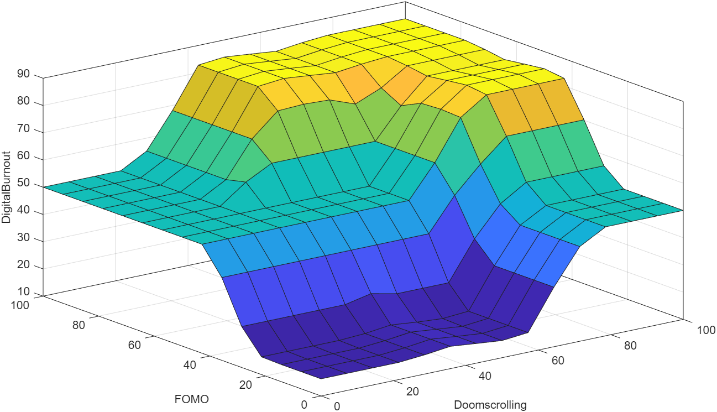
Introduction: Intensive digital technology use among university students may contribute to Digital Burnout, particularly when accompanied by doomscrolling and Fear of Missing Out (FOMO). This study classifies Digital Burnout risk into low, moderate, and high categories using these two digital-behavior factors. Method: A Mamdani Fuzzy Inference System was implemented in MATLAB using Doomscrolling and FOMO as inputs and Digital Burnout as the output. Data were collected through validated self-report questionnaires from 414 students, resulting in 408 valid records. The system employed nine IF–THEN rules, trapezoidal and triangular membership functions within a normalized [0,100] domain, centroid defuzzification, and twelve parameter-adjustment iterations. Results and Discussion: The ground-truth distribution showed that 47.5% of students were categorized as having high Digital Burnout, 30.1% moderate, and 22.3% low. The optimal fuzzy configuration achieved 67.89% accuracy and a macro F1-score of 0.6725. The High category achieved very high precision of 0.9688 but moderate recall of 0.6392, indicating that some high-risk students remained undetected. Classification accuracy was higher among gamers (77.19%) than general respondents (61.18%). Conclusion: The Mamdani Fuzzy approach demonstrates the feasibility of classifying Digital Burnout risk from Doomscrolling and FOMO; however, its moderate accuracy and reliance on self-reported, non-clinical labels indicate that it should be considered an exploratory prototype requiring independent validation and expert-reviewed rules before practical deployment.
Downloads
References
[1] A. Aksenta et al., Literasi Digital: Pengetahuan & Transformasi Terkini Teknologi Digital Era Industri 4.0 dan Society 5.0. Jambi: PT. Sonpedia Publishing Indonesia, 2023.
[2] T. P. Rahmadiani and A. F. Helmi, "Fear of Missing Out = Missing Out," Design Journal, vol. 22, no. sup1, pp. 2167–2168, 2019, doi: https://doi.org/https://doi.org/10.1080/14606925.2019.1595457.
[3] P. Mao, Z. Cai, B. Chen, and X. Sun, 'The association between problematic internet use and burnout: A three-level meta-analysis,' J. Affect. Disord., vol. 352, pp. 321–332, 2024, doi: https://doi.org/10.1016/j.jad.2024.01.240.
[4] S. Ç. Durmuş, E. Gülnar, and H. Özveren, "Determining digital burnout in nursing students: A descriptive research study," Nurse Educ. Today, vol. 111, 2022, doi: https://doi.org/10.1016/j.nedt.2022.105300.
[5] C. Maslach and S. E. Jackson, "The measurement of experienced burnout," J. Organ. Behav., vol. 2, no. 2, pp. 99–113, 1981, doi: https://doi.org/10.1002/job.4030020205.
[6] B. Göldağ, "An investigation of the relationship between university students' digital burnout levels and perceived stress levels," J. Learn. Teach. Digit. Age, vol. 7, no. 1, pp. 90–98, 2022, doi: https://doi.org/10.53850/joltida.958039.
[7] J. Thomas, F. Al-Beyahi, and C. Gaspar, "The impact of social media, gaming, and smartphone usage on mental health," Front. Psychiatry, vol. 15, 2024, doi: https://doi.org/10.3389/fpsyt.2024.1367335.
[8] S. A. Satici, E. Gocet Tekin, M. E. Deniz, and B. Satici, "Doomscrolling Scale: its association with personality traits, psychological distress, social media use, and wellbeing," Appl. Res. Qual. Life, vol. 18, no. 2, pp. 833–847, 2023, doi: https://doi.org/10.1007/s11482-022-10110-7.
[9] Faunesya and Ardoni, "The doomscrolling phenomenon of oversharing information on social media among students," J. Scinary Sci. Inf. Libr., vol. 3, no. 1, pp. 19–26, 2025.
[10] R. Shabahang, S. Kim, A. A. Hosseinkhanzadeh, M. S. Aruguete, and K. Kakabaraee, "'Give your thumb a break' from surfing tragic posts: Potential corrosive consequences of social media users' doomscrolling," Media Psychol., vol. 26, no. 4, pp. 460–479, 2023, doi: https://doi.org/10.1080/15213269.2022.2157287.
[11] J. D. Elhai, H. Yang, and C. Montag, "Fear of missing out (FOMO): Overview, theoretical underpinnings, and literature review on relations with severity of negative affectivity and problematic technology use," Braz. J. Psychiatry, vol. 43, no. 2, pp. 203–209, 2021, doi: https://doi.org/10.1590/1516-4446-2020-0870.
[12] E. Wegmann, U. Oberst, B. Stodt, and M. Brand, "Online-specific fear of missing out and internet-use expectancies contribute to symptoms of internet-communication disorder," Addict. Behav. Rep., vol. 5, pp. 33–42, 2017, doi: https://doi.org/10.1016/j.abrep.2017.04.001.
[13] X. Zhu, T. Zheng, L. Ding, X. Zhang, Z. Li, and H. Jiang, "Exploring associations between social media addiction, social media fatigue, fear of missing out and sleep quality among university students: A cross-section study," PLoS ONE, vol. 18, no. 10, p. e0292429, 2023, doi: https://doi.org/10.1371/journal.pone.0292429.
[14] M. Akbari, M. Hosseini, and F. Mohammadi, "Social media use and academic burnout among nursing students: The mediating role of FOMO," Nurse Educ. Today, vol. 127, 2023, doi: https://doi.org/10.1016/j.nedt.2023.105807.
[15] P. Prokopowicz and D. Mikołajewski, "Fuzzy approach to computational classification of burnout—preliminary findings," Appl. Sci., vol. 12, no. 8, 2022, doi: https://doi.org/10.3390/app12083767.
[16] E. H. Mamdani and S. Assilian, "An experiment in linguistic synthesis with a fuzzy logic controller," Int. J. Man-Mach. Stud., vol. 7, no. 1, pp. 1–13, 1975, doi: https://doi.org/10.1016/S0020-7373(75)80002-2.
[17] P. Erten and O. Özdemir, "Dijital Tükenmişlik Ölçeği Geliştirme Çalışması," J. Fac. Educ., vol. 21, no. 2, pp. 668–683, 2020, doi: https://doi.org/10.17679/inuefd.597890.
[18] J.-S. R. Jang, “ANFIS: Adaptive-Network-Based Fuzzy Inference System,” IEEE Trans. Syst., Man, Cybern., vol. 23, no. 3, pp. 665–685, 1993, doi: https://doi.org/10.1109/21.256541.
[19] P. A. Setiawan and A. Witanti, "Klasifikasi kondisi greenhouse secara real-time menggunakan Fuzzy Mamdani berbasis Bot Telegram," J. Tek. Inform., vol. 5, no. 2, 2025, doi: https://doi.org/10.58794/jekin.v5i2.1614.
[20] M. G. Sutisna, M. A. S. Yudono, M. Artiyasa, P. Narputo, and A. E. Jakfar, "Sistem pendukung keputusan tingkat stres mahasiswa dengan Fuzzy Mamdani," RIGGS J. Artif. Intell. Digit. Bus., vol. 4, no. 1, pp. 255–264, 2025, doi: https://doi.org/10.31004/riggs.v4i1.403.
[21] A. K. Przybylski, K. Murayama, C. R. DeHaan, and V. Gladwell, "Motivational, emotional, and behavioral correlates of fear of missing out," Comput. Human Behav., vol. 29, no. 4, pp. 1841–1848, 2013, doi: https://doi.org/10.1016/j.chb.2013.02.014.
[22] B. Sharma, S. S. Lee, and B. K. Johnson, "The dark at the end of the tunnel: Doomscrolling on social media newsfeeds," Technol. Mind Behav., vol. 3, no. 1, 2022, doi: https://doi.org/10.1037/tmb0000059.
[23] A. Kartol, S. Üztemur, and P. Yaşar, "'I cannot see ahead': Psychological distress, doomscrolling, and dark future among adult survivors following MW 7.7 and 7.6 earthquakes in Türkiye," BMC Public Health, vol. 23, Article 2513, 2023, doi: https://doi.org/10.1186/s12889-023-17460-3.
[24] Wijiyanto, A. I. Pradana, Sopingi, and V. Atina, "Teknik K-Fold Cross Validation untuk mengevaluasi kinerja mahasiswa," J. Algoritm., vol. 21, no. 1, pp. 239–248, 2024, doi: https://doi.org/10.33364/algoritma/v.21-1.1618.
[25] T. Wu and G. Meng, "Using fuzzy logic for monitoring students' academic performance in higher education," Eng. Proc., vol. 46, no. 1, p. 21, 2023, doi: https://doi.org/10.3390/engproc2023046021.
[26] R. A. D. Alvaridzi and V. Ardelia, “Dilema Mahasiswa di Era Digital: Korelasi antara FoMO dan Cyberslacking,” Character Jurnal Penelitian Psikologi, vol. 12, no. 01, pp. 601–610, Apr. 2025, doi: https://doi.org/10.26740/cjpp.v12n01.p601-610.
[27] L. A. Zadeh, “Fuzzy sets,” Information and Control, vol. 8, no. 3, pp. 338–353, 1965, doi: https://doi.org/10.1016/S0019-9958(65)90241-X.
[28] D. C. Pandey, G. S. Kushwaha, and S. Kumar, "Mamdani fuzzy rule-based models for psychological research," SN Appl. Sci., vol. 2, no. 913, 2020, doi: https://doi.org/10.1007/s42452-020-2726-z.
[29] Y. F. Hernández-Julio, M. J. Prieto-Guevara, W. Nieto-Bernal, I. Meriño-Fuentes, and A. Guerrero-Avendaño, "Framework for the development of data-driven Mamdani-type fuzzy clinical decision support systems," Diagnostics, vol. 9, no. 2, p. 52, 2019, doi: https://doi.org/10.3390/diagnostics9020052.
[30] L. Yang, X. Tan, R. Lang, T. Wang, and K. Li, "Reliability and validity of the Chinese version of the doomscrolling scale and the mediating role of doomscrolling in the bidirectional relationship between insomnia and depression," BMC Psychiatry, vol. 24, no. 565, 2024, doi: https://doi.org/10.1186/s12888-024-06006-5.
[31] S. Taskin, H. Yildirim Kurtulus, S. A. Satici, and M. E. Deniz, "Doomscrolling and mental well-being in social media users: A serial mediation through mindfulness and secondary traumatic stress," J. Community Psychol., vol. 52, no. 3, pp. 512–524, 2024, doi: https://doi.org/10.1002/jcop.23111.
[32] P. C. McKee, C. J. Budnick, K. S. Walters, and I. Antonios, "College student Fear of Missing Out (FoMO) and maladaptive behavior: Traditional statistical modeling and predictive analysis using machine learning," PLOS ONE, vol. 17, no. 10, e0274698, 2022, doi: https://doi.org/10.1371/journal.pone.0274698.
[33] M. M. P. Vanden Abeele, "Digital wellbeing as a dynamic construct," Commun. Theory, vol. 31, no. 4, pp. 932–955, 2021, doi: https://doi.org/10.1093/ct/qtaa024.
Downloads
Published
Issue
Section
License
Copyright (c) 2026 Matelda Yunanta Ambon, Rosmasari, Fahrul Agus

This work is licensed under a Creative Commons Attribution-NonCommercial 4.0 International License.
Authors retain copyright and full publishing rights to their articles. Upon acceptance, authors grant Indonesian Journal of Data and Science a non-exclusive license to publish the work and to identify itself as the original publisher.
Self-archiving. Authors may deposit the submitted version, accepted manuscript, and version of record in institutional or subject repositories, with citation to the published article and a link to the version of record on the journal website.
Commercial permissions. Uses intended for commercial advantage or monetary compensation are not permitted under CC BY-NC 4.0. For permissions, contact the editorial office at ijodas.journal@gmail.com.
Legacy notice. Some earlier PDFs may display “Copyright © [Journal Name]” or only a CC BY-NC logo without the full license text. To ensure clarity, the authors maintain copyright, and all articles are distributed under CC BY-NC 4.0. Where any discrepancy exists, this policy and the article landing-page license statement prevail.