An LLM-Based AI Task Agent for Academic Task Management with n8n and Telegram
DOI:
https://doi.org/10.56705/ijodas.v7i2.412Keywords:
SQL Injection, Deep Learning, Long Short-Term Memory, Convolutional Neural Network, EmbeddingAbstract
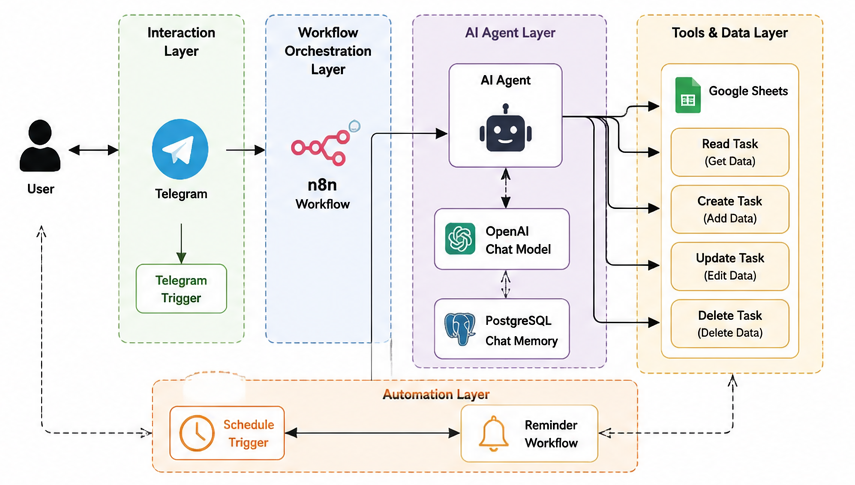
Introduction: Managing multiple academic tasks with overlapping deadlines remains challenging for university students, while conventional task-management applications still require substantial manual organization and prioritization. This study develops an LLM-based AI Task Agent that enables conversational academic task management through Telegram and workflow automation. Method: The proposed system integrates Telegram as the interaction interface, n8n for workflow orchestration, an LLM-based AI agent for natural-language interpretation and tool selection, Google Sheets for task-data operations, PostgreSQL for conversational memory, and scheduled workflows for automated reminders. The system supports Create, Read, Update, and Delete operations, contextual priority recommendations based on deadline, urgency, and lecturer strictness, and proactive reminders. Functional performance and response time were evaluated across the primary system functions. Results and Discussion: Create, Read, Update, and Delete operations achieved 100% functional accuracy, while priority recommendation and automated reminder functions achieved 95%. Recorded processing times ranged from 3.1 to 3.5 seconds, with an average of approximately 3.32 seconds. The results demonstrate that separating LLM-based interpretation from predefined external tool execution enables reliable conversational task management while maintaining controlled data operations. Conclusion: The proposed LLM-based AI Task Agent demonstrates the feasibility of integrating conversational interaction, executable task-management functions, contextual prioritization, memory, and proactive reminders within a unified Telegram-based academic workflow.
Downloads
References
[1] S. Yao, J. Zhao, D. Yu, N. Du, I. Shafran, K. Narasimhan, and Y. Cao, “ReAct: Synergizing reasoning and acting in language models,” in Proc. 11th Int. Conf. Learn. Representations (ICLR), 2023, doi: https://doi.org/10.48550/arXiv.2210.03629.
[2] T. Schick, J. Dwivedi-Yu, R. Dessì, R. Raileanu, M. Lomeli, E. Hambro, L. Zettlemoyer, N. Cancedda, and T. Scialom, “Toolformer: Language models can teach themselves to use tools,” in Advances in Neural Information Processing Systems, vol. 36, pp. 68539–68551, 2023, doi: https://doi.org/10.52202/075280-2997.
[3] Q. Wu et al., “AutoGen: Enabling next-gen LLM applications via multi-agent conversation,” in Proc. Conf. Language Modeling (COLM), 2024, doi: https://doi.org/10.48550/arXiv.2308.08155.
[4] J. S. Park, J. C. O’Brien, C. J. Cai, M. R. Morris, P. Liang, and M. S. Bernstein, “Generative agents: Interactive simulacra of human behavior,” in Proc. 36th Annu. ACM Symp. User Interface Software and Technology (UIST), 2023, Art. no. 2, pp. 1–22, doi: https://doi.org/10.1145/3586183.3606763.
[5] S. Gallo, F. Paternò, and A. Malizia, “A conversational agent for creating automations exploiting large language models,” Personal and Ubiquitous Computing, vol. 28, pp. 931–946, 2024, doi: https://doi.org/10.1007/s00779-024-01825-5.
[6] S. Kusal, S. Patil, J. Choudrie, K. Kotecha, S. Mishra, and A. Abraham, “AI-based conversational agents: A scoping review from technologies to future directions,” IEEE Access, vol. 10, pp. 92337–92356, 2022, doi: https://doi.org/10.1109/ACCESS.2022.3201144.
[7] H.-D. Xu, X.-L. Mao, F. Sun, T.-Y. Che, C. Xu, and H. Huang, “AgentTOD: A task-oriented dialogue agent with a flexible and adaptive API calling paradigm,” ACM Transactions on Information Systems, vol. 43, no. 5, Art. no. 136, pp. 1–32, 2025, doi: https://doi.org/10.1145/3745021.
[8] J. A. Kumar, “Educational chatbots for project-based learning: Investigating learning outcomes for a team-based design course,” International Journal of Educational Technology in Higher Education, vol. 18, Art. no. 65, 2021, doi: https://doi.org/10.1186/s41239-021-00302-w.
[9] C. W. Okonkwo and A. Ade-Ibijola, “Chatbots applications in education: A systematic review,” Computers and Education: Artificial Intelligence, vol. 2, Art. no. 100033, 2021, doi: https://doi.org/10.1016/j.caeai.2021.100033.
[10] S. Wollny, J. Schneider, D. Di Mitri, J. Weidlich, M. Rittberger, and H. Drachsler, “Are we there yet? A systematic literature review on chatbots in education,” Frontiers in Artificial Intelligence, vol. 4, Art. no. 654924, 2021, doi: https://doi.org/10.3389/frai.2021.654924.
[11] M. I. Maulana, Purnawansyah, and H. Azis, “Implementasi Bot Telegram pada proses retrieval data dalam database,” Buletin Sistem Informasi dan Teknologi Islam, vol. 1, no. 3, pp. 150–157, 2020, doi: https://doi.org/10.33096/busiti.v1i3.835.
[12] Y. Salim, I. Muis, L. Syafie, H. Azis, and A. R. Manga, “One-gateway system in managing campus information system using microservices architecture,” Bulletin of Social Informatics Theory and Application, vol. 7, no. 2, pp. 83–91, 2023, doi: https://doi.org/10.31763/businta.v7i2.635.
[13] S. Hao, T. Liu, Z. Wang, and Z. Hu, “ToolkenGPT: Augmenting frozen language models with massive tools via tool embeddings,” in Advances in Neural Information Processing Systems, vol. 36, pp. 45870–45894, 2023, doi: https://doi.org/10.52202/075280-1988.
[14] L. Wang et al., “A survey on large language model based autonomous agents,” Frontiers of Computer Science, vol. 18, Art. no. 186345, 2024, doi: https://doi.org/10.1007/s11704-024-40231-1.
[15] W. Xu, C. Huang, S. Gao, and S. Shang, “LLM-based agents for tool learning: A survey,” Data Science and Engineering, vol. 10, pp. 533–563, 2025, doi: https://doi.org/10.1007/s41019-025-00296-9.
[16] X. Li, S. Wang, S. Zeng, Y. Wu, and Y. Yang, “A survey on LLM-based multi-agent systems: Workflow, infrastructure, and challenges,” Vicinagearth, vol. 1, Art. no. 9, 2024, doi: https://doi.org/10.1007/s44336-024-00009-2.
[17] J. Sánchez Cuadrado, S. Pérez-Soler, E. Guerra, and J. de Lara, “Automating the development of task-oriented LLM-based chatbots,” in Proc. 6th ACM Conf. Conversational User Interfaces (CUI ’24), Luxembourg, 2024, Art. no. 1, 11 pp., doi: https://doi.org/10.1145/3640794.3665538.
[18] D.-L. Chen, K. Aaltonen, H. Lampela, and J. Kujala, “The design and implementation of an educational chatbot with personalized adaptive learning features for project management training,” Technology, Knowledge and Learning, vol. 30, pp. 1047–1072, 2025, doi: https://doi.org/10.1007/s10758-024-09807-5.
[19] M. Ben Hassen and A. Bellaaj, “Optimizing agile project management with a Copilot extension for Jira: Integrating AI, automation, and business intelligence,” Procedia Computer Science, vol. 278, pp. 2028–2038, 2026, doi: https://doi.org/10.1016/j.procs.2026.03.200.
[20] L. Ramaul, P. Ritala, and M. Ruokonen, “Creational and conversational AI affordances: How the new breed of chatbots is revolutionizing knowledge industries,” Business Horizons, vol. 67, no. 5, pp. 615–627, 2024, doi: https://doi.org/10.1016/j.bushor.2024.05.006.
[21] M. A. Kuhail, N. Alturki, S. Alramlawi, and K. Alhejori, “Interacting with educational chatbots: A systematic review,” Education and Information Technologies, vol. 28, no. 1, pp. 973–1018, 2023, doi: https://doi.org/10.1007/s10639-022-11177-3.
[22] L. Labadze, M. Grigolia, and L. Machaidze, “Role of AI chatbots in education: Systematic literature review,” International Journal of Educational Technology in Higher Education, vol. 20, Art. no. 56, 2023, doi: https://doi.org/10.1186/s41239-023-00426-1.
[23] E. Alemdag, “The effect of chatbots on learning: A meta-analysis of empirical research,” Journal of Research on Technology in Education, vol. 57, no. 2, pp. 459–481, 2025, doi: https://doi.org/10.1080/15391523.2023.2255698.
[24] A. Tabassum, A. Sultana, A. Noor, M. S. Alam, and F. Tasnim, “Intelligent healthcare scheduling: A multilingual Rasa chatbot and Flutter-based doctor appointment framework,” in Proc. 2025 IEEE International Women in Engineering Conference on Electrical and Computer Engineering (WIECON-ECE), Dhaka, Bangladesh, 2025, doi: https://doi.org/10.1109/WIECON-ECE69386.2025.11526351.
[25] T. V. Fridgeirsson, H. T. Ingason, H. I. Jonasson, and H. Jonsdottir, “An authoritative study on the near future effect of artificial intelligence on project management knowledge areas,” Sustainability, vol. 13, no. 4, Art. no. 2345, 2021, doi: https://doi.org/10.3390/su13042345.
[26] V. Holzmann, D. Zitter, and S. Peshkess, “The expectations of project managers from artificial intelligence: A Delphi study,” Project Management Journal, vol. 53, no. 5, pp. 438–455, 2022, doi: https://doi.org/10.1177/87569728211061779.
[27] R. Wu and Z. Yu, “Do AI chatbots improve students’ learning outcomes? Evidence from a meta-analysis,” British Journal of Educational Technology, vol. 55, no. 1, pp. 10–33, 2024, doi: https://doi.org/10.1111/bjet.13334.
[28] A. Ganguly, N. Mehjabin, A. Malik, and A. Johri, “Conversational AI agents in education: An umbrella review of current utilization, challenges, and future directions for ethical and responsible use,” AI and Ethics, vol. 6, Art. no. 72, 2026, doi: https://doi.org/10.1007/s43681-025-00916-0.
[29] J. Quiroga Pérez, T. Daradoumis, and J. M. Marquès Puig, “Rediscovering the use of chatbots in education: A systematic literature review,” Computer Applications in Engineering Education, vol. 28, no. 6, pp. 1549–1565, 2020, doi: https://doi.org/10.1002/cae.22326.
[30] L. K. Lee, Y. C. Fung, Y. W. Pun, K. K. Wong, M. T. Y. Yu, and N. I. Wu, “Using a multiplatform chatbot as an online tutor in a university course,” in Proc. 2020 International Symposium on Educational Technology (ISET), Bangkok, Thailand, 2020, pp. 53–56, doi: https://doi.org/10.1109/ISET49818.2020.00021.
Downloads
Published
Issue
Section
License
Copyright (c) 2026 Huzain Azis, Nabila Widiyanti

This work is licensed under a Creative Commons Attribution-NonCommercial 4.0 International License.
Authors retain copyright and full publishing rights to their articles. Upon acceptance, authors grant Indonesian Journal of Data and Science a non-exclusive license to publish the work and to identify itself as the original publisher.
Self-archiving. Authors may deposit the submitted version, accepted manuscript, and version of record in institutional or subject repositories, with citation to the published article and a link to the version of record on the journal website.
Commercial permissions. Uses intended for commercial advantage or monetary compensation are not permitted under CC BY-NC 4.0. For permissions, contact the editorial office at ijodas.journal@gmail.com.
Legacy notice. Some earlier PDFs may display “Copyright © [Journal Name]” or only a CC BY-NC logo without the full license text. To ensure clarity, the authors maintain copyright, and all articles are distributed under CC BY-NC 4.0. Where any discrepancy exists, this policy and the article landing-page license statement prevail.