Analisis perbandingan Reduction Technique dengan metode Dimentional Reduction dan Cross Validation pada dataset Breast Cancer
DOI:
https://doi.org/10.56705/ijodas.v3i2.41Keywords:
dimentional reduction, cross validation, reduction technique, breast cancer, machine learningAbstract
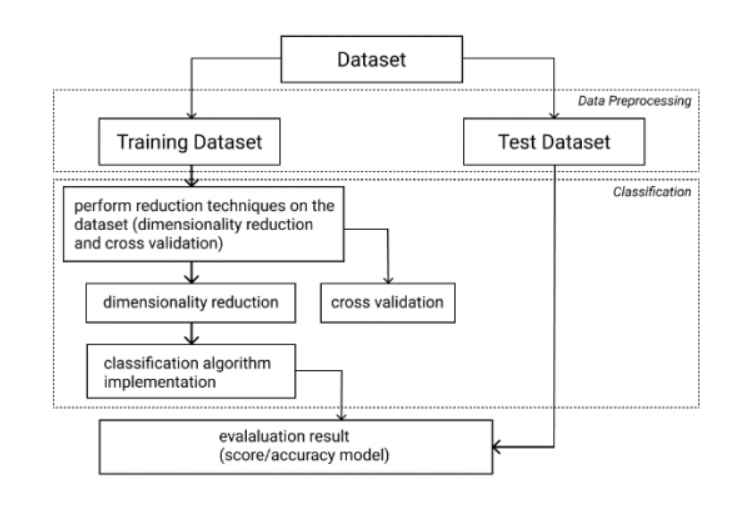
Machine learning (ML) merupakan bidang ilmu yang memungkinkan komputer dalam mengembangkan sebuah sistem yang dapat belajar dari data. Dalam ML sendiri banyak teknik sangat berperan penting dalam pengembangan machine ML salah satunya adalah teknik reduksi yang dimana membuat sistem lebih baik dari data yang telah di reduksi. Penelitian ini bertujuan membandingkan performa teknik reduksi dengan metode dimentional reduction dan cross validation pada dataset breast cancer. Dimentional reduction merupakan teknik yang menyederhanakan feature atau mengurangi dimensi pada dataset sedangkan cross validation merupakan metode yang digunakan untuk memaksimalkan hasil dari prediksi pada suatu model. Setalah melakukan tahapan-tahapn dalam pengujian dengan dimentional reduction dan cross validation menggunakan algoritma K-Nearest Neighbors dengan dataset breast cancer berjumlah 500. Hasil yang diperolah untuk dimentional reduction akurasi rata-rata pada model 95.2%, sedangkan pada cross validation 96.6%.
Downloads
References
M. M. Baharuddin, T. Hasanuddin, and H. Azis, “Analisis Performa Metode K-Nearest Neighbor untuk Identifikasi Jenis Kaca,” Ilk. J. Ilm., vol. 11, no. 28, pp. 269–274, 2019.
H. Zhang, “The optimality of Naive Bayes,” Proc. Seventeenth Int. Florida Artif. Intell. Res. Soc. Conf. FLAIRS 2004, vol. 2, pp. 562–567, 2004.
M. B. Bejiga, A. Zeggada, A. Nouffidj, and F. Melgani, “A convolutional neural network approach for assisting avalanche search and rescue operations with UAV imagery,” Remote Sens., vol. 9, no. 2, 2017, doi: 10.3390/rs9020100.
J. D. Kelleher, B. Mac Namee, and A. D. Arcy, Fundamentals of Machine Learning For Predictive Data Analytics Algorithms, Worked Examples, and Case Studies. London: The MIT Press, 2015.
Rizky Ade Putranto, Triastiti Wuryandari, and Sudarno, “Perbandingan Analisis Klasifikasi Antara Decision Tree Dan Support Vector Machine Multiclass Untuk Penentuan Jurusan Pada Siswa Sma,” J. Gaussian, vol. 4, no. 4, pp. 1007–1016, 2015.
I. F. Nurahmadan, A. Agusta, P. A. Winarno, and B. H. Sazali, “Perbandingan Algoritma Machine Learning Untuk Klasifikasi Denyut Jantung Janin,” no. April, pp. 733–740, 2021.
D. Cahyanti, A. Rahmayani, and S. Ainy, “Analisis performa metode Knn pada Dataset pasien pengidap Kanker Payudara,” Indones. J. Data Sci., vol. 1, no. 2, pp. 39–43, 2020.
A. Primajaya, B. N. Sari, and A. Khusaeri, “Prediksi Potensi Kebakaran Hutan dengan Algoritma Klasifikasi C4.5 Studi Kasus Provinsi Kalimantan Barat,” J. Edukasi dan Penelit. Inform., vol. 6, no. 2, p. 188, 2020, doi: 10.26418/jp.v6i2.37834.
W. Purnami, A. M. Regresi, and L. Ordinal, “Perbandingan Klasifikasi Tingkat Keganasan Breast Cancer Dengan Menggunakan Regresi Logistik Ordinal Dan Support Vector Machine ( SVM ),” J. Sains Dan Seni Its, vol. 1, no. 1, 2012.
H. Azis, F. Tangguh Admojo, and E. Susanti, “Analisis Perbandingan Performa Metode Klasifikasi pada Dataset Multiclass Citra Busur Panah,” Techno.Com, vol. 19, no. 3, pp. 286–294, 2020.
N. Fadhillah, H. Azis, and D. Lantara, “Validasi Pencarian Kata Kunci Menggunakan Algoritma Levenshtein Distance Berdasarkan Metode Approximate String Matching,” Pros. Semin. Nas. Ilmu Komput. dan Teknol. Inf, vol. 1, pp. 3–7.
F. Muharram, H. Azis, and A. R. Manga, “Analisis Algoritma pada Proses Enkripsi dan Dekripsi File Menggunakan Advanced Encryption Standard (AES),” Pros. Semin. Nas. Ilmu Komput. dan Teknol. Inf., vol. 3, no. 2, pp. 112–115, 2018.
A. Prasetya Wibawa, W. Lestar, A. Bella Putra Utama, I. Tri Saputra, and Z. Nabila Izdihar, “Multilayer Perceptron untuk Prediksi Sessions pada Sebuah Website Journal Elektronik,” Indones. J. Data Sci., vol. 1, no. 3, pp. 57–67, 2020, doi: 10.33096/ijodas.v1i3.15.
K. Ilunga, T. Lumbala, and K. Mulenda, “Application of Big data to configuration management in a PLM context,” Indones. J. Data Sci., vol. 3, no. 1, pp. 9–16, 2022.
S. Sari, U. Khaira, P. Pradita, and T. S. Tri, “… Beauty Shaming Di Media Sosial Twitter Menggunakan Algoritma SentiStrength: Sentiment Analysis Against Beauty Shaming Comments on Twitter Social Media …,” Indones. J. …, vol. 1, no. 1, pp. 71–78, 2021.
Hasran, “Klasifikasi Penyakit Jantung Menggunakan Metode K-Nearest Neighbor,” Indones. J. Data Sci., vol. 1, no. 1, pp. 1–4, 2020.
N. Rokhman and J. Maharanti, “Deteksi Steganografi Berbasis Least Significant Bit (LSB) Dengan Menggunakan Analisis Statistik,” IJCCS (Indonesian J. Comput. Cybern. Syst., vol. 5, no. 2, pp. 57–62, 2013, doi: 10.22146/ijccs.2007.
H. Nursan and Muslim, “Penerapan Metode Digital Watermarking dan Privilege pada Dokumen Skripsi,” Indones. J. Data Sci., vol. 1, no. 1, pp. 19–22, 2020.
W. Xing and Y. Bei, “Medical Health Big Data Classification Based on KNN Classification Algorithm,” IEEE Access, vol. 8, pp. 28808–28819, 2020, doi: 10.1109/ACCESS.2019.2955754.
M. S. Vural and M. Gök, “Criminal prediction using Naive Bayes theory,” Neural Comput. Appl., vol. 28, no. 9, pp. 2581–2592, 2017, doi: 10.1007/s00521-016-2205-z.
N. Nurajijah and D. Riana, “Algoritma Naïve Bayes, Decision Tree, dan SVM untuk Klasifikasi Persetujuan Pembiayaan Nasabah Koperasi Syariah,” J. Teknol. dan Sist. Komput., vol. 7, no. 2, pp. 77–82, 2019, doi: 10.14710/jtsiskom.7.2.2019.77-82.
S. C. Esananda, B. Nugroho, F. T. Anggraeny, P. S. Informatika, F. I. Komputer, and U. P. Nasional, “Penerapan Algoritma Decision Tree Dalam Menentukan Prestasi Akademik Siswa,” vol. 02, no. 2, 2021.
Published
Issue
Section
License
Authors retain copyright and full publishing rights to their articles. Upon acceptance, authors grant Indonesian Journal of Data and Science a non-exclusive license to publish the work and to identify itself as the original publisher.
Self-archiving. Authors may deposit the submitted version, accepted manuscript, and version of record in institutional or subject repositories, with citation to the published article and a link to the version of record on the journal website.
Commercial permissions. Uses intended for commercial advantage or monetary compensation are not permitted under CC BY-NC 4.0. For permissions, contact the editorial office at ijodas.journal@gmail.com.
Legacy notice. Some earlier PDFs may display “Copyright © [Journal Name]” or only a CC BY-NC logo without the full license text. To ensure clarity, the authors maintain copyright, and all articles are distributed under CC BY-NC 4.0. Where any discrepancy exists, this policy and the article landing-page license statement prevail.