Resin Code Classification on Plastic Packaging Using Few-Shot Learning
DOI:
https://doi.org/10.56705/ijodas.v7i2.406Keywords:
Few-Shot Learning, Prototypical Network, RIC Classification, EfficientNet-B2, Plastic Waste SortingAbstract
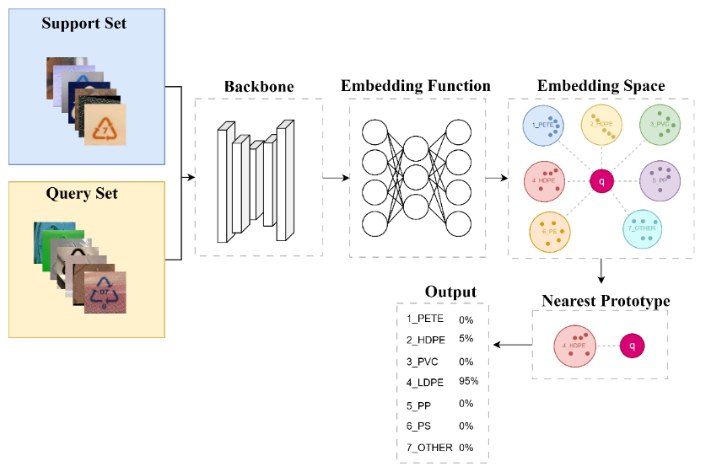
Introduction: Accurate sorting of plastic waste using Resin Identification Codes (RICs) is essential for improving recycling quality. However, conventional deep learning approaches generally require large labeled datasets, which are difficult and costly to collect for small RIC symbols on plastic packaging. Method: This study employed a Few-Shot Learning approach based on Prototypical Networks using a 7-way 5-shot episodic training configuration. A self-collected dataset of 350 images, comprising 50 images for each of seven RIC categories—PETE, HDPE, PVC, LDPE, PP, PS, and OTHER—was used. Three backbone architectures, ConvNet4, ResNet-18, and EfficientNet-B2, were compared. An ablation study evaluated support-set augmentation, followed by supervised fine-tuning of the selected model. Results and Discussion: EfficientNet-B2 achieved the highest episodic accuracy of 93.36%, outperforming ResNet-18 at 88.71% and ConvNet4 at 54.14%. EfficientNet-B2 with light augmentation attained 85.71% accuracy on the fixed 42-image test set, with perfect recall for PVC, LDPE, and PP. Most errors involved visually similar HDPE and PP symbols. Fine-tuning corrected five of six misclassifications, increasing test accuracy to 90.48% and the F1-score from 0.857 to 0.903. Conclusion: Prototypical Networks with an EfficientNet-B2 backbone and cosine distance provide an effective solution for RIC classification under limited-data conditions and offer a practical foundation for automated plastic-waste sorting systems.
Downloads
References
[1] Sustainable Waste Indonesia, “Collection and Recycling Rate Index of Plastic Waste in Indonesia,” 2025.
[2] OECD, Regional Plastics Outlook for Southeast and East Asia. OECD Publishing, 2025.
[3] J. Vaucher, A. Demongeot, V. Michaud, and Y. Leterrier, “Recycling of Bottle Grade PET: Influence of HDPE Contamination on the Microstructure and Mechanical Performance of 3D Printed Parts,” Polymers, vol. 14, no. 24, p. 5507, Dec. 2022, https://doi.org/10.3390/polym14245507.
[4] T. Werner, I. Taha, and D. Aschenbrenner, “An overview of polymer identification techniques in recycling plants with focus on current and future challenges,” Procedia CIRP, vol. 120, pp. 1381-1386, 2023, https://doi.org/10.1016/j.procir.2023.09.180.
[5] J. Bobulski and M. Kubanek, “Deep Learning for Plastic Waste Classification System,” Applied Computational Intelligence and Soft Computing, vol. 2021, pp. 1-7, May 2021, https://doi.org/10.1155/2021/6626948.
[6] A. A. P. Chazhoor, E. S. L. Ho, B. Gao, and W. L. Woo, “Deep transfer learning benchmark for plastic waste classification,” Intelligence & Robotics, 2022, https://doi.org/10.20517/ir.2021.15.
[7] E. Gothai, R. Thamilselvan, P. Natesan, M. Keerthivasan, K. Kabinesh, and D. K. Ruban, “Plastic Waste Classification Using CNN for Supporting 3R’s Principle,” in 2022 International Conference on Computer Communication and Informatics (ICCCI), Jan. 2022, pp. 01-07, https://doi.org/10.1109/ICCCI54379.2022.9740902.
[8] K. He, X. Zhang, S. Ren, and J. Sun, “Deep Residual Learning for Image Recognition,” in 2016 IEEE Conference on Computer Vision and Pattern Recognition (CVPR), June 2016, pp. 770-778, https://doi.org/10.1109/CVPR.2016.90.
[9] M. Tan and Q. V. Le, “EfficientNet: Rethinking Model Scaling for Convolutional Neural Networks.”
[10] L. Listyalina, Y. Yudianingsih, A. W. Soedjono, E. L. Utari, and D. A. Dharmawan, “Deep-RIC: Plastic Waste Classification using Deep Learning and Resin Identification Codes (RIC),” Telematika, vol. 19, no. 2, p. 215, June 2022, https://doi.org/10.31315/telematika.v19i2.7419.
[11] S. Agarwal, R. Gudi, and P. Saxena, “Image Classification Approaches for Segregation of Plastic Waste Based on Resin Identification Code,” Transactions of the Indian National Academy of Engineering, vol. 7, no. 3, pp. 739-751, Sept. 2022, https://doi.org/10.1007/s41403-022-00324-4.
[12] Y. Wang, Q. Yao, J. T. Kwok, and L. M. Ni, “Generalizing from a Few Examples: A Survey on Few-shot Learning,” ACM Computing Surveys, vol. 53, no. 3, pp. 1-34, May 2021, https://doi.org/10.1145/3386252.
[13] Y. Song, T. Wang, P. Cai, S. K. Mondal, and J. P. Sahoo, “A Comprehensive Survey of Few-shot Learning: Evolution, Applications, Challenges, and Opportunities,” ACM Computing Surveys, vol. 55, no. 13s, pp. 1-40, Dec. 2023, https://doi.org/10.1145/3582688.
[14] J. Snell, K. Swersky, and R. S. Zemel, “Prototypical Networks for Few-shot Learning.” arXiv, June 19, 2017, Accessed: Feb. 15, 2024, http://arxiv.org/abs/1703.05175.
[15] C. Finn, P. Abbeel, and S. Levine, “Model-Agnostic Meta-Learning for Fast Adaptation of Deep Networks.” arXiv, July 18, 2017, https://doi.org/10.48550/arXiv.1703.03400.
[16] J. Y. Lim, K. M. Lim, C. P. Lee, and Y. X. Tan, “A review of few-shot image classification: Approaches, datasets and research trends,” Neurocomputing, vol. 649, p. 130774, Oct. 2025, https://doi.org/10.1016/j.neucom.2025.130774.
[17] E. Triantafillou et al., “Meta-Dataset: A Dataset of Datasets for Learning to Learn from Few Examples.” arXiv, Apr. 08, 2020, https://doi.org/10.48550/arXiv.1903.03096.
[18] Y. Tian, Y. Wang, D. Krishnan, J. B. Tenenbaum, and P. Isola, “Rethinking Few-Shot Image Classification: A Good Embedding is All You Need?,” in Computer Vision - ECCV 2020, vol. 12359, A. Vedaldi, H. Bischof, T. Brox, and J.-M. Frahm, Eds. Cham: Springer International Publishing, 2020, pp. 266-282.
[19] S. Hou, W. Liu, A. Karim, Z. Jia, W. Jia, and Y. Zheng, “Few‐shot logo detection,” IET Computer Vision, vol. 17, no. 5, pp. 586-598, Aug. 2023, https://doi.org/10.1049/cvi2.12205.
[20] L. Jamieson, E. Elyan, and C. F. Moreno-García, “Few-Shot Symbol Detection in Engineering Drawings,” Applied Artificial Intelligence, vol. 38, no. 1, p. 2406712, Dec. 2024, https://doi.org/10.1080/08839514.2024.2406712.
[21] M. Alfaro-Contreras, A. Ríos-Vila, J. J. Valero-Mas, and J. Calvo-Zaragoza, “Few-shot symbol classification via self-supervised learning and nearest neighbor,” Pattern Recognition Letters, vol. 167, pp. 1-8, Mar. 2023, https://doi.org/10.1016/j.patrec.2023.01.014.
[22] I. Ranjbar, Y. Ventikos, and M. Arashpour, “Zero-shot and few-shot multimodal plastic waste classification with vision-language models,” Waste Management, vol. 202, p. 114815, July 2025, https://doi.org/10.1016/j.wasman.2025.114815.
[23] O. Russakovsky et al., “ImageNet Large Scale Visual Recognition Challenge,” International Journal of Computer Vision, vol. 115, no. 3, pp. 211-252, Dec. 2015, https://doi.org/10.1007/s11263-015-0816-y.
[24] H. Wang, S. Tian, Y. Fu, J. Zhou, J. Liu, and D. Chen, “Feature augmentation based on information fusion rectification for few-shot image classification,” Scientific Reports, vol. 13, no. 1, p. 3607, Mar. 2023, https://doi.org/10.1038/s41598-023-30398-1.
[25] P. Zhu, Z. Zhu, Y. Wang, J. Zhang, and S. Zhao, “Multi-granularity episodic contrastive learning for few-shot learning,” Pattern Recognition, vol. 131, p. 108820, Nov. 2022, https://doi.org/10.1016/j.patcog.2022.108820.
[26] S. Agustiani, A. Junaidi, R. Aryanti, and A. A. B. Kamil, “Waste Classification using EfficientNetB3-Based Deep Learning for Supporting Sustainable Waste Management,” vol. 4, no. 1, 2025.
[27] A. Tharwat, “Classification assessment methods,” Applied Computing and Informatics, vol. 17, no. 1, pp. 168-192, Jan. 2021, https://doi.org/10.1016/j.aci.2018.08.003.
[28] X. Li, X. Yang, Z. Ma, and J.-H. Xue, “Deep metric learning for few-shot image classification: A Review of recent developments,” Pattern Recognition, vol. 138, p. 109381, June 2023, https://doi.org/10.1016/j.patcog.2023.109381.
[29] V. O. Kuzevanov and D. V. Tikhomirova, “Deep Learning for Effective Visualization and Classification of Recyclable Material Labels,” Scientific Visualization, vol. 16, no. 5, pp. 179-196, Dec. 2024, https://doi.org/10.26583/sv.16.5.12.
[30] W. Li, L. Wang, J. Xu, J. Huo, Y. Gao, and J. Luo, “Revisiting Local Descriptor Based Image-To-Class Measure for Few-Shot Learning,” in 2019 IEEE/CVF Conference on Computer Vision and Pattern Recognition (CVPR), June 2019, pp. 7253-7260, https://doi.org/10.1109/CVPR.2019.00743.
Downloads
Published
Versions
- 2026-07-31 (2)
- 2026-07-31 (1)
Issue
Section
License
Copyright (c) 2026 Anindita Septiarini, Alyani Noor Septalia, Masna Wati

This work is licensed under a Creative Commons Attribution-NonCommercial 4.0 International License.
Authors retain copyright and full publishing rights to their articles. Upon acceptance, authors grant Indonesian Journal of Data and Science a non-exclusive license to publish the work and to identify itself as the original publisher.
Self-archiving. Authors may deposit the submitted version, accepted manuscript, and version of record in institutional or subject repositories, with citation to the published article and a link to the version of record on the journal website.
Commercial permissions. Uses intended for commercial advantage or monetary compensation are not permitted under CC BY-NC 4.0. For permissions, contact the editorial office at ijodas.journal@gmail.com.
Legacy notice. Some earlier PDFs may display “Copyright © [Journal Name]” or only a CC BY-NC logo without the full license text. To ensure clarity, the authors maintain copyright, and all articles are distributed under CC BY-NC 4.0. Where any discrepancy exists, this policy and the article landing-page license statement prevail.