The Effect of Clinical Rule-Based Domain Filtering on the Performance of FP-Growth-Based Drug Recommendation Systems
DOI:
https://doi.org/10.56705/ijodas.v7i1.398Keywords:
Association Rule Mining, FP-Growth, Domain Filtering, Drug Recommendation System, Medical DataAbstract
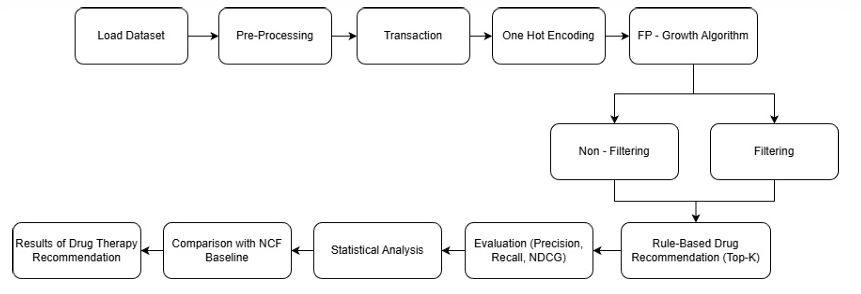
This study analyzes the effect of domain filtering on drug recommendation systems based on association rule mining using the FP-Growth algorithm with Neural Collaborative Filtering (NCF) as a comparison. The dataset used was derived from patient medical records containing attributes such as complaints, diagnoses, and drug therapies, with a total of 1,000 patient transactions. To avoid data leakage, the dataset was randomly divided into 70% training data and 30% test data before the modeling process was carried out. Domain filtering was applied by limiting the rule structure so that complaints and diagnoses acted as antecedents and drugs as consequents. The performance of the recommendation system was evaluated using the Precision@5, Recall@5, and Normalized Discounted Cumulative Gain (NDCG@5) metrics. The results of the experiment show that the FP-Growth approach with domain filtering produces higher Precision@5 and NDCG@5 values than the non-filtering approach. The Wilcoxon Signed-Rank test shows that the difference is statistically significant, while effect size analysis using Cliff's Delta shows a practically meaningful impact. Furthermore, a comparison with Neural Collaborative Filtering shows that the collaborative filtering-based approach is less effective on transactional clinical prescription data with limited historical interactions. These findings indicate that integrating medical domain knowledge into FP-Growth can improve the clinical relevance and quality of drug recommendation rankings
Downloads
References
[1] S. Murthi, N. Martini, N. Falconer, and S. Scahill, “Evaluating EHR-Integrated Digital Technologies for Medication-Related Outcomes and Health Equity in Hospitalised Adults: A Scoping Review,” Dec. 01, 2024, Springer. doi: 10.1007/s10916-024-02097-5.
[2] C. Scherkl et al., “Towards a prescribing monitoring system for medication safety evaluation within electronic health records: a scoping review,” BMC Med. Inform. Decis. Mak., vol. 25, no. 1, Dec. 2025, doi: 10.1186/s12911-025-03096-3.
[3] S. E. Davis et al., “Use of Electronic Health Record Data for Drug Safety Signal Identification: A Scoping Review,” Aug. 01, 2023, Adis. doi: 10.1007/s40264-023-01325-0.
[4] K. Li, K. Xiao, S. Zhu, Y. Wang, and W. Wang, “Chinese Herbal Medicine for Primary Liver Cancer Therapy: Perspectives and Challenges,” May 05, 2022, Frontiers Media S.A. doi: 10.3389/fphar.2022.889799.
[5] I. As’ad, “Advancing Healthcare Diagnostics: A Study on Gaussian Naive Bayes Classification of Blood Samples,” International Journal of Artificial Intelligence in Medical Issues, vol. 1, no. 2, pp. 115–123, Nov. 2023, doi: 10.56705/ijaimi.v1i2.120.
[6] A. Q. Wang et al., “A Framework for Interpretability in Machine Learning for Medical Imaging,” IEEE Access, vol. 12, pp. 53277–53292, 2024, doi: 10.1109/ACCESS.2024.3387702.
[7] Y. Salim, A. P. Utami, A. R. Manga, H. Azis, and F. T. Admojo, “Optimal Strategy for Handling Unbalanced Medical Datasets: Performance Evaluation of K-NN Algorithm Using Sampling Techniques,” Knowledge Engineering and Data Science, vol. 7, no. 2, Dec. 2024, doi: 10.17977/um018v7i22024p176-186.
[8] H. Yamamoto, G. Kayanuma, T. Nagashima, C. Toda, K. Nagayasu, and S. Kaneko, “Early Detection of Adverse Drug Reaction Signals by Association Rule Mining Using Large-Scale Administrative Claims Data,” Drug Saf., vol. 46, no. 4, pp. 371–389, Apr. 2023, doi: 10.1007/s40264-023-01278-4.
[9] R. Dio et al., “Scenario-Based Association Rule Mining in Veterinary Services Using FP-Growth: Differentiating Clinical and Customer-Driven Patterns,” Journal of Applied Informatics and Computing, p., 2025, doi: 10.30871/jaic.v9i3.9698.
[10] H. Harlinda and R. Satra, “Data Mining Approach to Improve Minimarket Sales using Association Rule Method,” Jurnal Informatika, vol. 12, no. 1, pp. 10–14, 2025.
[11] S. Darrab, D. Broneske, and G. Saake, “Exploring the predictive factors of heart disease using rare association rule mining,” Sci. Rep., vol. 14, no. 1, Dec. 2024, doi: 10.1038/s41598-024-69071-6.
[12] O. Seneviratne et al., “Semantically enabling clinical decision support recommendations,” J. Biomed. Semantics, vol. 14, no. 1, Dec. 2023, doi: 10.1186/s13326-023-00285-9.
[13] M. Jacobs, M. F. Pradier, T. H. McCoy, R. H. Perlis, F. Doshi-Velez, and K. Z. Gajos, “How machine-learning recommendations influence clinician treatment selections: the example of the antidepressant selection,” Transl. Psychiatry, vol. 11, no. 1, Jun. 2021, doi: 10.1038/s41398-021-01224-x.
[14] S. Hur et al., “Comparison of SHAP and clinician friendly explanations reveals effects on clinical decision behaviour,” NPJ Digit. Med., vol. 8, no. 1, Dec. 2025, doi: 10.1038/s41746-025-01958-8.
[15] M. R. Pinsky et al., “Use of artificial intelligence in critical care: opportunities and obstacles,” Crit. Care, vol. 28, no. 1, Dec. 2024, doi: 10.1186/s13054-024-04860-z.
[16] Q. Xu et al., “Interpretability of Clinical Decision Support Systems Based on Artificial Intelligence from Technological and Medical Perspective: A Systematic Review,” 2023, Hindawi Limited. doi: 10.1155/2023/9919269.
[17] C. Sirocchi, A. Bogliolo, and S. Montagna, “Medical-informed machine learning: integrating prior knowledge into medical decision systems,” BMC Med. Inform. Decis. Mak., vol. 24, no. Suppl 4, Dec. 2024, doi: 10.1186/s12911-024-02582-4.
[18] Z. Zulham, E. E. Putri, and B. S. Hasugian, “Pattern Analysis of Drug Procurement System With FP-Growth Algorithm,” Jurnal Online Informatika, p., 2022, doi: 10.15575/join.v7i1.841.
[19] B. Anwar, A. Ambiyar, and F. Fadhilah, “Application of the FP-Growth Method to Determine Drug Sales Patterns,” Sinkron, vol. 8, no. 1, pp. 405–414, Jan. 2023, doi: 10.33395/sinkron.v8i1.12004.
[20] J. Nugraha and C. Yustia Purnamawati, “Application of the Association Method Using FP-Growth Algorithm to Find Pattern Of Medicine Purchasing Transactions at Pharmacy,” Journal of Applied Research In Computer Science and Information Systems, vol. 1, no. 2, pp. 48–53, Nov. 2023, doi: 10.61098/jarcis.v1i2.50.
[21] Q. H. Nguyen et al., “Influence of data splitting on performance of machine learning models in prediction of shear strength of soil,” Math. Probl. Eng., vol. 2021, 2021, doi: 10.1155/2021/4832864.
[22] H. Essalmi and A. El Affar, “Dynamic Algorithm for Mining Relevant Association Rules via Meta-Patterns and Refinement-Based Measures,” Information (Switzerland), vol. 16, no. 6, Jun. 2025, doi: 10.3390/info16060438.
[23] M. Rosenblatt, L. Tejavibulya, R. Jiang, S. Noble, and D. Scheinost, “Data leakage inflates prediction performance in connectome-based machine learning models,” Nat. Commun., vol. 15, no. 1, Dec. 2024, doi: 10.1038/s41467-024-46150-w.
[24] Z. Wu and G. Fang, “The Research on the Improvement of FP-growth Algorithm,” Artificial Intelligence Technology Research, vol. 2, no. 1, Mar. 2024, doi: 10.18686/aitr.v2i1.3860.
[25] H. A. Alsaeedi and A. S. Alhegami, “An Incremental Interesting Maximal Frequent Itemset Mining Based on FP-Growth Algorithm,” Complexity, vol. 2022, 2022, doi: 10.1155/2022/1942517.
[26] C. Fernandez-Basso, M. D. Ruiz, and M. J. Martin-Bautista, “New Spark solutions for distributed frequent itemset and association rule mining algorithms,” Cluster Comput., vol. 27, no. 2, pp. 1217–1234, Apr. 2024, doi: 10.1007/s10586-023-04014-w.
[27] A. Ahmadipour and A. Sarafinejad, “Investigation of Drug Interactions through Analysis of Prescribed Medications Association Rules Using the FP -growth Algorithm,” Journal of Health and Biomedical Informatics, vol. 11, no. 2, pp. 166–175, Sep. 2024, doi: 10.34172/jhbmi.2024.22.
[28] W. Yang et al., “Breaking the Top-K Barrier: Advancing Top-K Ranking Metrics Optimization in Recommender Systems,” in Proceedings of the ACM SIGKDD International Conference on Knowledge Discovery and Data Mining, Association for Computing Machinery, Aug. 2025, pp. 3542–3552. doi: 10.1145/3711896.3736866.
[29] H. Darwis, F. A. Syahrir, and L. N. Hayati, “A Hybrid Movie Recommendation System to Address Data Sparsity Using Genre-Based K-Means and Neural Collaborative Filtering,” ILKOM Jurnal Ilmiah, vol. 17, no. 2, pp. 203–212, Sep. 2025, doi: 10.33096/ilkom.v17i2.2868.203-212.
[30] H. Lahuddin, M. R. A. Muliawan, K. Takemoto, H. Darwis, S. R. Jabir, and R. Adawiyah, “Cryptocurrency Prices Forecasting Using LSTM, CNN, Transformer, TCN, and Hybrid Model: A Deep Learning Approach,” in 2025 9th International Conference On Electrical, Electronics And Information Engineering (ICEEIE), 2025, pp. 1–6. doi: 10.1109/ICEEIE66203.2025.11252474.
[31] B. Drammeh and H. Li, “Enhancing neural collaborative filtering using hybrid feature selection for recommendation,” PeerJ Comput. Sci., vol. 9, 2023, doi: 10.7717/peerj-cs.1456.
[32] X. Meng, “Cross-domain information fusion and personalized recommendation in artificial intelligence recommendation system based on mathematical matrix decomposition,” Sci. Rep., vol. 14, no. 1, Dec. 2024, doi: 10.1038/s41598-024-57240-6.
[33] W. Y. Tan, Q. Gao, R. W. Oei, W. Hsu, M. L. Lee, and N. C. Tan, “Diabetes medication recommendation system using patient similarity analytics,” Sci. Rep., vol. 12, no. 1, Dec. 2022, doi: 10.1038/s41598-022-24494-x.
[34] A. Sae-Ang, S. Chairat, N. Tansuebchueasai, O. Fumaneeshoat, T. Ingviya, and S. Chaichulee, “Drug Recommendation from Diagnosis Codes: Classification vs. Collaborative Filtering Approaches,” Int. J. Environ. Res. Public Health, vol. 20, no. 1, Jan. 2023, doi: 10.3390/ijerph20010309.
[35] P. Cui, B. Yin, and B. Xu, “The application of social recommendation algorithm integrating attention model in movie recommendation,” Sci. Rep., vol. 13, no. 1, Dec. 2023, doi: 10.1038/s41598-023-43511-1.
Downloads
Published
Issue
Section
License
Copyright (c) 2026 Muhammad Zaqly Luluang, Irawati, Herdianti Darwis

This work is licensed under a Creative Commons Attribution-NonCommercial 4.0 International License.
Authors retain copyright and full publishing rights to their articles. Upon acceptance, authors grant Indonesian Journal of Data and Science a non-exclusive license to publish the work and to identify itself as the original publisher.
Self-archiving. Authors may deposit the submitted version, accepted manuscript, and version of record in institutional or subject repositories, with citation to the published article and a link to the version of record on the journal website.
Commercial permissions. Uses intended for commercial advantage or monetary compensation are not permitted under CC BY-NC 4.0. For permissions, contact the editorial office at ijodas.journal@gmail.com.
Legacy notice. Some earlier PDFs may display “Copyright © [Journal Name]” or only a CC BY-NC logo without the full license text. To ensure clarity, the authors maintain copyright, and all articles are distributed under CC BY-NC 4.0. Where any discrepancy exists, this policy and the article landing-page license statement prevail.