Hybrid Deep Learning Models For Gold Price Prediction: Enhancing Forecast In Volatile Financial Markets
DOI:
https://doi.org/10.56705/ijodas.v7i2.394Keywords:
Gold price prediction, Hybrid Deep Learning, Convolutional Neural Network, Long Short-Term MemoryAbstract
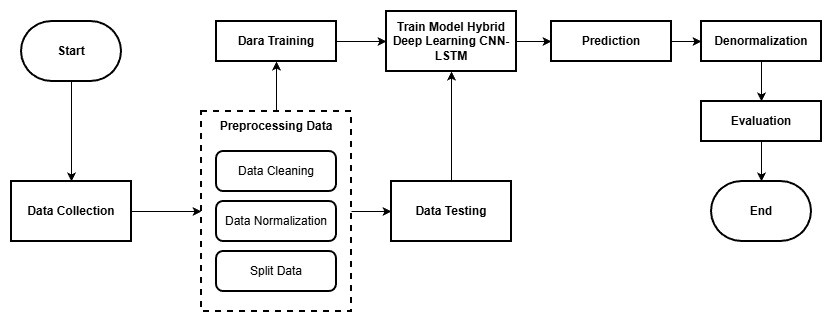
Introduction: Gold is widely regarded as a long-term store of value and a hedge against inflation, yet its short-term price volatility creates significant challenges for investment decision-making and requires accurate forecasting methods. This study evaluates a hybrid deep learning approach combining Convolutional Neural Network (CNN) and Long Short-Term Memory (LSTM) to capture both short-term fluctuations and long-term temporal dependencies in gold price movements. Method: Historical daily gold closing-price data comprising 2,735 observations from 2015 to 2025 were collected and normalized using Min-Max Scaling. The data were divided chronologically into 80% training and 20% testing sets. A hybrid CNN–LSTM model was trained using the Adam optimizer with a learning rate of 0.0001, dropout of 0.2, a timestep of 30, and batch sizes of 16, 32, and 64. Model performance was evaluated using Root Mean Square Error (RMSE). Results and Discussion: The batch size of 16 achieved the best performance, producing the lowest validation RMSE of 0.0929 and an RMSE of 11.518535% after denormalization, outperforming batch sizes of 32 and 64. The model also followed actual gold-price trends more closely, while the inclusion of Dense and Dropout layers improved generalization. Conclusion: The CNN–LSTM hybrid model, particularly with a batch size of 16, provides an effective approach for forecasting volatile gold prices by integrating local pattern extraction with long-term temporal modeling.
Downloads
References
[1] S. Aprizal dan M. N. Harahap, “Determinants of Gold Prices in Indonesia Period of 2018-2022.”
[2] A. Amini dan R. Kalantari, “Gold price prediction by a CNN-Bi-LSTM model along with automatic parameter tuning,” PLoS One, vol. 19, no. 3 March, Mar 2024, doi: https://doi.org/10.1371/journal.pone.0298426.
[3] G. Taneva-Angelova, S. Raychev, dan G. Ilieva, “A Framework for Gold Price Prediction Combining Classical and Intelligent Methods with Financial, Economic, and Sentiment Data Fusion,” International Journal of Financial Studies, vol. 13, no. 2, Jun 2025, doi: https://doi.org/10.3390/ijfs13020102.
[4] S. Sathyanarayana dan T. Mohanasundaram, “The Surge in Gold Price Volatility: Macroeconomic Drivers, Geopolitical Risk, and Market Dynamics,” IRA-International Journal of Management & Social Sciences (ISSN 2455-2267), vol. 21, no. 1, hlm. 15, Apr 2025, doi: https://doi.org/10.21013/jmss.v21.n1.p2.
[5] M. M. Ataey dan A. K. Azizi, “Forecasting Gold Price Volatility Using Econometric and Machine-Learning Models,” Journal of Social Sciences and Humanities, vol. 3, no. 1, hlm. 173–188, Jan 2026, doi: https://doi.org/10.62810/jssh.v3i1.231.
[6] Afiz Adewale Lawal, Omogbolahan Alli, Aishat Oluwatoyin Olatunji, Enuma Ezeife, dan Ehizele Dean Okoduwa, “Time series analysis and forecasting in finance: A data mining approach,” Open Access Research Journal of Science and Technology, vol. 9, no. 1, hlm. 075–075, Okt 2023, doi: https://doi.org/10.53022/oarjst.2023.9.1.0045.
[7] R. P. dos Santos, J. P. Matos-Carvalho, dan V. R. Q. Leithardt, “Deep learning in time series forecasting with transformer models and RNNs,” PeerJ Comput. Sci., vol. 11, 2025, doi: https://doi.org/10.7717/peerj-cs.3001.
[8] S. Joddy, “Comparative Analysis of CNN, LSTM, and CNN-LSTM for Indonesian Stock Prediction,” vol. 7, no. 3, hlm. 283–289, 2025, doi: https://doi.org/10.21512/emacsjournal.v6.
[9] Ni Luh Sri April Yanti, Ni Wayan Jeri Kusuma Dewi, I Gede Made Yudi Antara, Desak Made Dwi Utami Putra, dan Putu Wirayudi Aditama, “Sales Forecasting Analysis Using Fuzzy Time Series and Simple Linear Regression Methods at Toko Ari,” Indonesian Journal of Data and Science, vol. 6, no. 3, hlm. 473–480, Des 2025, doi: https://doi.org/10.56705/ijodas.v6i3.368.
[10] I. W. Krisna Gita Santika, S. Sa’adah, dan P. E. Yunanto, “Gold price prediction using Convolutional Neural Network-Long Short-Term Memory (CNN-LSTM),” Kinetik: Game Technology, Information System, Computer Network, Computing, Electronics, and Control, Agu 2021, doi: https://doi.org/10.22219/kinetik.v6i3.1253.
[11] “Deep Learning for Financial Forecasting: A Review of Recent Trends.”
[12] Z. Dong dan Y. Zhou, “A Novel Hybrid Model for Financial Forecasting Based on CEEMDAN-SE and ARIMA-CNN-LSTM,” Mathematics, vol. 12, no. 16, Agu 2024, doi: https://doi.org/10.3390/math12162434.
[13] S. M. Chishti, “Hybrid Deep Learning Architectures for Time-Series Forecasting,” International Journal of Engineering & Extended Technologies Research (IJEETR) | A Bimonthly, Peer Reviewed, Scholarly Indexed Journal | |, vol. 7, no. 4, hlm. 10252, doi: https://doi.org/10.15662/IJEETR.2025.0704003.
[14] B. J. Kim dan I. W. Nam, “A Review of Hybrid LSTM Models in Smart Cities,” 1 Juli 2025, Multidisciplinary Digital Publishing Institute (MDPI). doi: https://doi.org/10.3390/pr13072298.
[15] D. Anggreani, ; Nurmisba, ; Aedah, dan A. Rahman, “A Hybrid Convolutional Neural Network and Bidirectional LSTM Architecture for Multi-Sector Export Forecasting: A Macroeconomic Time Series Analysis of Indonesia,” Indonesian Journal of Data and Science, vol. 6, 2025, doi: https://doi.org/10.56705/ijodas.v5i3.330.
[16] X. Zhou, “Stock Price Prediction using Combined LSTM-CNN Model,” dalam Proceedings - 2021 3rd International Conference on Machine Learning, Big Data and Business Intelligence, MLBDBI 2021, Institute of Electrical and Electronics Engineers Inc., 2021, hlm. 67–71. doi: https://doi.org/10.1109/MLBDBI54094.2021.00020.
[17] C. Fan, M. Chen, X. Wang, J. Wang, dan B. Huang, “A Review on Data Preprocessing Techniques Toward Efficient and Reliable Knowledge Discovery From Building Operational Data,” 29 Maret 2021, Frontiers Media S.A. doi: https://doi.org/10.3389/fenrg.2021.652801.
[18] P. Koukaras dan C. Tjortjis, “Data Preprocessing and Feature Engineering for Data Mining: Techniques, Tools, and Best Practices,” 1 Oktober 2025, Multidisciplinary Digital Publishing Institute (MDPI). doi: https://doi.org/10.3390/ai6100257.
[19] A. Alsarhan, F. Hussein, S. Moh, dan F. S. El-Salhi, “The Effect of Preprocessing Techniques, Applied to Numeric Features, on Classification Algorithms’ Performance,” 2021, doi: https://doi.org/10.3390/data.
[20] H. Bichri, A. Chergui, dan M. Hain, “Investigating the Impact of Train / Test Split Ratio on the Performance of Pre-Trained Models with Custom Datasets,” 2024.
[21] K. O. Adefemi dan M. B. Mutanga, “A Robust Hybrid CNN–LSTM Model for Predicting Student Academic Performance,” Digital, vol. 5, no. 2, Jun 2025, doi: https://doi.org/10.3390/digital5020016.
[22] A. Hidayatur, M. Idhom, dan W. Syaifullah, “Hybrid Prediction Model Fuzzy Time Series-LSTM on Stock Price Data with Volatility Variation,” bit-Tech, vol. 8, no. 2, hlm. 1625–1636, Des 2025, doi: https://doi.org/10.32877/bt.v8i2.3014.
[23] G. Airlangga, “Performance Evaluation of Machine Learning Models for Predicting Household Energy Consumption: A Comparative Study,” Indonesian Journal of Artificial Intelligence and Data Mining, vol. 8, no. 1, hlm. 76, Des 2024, doi: https://doi.org/10.24014/ijaidm.v8i1.32791.
Downloads
Published
Issue
Section
License
Copyright (c) 2026 Ni Luh Wiwik Sri Rahayu Ginantra, Ni Wayan Yeni Pratiwi , Christina Purnama Yanti, Wayan Gede Suka Parwita

This work is licensed under a Creative Commons Attribution-NonCommercial 4.0 International License.
Authors retain copyright and full publishing rights to their articles. Upon acceptance, authors grant Indonesian Journal of Data and Science a non-exclusive license to publish the work and to identify itself as the original publisher.
Self-archiving. Authors may deposit the submitted version, accepted manuscript, and version of record in institutional or subject repositories, with citation to the published article and a link to the version of record on the journal website.
Commercial permissions. Uses intended for commercial advantage or monetary compensation are not permitted under CC BY-NC 4.0. For permissions, contact the editorial office at ijodas.journal@gmail.com.
Legacy notice. Some earlier PDFs may display “Copyright © [Journal Name]” or only a CC BY-NC logo without the full license text. To ensure clarity, the authors maintain copyright, and all articles are distributed under CC BY-NC 4.0. Where any discrepancy exists, this policy and the article landing-page license statement prevail.