Application of the DeepSurv Model to Predict Survival in Patients with Kidney Failure Undergoing Hemodialysis
DOI:
https://doi.org/10.56705/ijodas.v7i1.389Keywords:
DeepSurv, Hemodialysis, Kidney Failure, Survival AnalysisAbstract
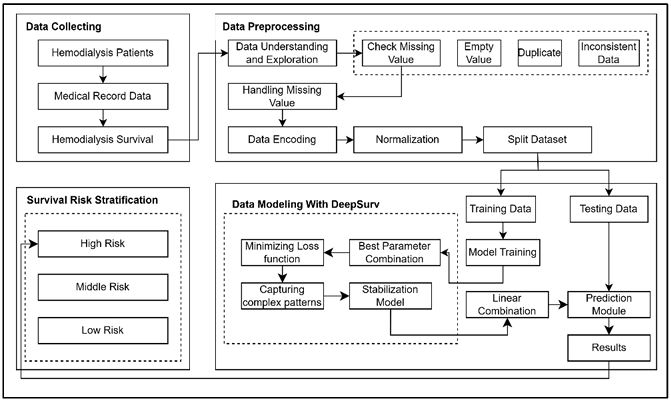
This study aims to improve survival prediction in patients with kidney failure undergoing hemodialysis, given their high mortality risk. Traditional models such as Cox Proportional Hazards (Cox PH) have limitations in capturing complex and nonlinear relationships in clinical data. Therefore, this study applies DeepSurv, a deep learning–based survival model, and compares its performance with Cox PH and Cox PH Spline. A total of 300 patients were included, with 165 events and 135 censored observations. The data were split into training and testing sets. DeepSurv was implemented using two hidden layers (64 and 32 neurons), a dropout rate of 0.2, and a learning rate of 1e-3. The model was trained for up to 1000 epochs with early stopping at epoch 435. Performance was evaluated using the concordance index (C-index) and time-dependent AUC at 365, 544, and 730 days. Patients were stratified into low-, medium-, and high-risk groups based on predicted scores. Results showed that Cox PH achieved a C-index of 0.913 and average AUC of 0.964, while Cox PH Spline reached 0.917 and 0.971. DeepSurv achieved a C-index of 0.920 and average AUC of 0.969. Performance differences were small, but DeepSurv provided consistent individual risk estimates. In conclusion, DeepSurv is a flexible approach with performance comparable to Cox-based models. Further external validation and clinical evaluation are needed before wider application
Downloads
References
[1] M. Muhajir and C. H. Imanina, “Survival analysis of chronic kidney disease patients using stratified cox regression in arifin achmad hospital, Pekanbaru, Riau,” Indian J. Public Health Res. Dev., vol. 9, no. 11, p. 1592, 2018, doi: 10.5958/0976-5506.2018.01673.X.
[2] A. Séraphin et al., “Survival and Predictors of Mortality in Hemodialysis Patients at the Departmental Teaching Hospital of Borgou and Alibori (Benin),” Int. J. Nephrol. Kidney Fail., vol. 11, no. 2, 2025, doi: 10.16966/2380-5498.254.
[3] T. Tourountzis et al., “Survival and Predictors of Mortality in Hemodialysis Patients,” Nephrology Dialysis Transplantation, vol. 38, no. Supplement_1, Jun. 2023, doi: 10.1093/ndt/gfad063c_4742.
[4] R. Laksana Aryananda, Trimono, W. Syaifullah J, and W. S. Wan Awang, “Hyperparameter optimization of XGBoost using artificial bee colony for predicting medical complications in hemodialysis patients,” Jurnal Ilmiah Kursor, vol. 13, no. 1, pp. 32–45, Jul. 2025, doi: 10.21107/kursor.v13i1.459.
[5] Y. Huang, J. Li, M. Li, and R. R. Aparasu, “Application of machine learning in predicting survival outcomes involving real-world data: a scoping review,” BMC Med. Res. Methodol., vol. 23, no. 1, p. 268, Nov. 2023, doi: 10.1186/s12874-023-02078-1.
[6] J. Lei et al., “The predictive value of modified-DeepSurv in overall survivals of patients with lung cancer,” iScience, vol. 26, no. 11, p. 108200, Nov. 2023, doi: 10.1016/j.isci.2023.108200.
[7] Y. ’Maulida, E. A. ’Desinaini, L. N. ’Utami, W. D. ’Yuliati, D. ’Farida, “Breast Cancer Survival Analysis Using Cox Proportional Hazard Regression and Kaplan Meier Method,” JTAM (Jurnal Teori dan Aplikasi Matematika), vol. 5, no. 2, pp. 340–358, Oct. 2021.
[8] M. Herrmann, P. Probst, R. Hornung, V. Jurinovic, and A.-L. Boulesteix, “Large-scale benchmark study of survival prediction methods using multi-omics data,” Mar. 2020, doi: 10.1093/bib/bbaa167.
[9] D. Chicco and G. Jurman, “Machine learning can predict survival of patients with heart failure from serum creatinine and ejection fraction alone,” BMC Med. Inform. Decis. Mak., vol. 20, no. 1, p. 16, Dec. 2020, doi: 10.1186/s12911-020-1023-5.
[10] A. R. Cuthbert, L. C. Giles, G. Glonek, L. M. Kalisch Ellett, and N. L. Pratt, “A comparison of survival models for prediction of eight-year revision risk following total knee and hip arthroplasty,” BMC Med. Res. Methodol., vol. 22, no. 1, p. 164, Jun. 2022, doi: 10.1186/s12874-022-01644-3.
[11] J. Katzman, U. Shaham, J. Bates, A. Cloninger, T. Jiang, and Y. Kluger, “DeepSurv: Personalized Treatment Recommender System Using A Cox Proportional Hazards Deep Neural Network,” Aug. 2017, doi: 10.1186/s12874-018-0482-1.
[12] N. Asghar et al., “Improved nonparametric survival prediction using CoxPH, Random Survival Forest & DeepHit Neural Network,” BMC Med. Inform. Decis. Mak., vol. 24, no. 1, p. 120, May 2024, doi: 10.1186/s12911-024-02525-z.
[13] P. Sankar and R. Bai V, “Survival Analysis on Relapse Predictions of Breast Cancer using Optimized ANN and Deepsurv Model,” in 2022 International Conference on Computing, Communication, Security and Intelligent Systems (IC3SIS), IEEE, Jun. 2022, pp. 1–6. doi: 10.1109/IC3SIS54991.2022.9885556.
[14] L. M.K., S. N. S. Acharya, A. Kamath, and D. R. Micheal, “Mortality Prediction of Surgical Intensive Care Unit Patients Using Deep Learning Based Survival Models ,” Malaysian Journal of Science, vol. 41, no. 3, pp. 44–48, Oct. 2022, doi: 10.22452/mjs.vol41no3.6.
[15] B. Yang et al., “Development and Validation of a DeepSurv Nomogram to Predict Survival Outcomes and Guide Personalized Adjuvant Chemotherapy in Non-Small Cell Lung Cancer,” Front. Oncol., vol. 12, Jun. 2022, doi: 10.3389/fonc.2022.895014.
[16] C. Cui, Y. Tang, and W. Zhang, “Deep Contrastive Survival Analysis with Dual-View Clustering,” Electronics (Basel)., vol. 13, no. 24, p. 4866, Dec. 2024, doi: 10.3390/electronics13244866.
[17] X. Yang, H. Qiu, L. Wang, and X. Wang, “Predicting Colorectal Cancer Survival Using Time-to-Event Machine Learning: Retrospective Cohort Study,” J. Med. Internet Res., vol. 25, p. e44417, Oct. 2023, doi: 10.2196/44417.
[18] Y. Liu, L. Xie, D. Wang, and K. Xia, “A deep learning algorithm with good prediction efficacy for cancer-specific survival in osteosarcoma: A retrospective study,” PLoS One, vol. 18, no. 9, p. e0286841, Sep. 2023, doi: 10.1371/journal.pone.0286841.
[19] C. Jiang, K. Wang, L. Yan, H. Yao, H. Shi, and R. Lin, “Predicting the survival of patients with pancreatic neuroendocrine neoplasms using deep learning: A study based on Surveillance, Epidemiology, and End Results database,” Cancer Med., vol. 12, no. 11, pp. 12413–12424, Jun. 2023, doi: 10.1002/cam4.5949.
[20] J. Zeng, D. Song, K. Li, F. Cao, and Y. Zheng, “Deep learning model for predicting postoperative survival of patients with gastric cancer,” Front. Oncol., vol. 14, Apr. 2024, doi: 10.3389/fonc.2024.1329983.
[21] N. Bice et al., “Deep learning‐based survival analysis for brain metastasis patients with the national cancer database,” J. Appl. Clin. Med. Phys., vol. 21, no. 9, pp. 187–192, Sep. 2020, doi: 10.1002/acm2.12995.
[22] J. Zeng, K. Li, F. Cao, and Y. Zheng, “Development and validation of survival prediction model for gastric adenocarcinoma patients using deep learning: A SEER-based study,” Front. Oncol., vol. 13, Mar. 2023, doi: 10.3389/fonc.2023.1131859.
[23] Z. Wang et al., “Survival modeling using deep learning, machine learning and statistical methods: A comparative analysis for predicting mortality after hospital admission,” Mar. 2024.
[24] T. G. Baidoo and H. Rodrigo, “Data-driven survival modeling for breast cancer prognostics: A comparative study with machine learning and traditional survival modeling methods,” PLoS One, vol. 20, no. 4, p. e0318167, Apr. 2025, doi: 10.1371/journal.pone.0318167.
[25] N. E. Alsubaie, F. El Guma, A. G. M. Musa, H. A. Abdali, M. Awadalla, and B. Alosaimi, “Comparative evaluation of Cox regression and machine learning approaches for survival prediction in stage IV lung cancer,” Discover Computing, vol. 29, no. 1, p. 102, Feb. 2026, doi: 10.1007/s10791-026-10014-2.
[26] Di Asih I Maruddani, Tarno, Abdul Hoyyi, Rita Rahmawati, and Yuciana Wilandari, Survival Analysis. Universitas Diponegoro, 2021.
[27] S. V. Deo, V. Deo, and V. Sundaram, “Survival analysis—part 2: Cox proportional hazards model,” Indian J. Thorac. Cardiovasc. Surg., vol. 37, no. 2, pp. 229–233, Mar. 2021, doi: 10.1007/s12055-020-01108-7.
[28] C. P. Obite, E. O. Chukwudi, M. Uchechukwu, and U. I. Nwosu, “Factor enhanced DeepSurv: A deep learning approach for predicting survival probabilities in cirrhosis data,” Comput. Biol. Med., vol. 189, p. 109963, May 2025, doi: 10.1016/j.compbiomed.2025.109963.
[29] E. Zhu et al., “Individualized Survival Prediction and Surgery Recommendation for Patients with Glioblastoma,” Front. Med. (Lausanne)., vol. 11, May 2024, doi: 10.3389/fmed.2024.1330907.
[30] N. Bozhbanbayeva et al., “DeepSurv: A machine learning model for predicting mortality in very-low-birth-weight infants treated in intensive care units,” Aug. 11, 2025. doi: 10.21203/rs.3.rs-7126001/v1.
[31] S. Malik et al., “A unified multi modal transformer framework for breast cancer recurrence prediction and survival analysis,” Sci. Rep., vol. 16, no. 1, p. 8334, Feb. 2026, doi: 10.1038/s41598-026-37046-4.
Downloads
Published
Issue
Section
License
Copyright (c) 2026 Rizki Amanda, Aviolla Terza Damaliana, Muhammad Idhom, Muhamad Liswansyah Pratama

This work is licensed under a Creative Commons Attribution-NonCommercial 4.0 International License.
Authors retain copyright and full publishing rights to their articles. Upon acceptance, authors grant Indonesian Journal of Data and Science a non-exclusive license to publish the work and to identify itself as the original publisher.
Self-archiving. Authors may deposit the submitted version, accepted manuscript, and version of record in institutional or subject repositories, with citation to the published article and a link to the version of record on the journal website.
Commercial permissions. Uses intended for commercial advantage or monetary compensation are not permitted under CC BY-NC 4.0. For permissions, contact the editorial office at ijodas.journal@gmail.com.
Legacy notice. Some earlier PDFs may display “Copyright © [Journal Name]” or only a CC BY-NC logo without the full license text. To ensure clarity, the authors maintain copyright, and all articles are distributed under CC BY-NC 4.0. Where any discrepancy exists, this policy and the article landing-page license statement prevail.