Applicant Data Segmentation and Pattern Analytics for University Admissions Strategy Using Hybrid SOM and K-Means
DOI:
https://doi.org/10.56705/ijodas.v7i2.388Keywords:
Davies-Bouldin Index, Data Mining, K-Means, Prediction, Segmentation, SOMAbstract
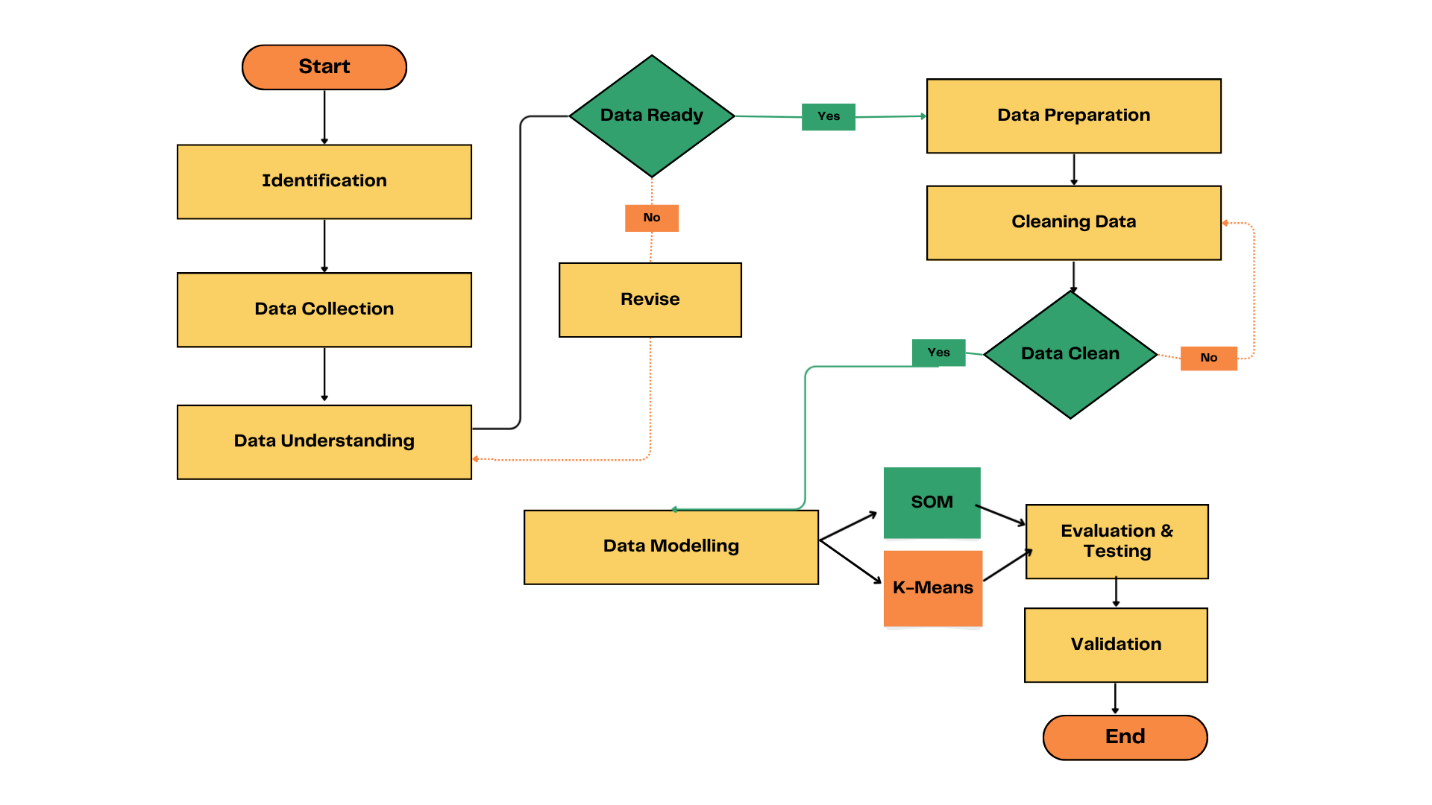
Introduction: Effective university admissions strategies require a clear understanding of applicant demographics, academic characteristics, geographic origins, and information channels. This study applies a hybrid clustering approach to identify meaningful applicant segments that can support targeted recruitment and resource allocation. Method: Historical applicant records from Universitas Sahid Surakarta covering 2021–2025 were preprocessed through data cleaning, one-hot encoding of categorical variables, and Min-Max normalization. A hybrid Self-Organizing Map (SOM) and K-Means framework was employed, where SOM projected high-dimensional applicant characteristics into a lower-dimensional topological representation and K-Means partitioned the resulting prototypes into distinct clusters. Clustering quality was evaluated using the Davies–Bouldin Index (DBI) to determine the optimal number of segments. Results and Discussion: The lowest DBI was obtained for three clusters, indicating the most appropriate segmentation structure. The resulting groups were characterized as proximity-driven local applicants, regional career-oriented applicants dominated by vocational-school backgrounds, and high-achieving out-of-region applicants with stronger academic performance and greater reliance on institutional websites and search channels. These patterns provide actionable insight for differentiated recruitment strategies. Conclusion: The hybrid SOM–K-Means approach effectively identifies interpretable applicant segments and provides descriptive intelligence that can support more targeted marketing, channel selection, scholarship strategies, and admissions resource allocation in higher education
Downloads
References
[1] W. Zhang and Z. Wu, “E-commerce recommender system based on improved K-means commodity information management model,” Heliyon, vol. 10, no. 9, p. e29045, 2024, doi: https://doi.org/10.1016/j.heliyon.2024.e29045.
[2] D. Feblian and D. U. Daihani, “Application of the Crisp-DM Method with the K-Means Clustering Algorithm for Student Segmentation Based on Academic Quality,” J. Teknol. Inform. dan Komput., vol. 6, no. 2, pp. 12–20, 2020, doi: https://doi.org/10.37012/jtik.v6i2.299.
[3] W. Leal Filho et al., “Sustainability practices at private universities: a state-of-the-art assessment,” Int. J. Sustain. Dev. World Ecol., vol. 28, no. 5, pp. 402–416, 2021, doi: https://doi.org/10.1080/13504509.2020.1848940.
[4] B. Ma et al., “Making the choice: University and program selection factors for undergraduate management education in Maritime Canada,” Int. J. Manag. Educ., vol. 14, no. 2, pp. 6214–6235, 2021, doi: https://doi.org/10.1016/j.ijme.2016.04.002.
[5] I. Muis, “The Role of Strategic Management in Enhancing University Performance in Indonesia : A SLR Approach,” IJAM Int. J. Adv. Multidiciplinary, vol. 4, no. 2, pp. 286–294, 2025.
[6] M. Ramaditya, M. S. Maarif, J. Affandi, and A. Sukmawati, “How Private University Navigates and Survive: Insights from Indonesia,” Mimb. J. Sos. dan Pembang., no. 10, pp. 122–131, 2022, doi: https://doi.org/10.29313/mimbar.v0i0.8784.
[7] W. A. Prastyabudi, A. N. Alifah, and A. Nurdin, “Segmenting the Higher Education Market: An Analysis of Admissions Data Using K-Means Clustering,” Procedia Comput. Sci., vol. 234, no. 2023, pp. 96–105, 2024, doi: https://doi.org/10.1016/j.procs.2024.02.156.
[8] C. Tilioui, E. M. Bellfkih, I. C. E. Idrissi, K. El Kababi, M. Radid, and G. Chemsi, “Predicting Middle School Students’ Academic Orientation Using SOM and Machine Learning,” Educ. Process Int. J., vol. 17, 2025, doi: https://doi.org/10.22521/edupij.2025.17.376.
[9] H. Yang, D. Ma, H. Chen, and Y. Zhu, “Analysis of power plant outage event results based on SOM clustering,” Results Eng., vol. 21, no. September 2023, p. 101995, 2024, doi: https://doi.org/10.1016/j.rineng.2024.101995.
[10] A. Nowak-Brzezinska and C. Horyn, “Self-Organizing Map algorithm as a tool for outlier detection,” Procedia Comput. Sci., vol. 207, no. Kes, pp. 6162–6171, 2022, doi: https://doi.org/10.1016/j.procs.2022.09.276.
[11] R. G. Santosa, Y. Lukito, and A. R. Chrismanto, “Classification and Prediction of Students’ GPA Using K-Means Clustering Algorithm to Assist Student Admission Process,” J. Inf. Syst. Eng. Bus. Intell., vol. 7, no. 1, p. 1, 2021, doi: https://doi.org/10.20473/jisebi.7.1.1-10.
[12] R. Vankayalapati, K. B. Ghutugade, R. Vannapuram, and B. P. S. Prasanna, “K-means algorithm for clustering of learners performance levels using machine learning techniques,” Rev. d’Intelligence Artif., vol. 35, no. 1, pp. 99–104, 2021, doi: https://doi.org/10.18280/ria.350112.
[13] E. Karypidis, S. G. Mouslech, K. Skoulariki, and A. Gazis, “Comparison Analysis of Traditional Machine Learning and Deep Learning Techniques for Data and Image Classification,” WSEAS Trans. Math., vol. 21, pp. 122–130, 2022, doi: https://doi.org/10.37394/23206.2022.21.19.
[14] S. Hasana and D. Fitrianah, “A Study on Enhanced Spatial Clustering Using Ensemble DBscan and UMAP to Map Fire Zone in Greater Jakarta, Indonesia,” J. Ris. Inform., vol. 5, no. 3, pp. 409–418, 2023, doi: https://doi.org/10.34288/jri.v5i3.557.
[15] O. Ramos Terrades, A. Berenguel, and D. Gil, “A Flexible Outlier Detector Based on a Topology Given by Graph Communities,” Big Data Res., vol. 29, p. 100332, 2022, doi: https://doi.org/10.1016/j.bdr.2022.100332.
[16] B. A. Hassan, N. B. Tayfor, A. A. Hassan, A. M. Ahmed, T. A. Rashid, and N. N. Abdalla, “From A-to-Z review of clustering validation indices,” Neurocomputing, vol. 601, p. 128198, 2024, doi: https://doi.org/10.1016/j.neucom.2024.128198.
[17] Ö. İlhan and T. Erçelebi Ayyıldız, Sofware Quality Prediction: An Investigation Based on Artificial Intelligence Techniques for Object-Oriented Applications, vol. 76, no. Icaiame. 2021. doi: https://doi.org/10.1007/978-3-030-79357-9_27.
[18] I. Dermawan, Admi Salma, Yenni Kurniawati, and Tessy Octavia Mukhti, “Implementation of the Self Organizing Maps (SOM) Method for Grouping Provinces in Indonesia Based on the Earthquake Disaster Impact,” UNP J. Stat. Data Sci., vol. 1, no. 4, pp. 337–343, 2023, doi: https://doi.org/10.24036/ujsds/vol1-iss4/83.
[19] D. A. Tarigan, “Optimization of the K-Means Clustering Algorithm Using Davies Bouldin Index in Iris Data Classification,” Media Online), vol. 4, no. 1, pp. 545–552, 2023, doi: https://doi.org/10.30865/klik.v4i1.964.
[20] A. Maulana Majid, U. K. UL Khairat, and A. Qaslim, “Identifikasi Kualitas Fisik Pada Biji Kopi Menggunakan Teknologi Pengolahan Citra Dengan Metode Neural Network,” J. Peqguruang Conf. Ser., vol. 4, no. 1, p. 12, 2022, doi: https://doi.org/10.35329/jp.v4i1.2612.
[21] M. B. - and D. B. B. -, “A Comprehensive Review of Cross-Validation Techniques in Machine Learning,” Int. J. Sci. Technol., vol. 16, no. 1, pp. 1–4, 2025, doi: https://doi.org/10.71097/ijsat.v16.i1.1305.
[22] A. F. Fuady, Dwiky Oldi Amsyah, Muhammad Farhan, Rusma Riansyah, and M. Dayyan Dhiyaul Haq, “Implementasi Algoritma Convolutional Neural Network (CNN) untuk Pengenalan dan Klasifikasi Buah Berdasarkan Citra Digital,” J. Publ. Ilmu Komput. dan Multimed., vol. 4, no. 2, pp. 148–159, 2025, doi: https://doi.org/10.55606/jupikom.v4i2.4116.
[23] Z. Zhu et al., “Seismic Facies Analysis Using the Multiattribute SOM-K-Means Clustering,” Comput. Intell. Neurosci., vol. 2022, 2022, doi: https://doi.org/10.1155/2022/1688233.
[24] M. Lucchini and D. Bussi, “Self-Organizing Map,” in Encyclopedia of Quality of Life and Well-Being Research, F. Maggino, Ed., Cham: Springer International Publishing, 2020, pp. 1–5. doi: https://doi.org/10.1007/978-3-319-69909-7_104673-1.
[25] A. Idrus, N. Tarihoran, U. Supriatna, A. Tohir, S. Suwarni, and R. Rahim, “Distance Analysis Measuring for Clustering using K-Means and Davies Bouldin Index Algorithm,” TEM J., vol. 11, no. 4, pp. 1871–1876, 2022, doi: https://doi.org/10.18421/TEM114-55.
Downloads
Published
Issue
Section
License
Copyright (c) 2026 Diyah Ruswanti, Dahlan Susilo

This work is licensed under a Creative Commons Attribution-NonCommercial 4.0 International License.
Authors retain copyright and full publishing rights to their articles. Upon acceptance, authors grant Indonesian Journal of Data and Science a non-exclusive license to publish the work and to identify itself as the original publisher.
Self-archiving. Authors may deposit the submitted version, accepted manuscript, and version of record in institutional or subject repositories, with citation to the published article and a link to the version of record on the journal website.
Commercial permissions. Uses intended for commercial advantage or monetary compensation are not permitted under CC BY-NC 4.0. For permissions, contact the editorial office at ijodas.journal@gmail.com.
Legacy notice. Some earlier PDFs may display “Copyright © [Journal Name]” or only a CC BY-NC logo without the full license text. To ensure clarity, the authors maintain copyright, and all articles are distributed under CC BY-NC 4.0. Where any discrepancy exists, this policy and the article landing-page license statement prevail.