Sales Forecasting Analysis Using Fuzzy Time Series and Simple Linear Regression Methods at Toko Ari
DOI:
https://doi.org/10.56705/ijodas.v6i3.368Keywords:
Sales Forecasting, Fuzzy Time Series, Simple Linear Regression , MAPE, Retail BusinessAbstract
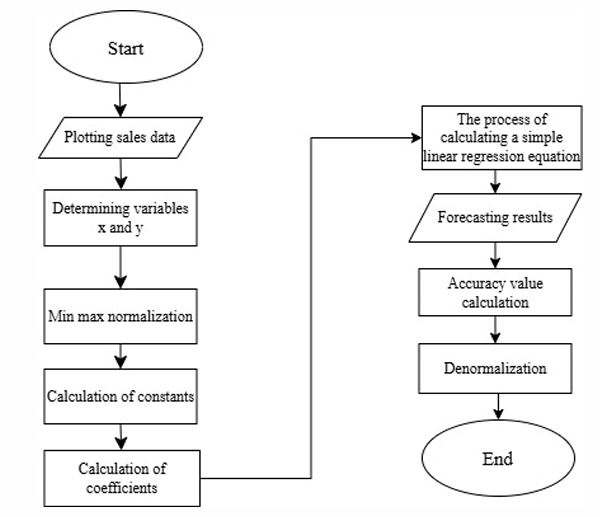
Introduction: Forecasting, often referred to as prediction, can actually help assess conditions or predict future sales. In the business world forecasting is crucial because it can help companies plan their future operations especially when faced with sudden increases and decreases in sales and stockpiles. Especially in retail forecasting is extremely helpful in purchasing merchandise, managing inventory in the warehouse, and reducing losses due to changing customer preferences. Ari's shop, located on Jalan Raya Samu, Singapadu Kaler, Gianyar, Bali, also experiences increases and decreases in monthly sales. Therefore, it is hoped that this sales forecasting can help maintain more stable and smooth operations. Methods: This study used two methods to forecast sales: Fuzzy Time Series (FTS) and Simple Linear Regression (SLR), to predict figures from Ari's shop's monthly sales data. Both methods use the same dataset, which is Ari's Store sales data for 13 months, from January 2024 to January 2025. The forecast results are then compared using the Mean Absolute Percentage Error (MAPE), which measures the model's accuracy in predicting results. Results: Based on the sales forecasts performed, both models produced fairly accurate predictions due to their low MAPE values, below 10%. Of the two methods, Simple Linear Regression provided more accurate results with a MAPE of 3.57%. Meanwhile, the Fuzzy Time Series method produced a MAPE of 5.53%. This difference in values indicates that the linear regression model is more appropriate for Ari's Store sales data, especially since the data pattern tends to follow a linear trend.
Downloads
References
[1] F. M. Putri, “Sales Forecasting Level of Embroidery and Needlework Products Using the Trend Moment
Method,” Jurnal Informatika Ekonomi Bisnis, vol. 4, pp. 34–38, 2022, doi: 10.37034/infeb.v4i2.122.
[2] A. Lusiana and P. Yuliarty, “APPLICATION OF FORECASTING METHODS ON ROOF DEMAND AT
PT X,” Industri Inovatif : Jurnal Teknik Industri, vol. 10, no. 1, pp. 11–20, 2020, doi:
10.36040/industri.v10i1.2530.
[3] M. Y. Fathoni and S. Wijayanto, “Forecasting LPG Gas Sales in Grocery Stores Using the Fuzzy Time Series
Method,” Jurnal JUPITER, vol. 13, no. 2, pp. 87–96, 2021, [Online]. Available:
https://www.academia.edu/download/91366556/489563665.pdf
[4] M. Mustopa, I. Junaedi, and A. Z. Sianipar, “Sales Information System and Stock Control of Building
Materials at Delima Building Materials Store,” Jurnal Manajamen Informatika Jayakarta, vol. 1, no. 2, p.
105, 2021, doi: 10.52362/jmijayakarta.v1i2.447.
[5] E. Aditya, “Sales Forecasting of Rice Sales Using Linear Regression Method to Determine Rice Inventory at
Uci Mart,” vol. 12, no. 1, pp. 75–84, 2024.
[6] Srilaksmi Maharani, “Sales Forecasting Analysis at CV. Sandang Jaya Gemilang Textile Using the Fuzzy
Time Series Method,” -, vol., no., p., 2024.
[7] Lovita Sari, “Analysis of Warung Mina Peguyangan's Revenue Forecasting Using the Simple Linear
Regression Method,” -, vol., no., p., 2023.
[8] A. Rianti, N. W. A. Majid, and A. Fauzi, “CRISP-DM: Data Science Project Methodology,” Prosiding
Seminar Nasional Teknologi …, pp. 107–114, 2023, [Online]. Available:
http://ojs.udb.ac.id/index.php/Senatib/article/view/3015
[9] [10] [11] [12] [13] [14] [15] [16] Indonesian Journal of Data and Science
B. G. Sudarsono, M. I. Leo, A. Santoso, and F. Hendrawan, “Netflix Data Mining Analysis Using Rapid Miner
Application,” JBASE - Journal of Business and Audit Information Systems, vol. 4, no. 1, pp. 13–21, 2021, doi:
10.30813/jbase.v4i1.2729.
I. Permana and F. N. S. Salisah, “The Effect of Data Normalization on the Performance of Backpropagation
Algorithm Classification Results,” Indonesian Journal of Informatic Research and Software Engineering
(IJIRSE), vol. 2, no. 1, pp. 67–72, 2022, doi: 10.57152/ijirse.v2i1.311.
F. S. Aritonang, I. M. Sarkis, and A. Situmorang, “Forecasting the Number of Vaccines Provided for Toddlers
Using the Trend Projection Method at the Toba Regency Health Office,” METHOSISFO : Jurnal Ilmiah
Sistem Informasi, vol. 2, no. 1, pp. 39–45, 2022, [Online]. Available: http://ojs.fikom-
methodist.net/index.php/METHOSISFO
E. Darnila, R. K. Dinata, and S. Ramadani, “Predicting Market Prices of Food Crop Commodities in North
Aceh During the Covid-19 Pandemic Using the Fuzzy Time Series Model Chen Method,” JTIK (Jurnal Teknik
Informatika Kaputama), vol. 7, no. 1, pp. 17–26, 2023, doi: 10.59697/jtik.v7i1.26.
V. Vivianti, M. Aidid, and M. Nusrang, “Implementation of Fuzzy Time Series Method for Quantity
Forecasting,” Journal of Statistics and Its Application on Teaching and Research, pp. 1–12, 2020.
W. Wahyudi, “Sales Forecasting Analysis of Aqua Gallon Filled Products to Determine Inventory (Case Study
at PT. Tirta Usaha Cianjur),” no. April, pp. 1–67, 2022, [Online]. Available:
http://eprints.unpak.ac.id/5714/%0Ahttp://eprints.unpak.ac.id/5714/1/2022 Widadi Wahyudi 021117082.pdf
W. Wijaya, “Faculty of Business, Buddhi Dharma University, Tangerang 2020,” Skripsi, p. 13, 2020.
R. A. Prasetyo, “Multiple Linear Regression Analysis to Examine Factors Influencing Poverty in West
Sumatra Province,” Journal of Mathematics UNP, vol. 7, no. 2, p. 62, 2022, doi:
10.24036/unpjomath.v7i2.12777
[17] [18] [19] [20] [21] [22] [23] [24] [25] Indonesian Journal of Data and Science
Fatawa Imam Al Muftin and Fendi Hidayat, “Sales Information System,” Zona Komputer: Program Studi
Sistem Informasi Universitas Batam, vol. 13, no. 3, pp. 232–237, 2024, doi: 10.37776/zkomp.v13i3.1461.
I. B. B. Mahayana, I. Mulyadi, and S. Soraya, “Helmet Sales Forecasting Using the ARIMA Method (Case
Study of Bagus Store)),” Inferensi, vol. 5, no. 1, p. 45, 2022, doi: 10.12962/j27213862.v5i1.12469.
W. B. Sebayang, “Adolescent Childbirth with Asphyxia Neonatorum,” Jurnal Aisyah : Jurnal Ilmu
Kesehatan, vol. 7, no. 2, pp. 669–672, 2022, doi: 10.30604/jika.v7i2.1507.
A. Triono, A. S. Budi, and R. Abdillah, “Implementation of Vigenère Chipper Cipher Cracking Using Python
Programming Language,” Jurnal JOCOTIS - Journal Science Informatika and Robotics, vol. 1, no. 1, pp. 1–
9, 2023, [Online]. Available: https://jurnal.ittc.web.id/index.php/jumri
N. Hudaningsih, S. Firda Utami, and W. A. Abdul Jabbar, “Comparison of Aknil Product Sales Forecasting
at PT. Sunthi Sepuri Using the Single Moving Average and Single Exponential Smoothing Methods” Jurnal
Informatika, Teknologi dan Sains, vol. 2, no. 1, pp. 15–22, 2020, doi: 10.51401/jinteks.v2i1.554.
M. Sofyan, R. Danni, F. Nurdiyansyah, and F. Marisa, “FORECASTING CHICKEN EGG SALES USING
THE ARIMA METHOD,” vol. 9, no. 3, pp. 3791–3796, 2025.
L. S. Memory, D. A. N. Gated, and R. Unit, “Forecasting the rupiah exchange rate against the US dollar using
the long short-term memory method and gated recurrent units 1,2,3,” vol. 14, pp. 13–22, 2025, doi:
10.14710/j.gauss.14.1.13-22.
Ines Saraswati Machfiroh and Cahaya Ayu Ramadhan, “Sales Forecasting of 220ml Cup Products Using the
Least Square Method at PT. Panen Embun Kemakmuran in 2022,” Jurnal MSA ( Matematika dan Statistika
serta Aplikasinya), vol. 10, no. 2, pp. 17–24, 2022, doi: 10.24252/msa.v10i2.27870.
R. Janah, A. Isro, A. Alfan, M. Nurul Alamin, and S. Sarwinda Mas Ayu, “Corn Harvest Forecasting in
Solokuro District Using the Trend Moment Method,” JurnalMatematika & Sains, vol. 1, no. 2, pp. 65–74,2021.
Downloads
Published
Issue
Section
License
Copyright (c) 2025 Ni Luh Sri April Yanti, Ni Wayan Jeri Kusuma Dewi, I Gede Made Yudi Antara, Desak Made Dwi Utami Putra, Putu Wirayudi Aditama

This work is licensed under a Creative Commons Attribution-NonCommercial 4.0 International License.
Authors retain copyright and full publishing rights to their articles. Upon acceptance, authors grant Indonesian Journal of Data and Science a non-exclusive license to publish the work and to identify itself as the original publisher.
Self-archiving. Authors may deposit the submitted version, accepted manuscript, and version of record in institutional or subject repositories, with citation to the published article and a link to the version of record on the journal website.
Commercial permissions. Uses intended for commercial advantage or monetary compensation are not permitted under CC BY-NC 4.0. For permissions, contact the editorial office at ijodas.journal@gmail.com.
Legacy notice. Some earlier PDFs may display “Copyright © [Journal Name]” or only a CC BY-NC logo without the full license text. To ensure clarity, the authors maintain copyright, and all articles are distributed under CC BY-NC 4.0. Where any discrepancy exists, this policy and the article landing-page license statement prevail.