Sentiment Analysis of BRImo Reviews on Google Play Store Using SVM and KNN
DOI:
https://doi.org/10.56705/ijodas.v6i3.365Keywords:
Sentiment Analysis, BRImo, Application Performance, Reviews Google Play Store, SVM, KNNAbstract
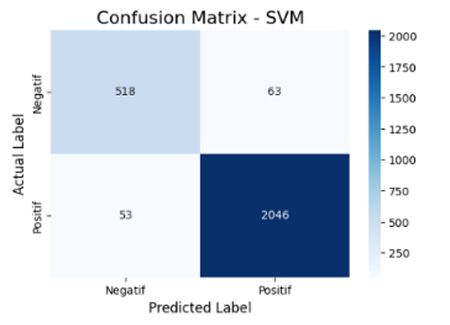
The rapid growth of digital banking has increased user interaction through mobile banking apps such as BRImo (Bank Rakyat Indonesia). Google Play Store reviews provide valuable insight into app quality, but their unstructured format makes manual analysis inefficient. This study analyzes user sentiment toward BRImo and compares the performance of Support Vector Machine (SVM) and K-Nearest Neighbors (KNN) for sentiment classification. Reviews were collected using Google Play Scraper from May 2024 to May 2025, yielding 15,945 raw reviews. After cleaning (removing duplicates, symbols, links, emojis) and language filtering, 15,233 valid reviews remained. Sentiment labels were generated using two lexicon-based methods: INSET and VADER. Using INSET, the data consisted of 6,238 positive, 4,987 negative, and 4,383 neutral reviews, producing 11,225 reviews for modeling. Using VADER, 10,496 positive, 2,903 negative, and 1,834 neutral reviews were obtained, totaling 13,399 reviews. Datasets were split into 80% training and 20% testing with stratified sampling. Features were extracted using TF-IDF unigrams. Classification was performed using linear SVM and KNN, with the optimal K=3 selected via Grid Search. Models were evaluated using 5-fold cross-validation, reporting mean accuracy, precision, recall, and F1-score (macro-average for INSET; weighted-average for VADER due to class imbalance). Results show SVM consistently outperforms KNN, achieving 98.36% mean accuracy and 98.34% mean F1-score on INSET, and 95.59% mean accuracy and 95.56% mean F1-score on VADER. Overall, BRImo user sentiment is predominantly positive, and findings can guide developers in improving app stability and quality
Downloads
References
[1] R. Ranjan, “The Evolution Of Digital Banking: Impacts On Traditional Financial Institutions International Journal Of Progressive Research In Engineering Management And Science (Ijprems) (Int Peer Reviewed The Evolution Of Digital Banking: Impacts On Traditional Financial Institutions,” Artic. Int. J. Progress. Res. Eng. Manag. Sci., vol. 04, no. 09, pp. 753–763, 2024.
[2] T. E. Sebayang, D. B. Hakim, T. Bakhtiar, and D. Indrawan, “What Accelerates the Choice of Mobile Banking for Digital Banks in Indonesia?,” J. Risk Financ. Manag., vol. 17, no. 1, 2024, doi: 10.3390/jrfm17010006.
[3] H. Yohanes Jefrinus Bessy, Yenny, “Communication Managerial Skill For Business Communication On Employee Relations Studies,” J. Ekon., vol. 13, no. 2, pp. 541–554, 2024, doi: 10.54209/ekonomi.v13i02.
[4] F. A. Willa Fatika Sari, Rida Rahim, “Sentiment Analysis Using Big Data User Reviews on Mobile Banking Performance in Indonesia,” IAR J. Bus. Manag., vol. 4, no. 3, pp. 27–35, 2023, doi: 10.47310/iarjbm.2023.v04i01.028.
[5] C. Yang, L. Wu, C. Yu, and Y. Zhou, “A phrase-level user requests mining approach in mobile application reviews: Concept, framework, and operation,” Inf., vol. 12, no. 5, pp. 1–24, 2021, doi: 10.3390/info12050177.
[6] Y. Mao, Q. Liu, and Y. Zhang, “Sentiment analysis methods, applications, and challenges: A systematic literature review,” J. King Saud Univ. - Comput. Inf. Sci., vol. 36, no. 4, p. 102048, 2024, doi: 10.1016/j.jksuci.2024.102048.
[7] N. Kaur, “Sentiment Analysis of E-Banking Customer Reviews Using Nlp,” ShodhKosh J. Vis. Perform. Arts, vol. 2, no. 2, pp. 458–465, 2021, doi: 10.29121/shodhkosh.v2.i2.2021.5743.
[8] E. Utama and E. Rudiawan Jamzuri, “Performance Comparison of Support Vector Machine (SVM) and k-Nearest Neighbors (kNN) in Verifying Material Orientation,” J. Appl. Comput. Sci. Technol., vol. 6, no. 1, pp. 17–22, 2025, doi: 10.52158/jacost.v6i1.1037.
[9] M. F. Ramadan, Martanto, A. R. Dikananda, and A. Rifa’i, “Comparison of Sentiment Analysis Models Enhanced by Naïve Bayes and Support Vector Machine Algorithms on Mobile Banking BRImo Reviews,” J. Artif. Intell. Eng. Appl., vol. 4, no. 2, pp. 677–686, 2025, doi: 10.59934/jaiea.v4i2.732.
[10] M. A. Palomino and F. Aider, “Evaluating-the-Effectiveness-of-Text-PreProcessing-in-Sentiment-AnalysisApplied-Sciences-Switzerland.pdf,” Mdpi, vol. 12, p. 8765, 2022.
[11] B. S. Ainapure et al., “Sentiment Analysis of COVID-19 Tweets Using Deep Learning and Lexicon-Based Approaches,” Sustain., vol. 15, no. 3, 2023, doi: 10.3390/su15032573.
[12] A. Arwan Sulaeman, M. Danny, S. Butsianto, and S. Pratama, “Sentiment Analysis on Social Media X (Twitter) Against ChatGBT Using the K-Nearest Neighbors Algorithm,” Brill. Res. Artif. Intell., vol. 4, no. 1, pp. 265–275, 2024, doi: 10.47709/brilliance.v4i1.4105.
[13] A. H. Sweidan, N. El-Bendary, and H. Al-Feel, “Sentence-Level Aspect-Based Sentiment Analysis for Classifying Adverse Drug Reactions (ADRs) Using Hybrid Ontology-XLNet Transfer Learning,” IEEE Access, vol. 9, pp. 90828–90846, 2021, doi: 10.1109/ACCESS.2021.3091394.
[14] S. Nazir, M. Asif, M. Rehman, and S. Ahmad, “Machine learning based framework for fine-grained word segmentation and enhanced text normalization for low resourced language,” PeerJ Comput. Sci., vol. 10, no. 1, pp. 1–19, 2024, doi: 10.7717/peerj-cs.1704.
[15] D. Fatharani, E. Syahrul, and U. Gunadarma, “hybrid sentiment analysis of maxim app users using support vector machine and lexicon-,” vol. 13, no. 3.
[16] Rianto, A. B. Mutiara, E. P. Wibowo, and P. I. Santosa, “Improving the accuracy of text classification using stemming method, a case of non-formal Indonesian conversation,” J. Big Data, vol. 8, no. 1, pp. 1–16, 2021, doi: 10.1186/s40537-021-00413-1.
[17] R. Firdaus, I. Asror, and A. Herdiani, “Lexicon-Based Sentiment Analysis of Indonesian Language Student Feedback Evaluation,” Indones. J. Comput., vol. 6, no. 1, pp. 1–12, 2021, doi: 10.34818/indojc.2021.6.1.408.
[18] V. Bonta, N. Kumaresh, and N. Janardhan, “A Comprehensive Study on Lexicon Based Approaches for Sentiment Analysis,” Asian J. Comput. Sci. Technol., vol. 8, no. S2, pp. 1–6, 2019, doi: 10.51983/ajcst-2019.8.s2.2037.
[19] E. Elinda, H. Yuliansyah, and M. I. A. Latiffi, “Sentiment Analysis of the Sheikh Zayed Grand Mosque’s Visitor Reviews on Google Maps Using the VADER Method,” Int. J. Adv. Data Inf. Syst., vol. 5, no. 1, pp. 71–84, 2024, doi: 10.59395/ijadis.v5i1.1320.
[20] A. Saoualih et al., “Exploring the Tourist Experience of the Majorelle Garden Using VADER-Based Sentiment Analysis and the Latent Dirichlet Allocation Algorithm: The Case of TripAdvisor Reviews,” Sustain., vol. 16, no. 15, 2024, doi: 10.3390/su16156378.
[21] A. Febriani, Khotibul Umam, and Mokhammad Iklil Mustofa, “Implementation of Support Vector Machine for Classifying User Reviews on the Sentuh Tanahku Application,” J. Appl. Informatics Comput., vol. 9, no. 4, pp. 1551–1558, 2025, doi: 10.30871/jaic.v9i4.9832.
[22] R. Obiedat et al., “Sentiment Analysis of Customers’ Reviews Using a Hybrid Evolutionary SVM-Based Approach in an Imbalanced Data Distribution,” IEEE Access, vol. 10, pp. 22260–22273, 2022, doi: 10.1109/ACCESS.2022.3149482.
[23] R. K. Halder, M. N. Uddin, M. A. Uddin, S. Aryal, and A. Khraisat, “Enhancing K-nearest neighbor algorithm: a comprehensive review and performance analysis of modifications,” J. Big Data, vol. 11, no. 1, 2024, doi: 10.1186/s40537-024-00973-y.
[24] H. Zhang, H. Niu, Z. Ma, and S. Zhang, “Wind Turbine Condition Monitoring Based on Bagging Ensemble Strategy and KNN Algorithm,” IEEE Access, vol. 10, no. April, pp. 93412–93420, 2022, doi: 10.1109/ACCESS.2022.3164717.
[25] R. Setiyawan and Z. Mustofa, “Comparison of the performance of naive bayes and support vector machine in sirekap sentiment analysis with the lexicon-based approach,” J. Soft Comput. Explor., vol. 5, no. 2, pp. 122–132, 2024, doi: 10.52465/joscex.v5i2.367.
[26] L. Li, L. Yang, and Y. Zeng, “Improving sentiment classification of restaurant reviews with attention-based bi-gru neural network,” Symmetry (Basel)., vol. 13, no. 8, 2021, doi: 10.3390/sym13081517.
[27] Heti Aprilianti, Khothibul Umam, and Maya Rini Handayani, “Comparative Study of SVM, KNN, and Naïve Bayes for Sentiment Analysis of Religious Application Reviews,” J. Appl. Informatics Comput., vol. 9, no. 3, pp. 920–927, 2025, doi: 10.30871/jaic.v9i3.9482.
[28] A. Ichwani and R. Gantino, “Sentiment Analysis of Marketplace Application Reviews Using Support Vector Machine ( SVM ) and K-Nearest Neighbors ( KNN ),” vol. 8, no. 2, 2025.
[29] T. K. Deo, R. K. Deshmukh, and G. Sharma, “Comparative Study of Performance of K Nearest Neighbor and Support Vector Machine Classifiers in Sentiment Analysis,” Int. Res. J. Eng. Technol., vol. 11, no. 2, pp. 501–506, 2024.
[30] M. K. Anam, T. A. Fitri, A. Agustin, L. Lusiana, M. B. Firdaus, and A. T. Nurhuda, “Sentiment Analysis for Online Learning using The Lexicon-Based Method and The Support Vector Machine Algorithm,” Ilk. J. Ilm., vol. 15, no. 2, pp. 290–302, 2023, doi: 10.33096/ilkom.v15i2.1590.290-302.
[31] V. Nurcahyawati and Z. Mustaffa, “Vader Lexicon and Support Vector Machine Algorithm to Detect Customer Sentiment Orientation,” J. Inf. Syst. Eng. Bus. Intell., vol. 9, no. 1, pp. 108–118, 2023, doi: 10.20473/jisebi.9.1.108-118.
Downloads
Published
Issue
Section
License
Copyright (c) 2025 Olivia Sutriani Jelni, Made Leo Radhitya, Gede Wirya Wardhana, Dewi, Ni Made Mila Rosa Desmayani

This work is licensed under a Creative Commons Attribution-NonCommercial 4.0 International License.
Authors retain copyright and full publishing rights to their articles. Upon acceptance, authors grant Indonesian Journal of Data and Science a non-exclusive license to publish the work and to identify itself as the original publisher.
Self-archiving. Authors may deposit the submitted version, accepted manuscript, and version of record in institutional or subject repositories, with citation to the published article and a link to the version of record on the journal website.
Commercial permissions. Uses intended for commercial advantage or monetary compensation are not permitted under CC BY-NC 4.0. For permissions, contact the editorial office at ijodas.journal@gmail.com.
Legacy notice. Some earlier PDFs may display “Copyright © [Journal Name]” or only a CC BY-NC logo without the full license text. To ensure clarity, the authors maintain copyright, and all articles are distributed under CC BY-NC 4.0. Where any discrepancy exists, this policy and the article landing-page license statement prevail.