Chatbot Interaksi Rumah Sakit menggunakan FFNN
DOI:
https://doi.org/10.56705/ijodas.v3i1.36Keywords:
Teknologi, Chatbot, Komunikasi, Informasi, Feedforward Neural NetworkAbstract
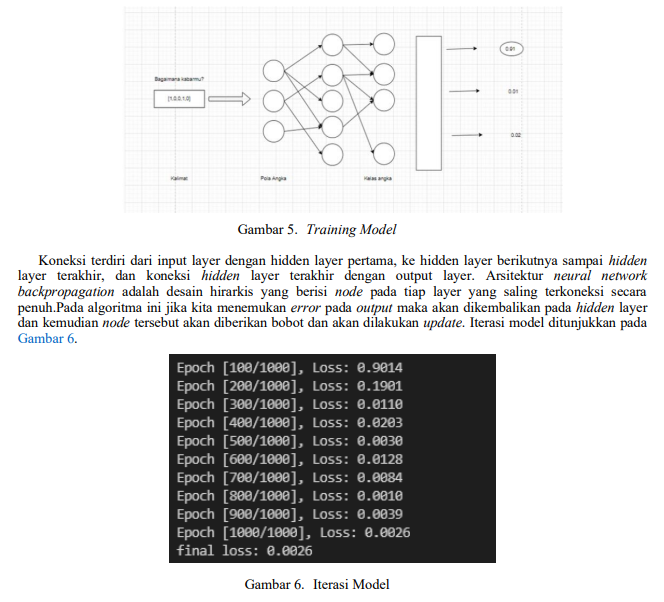
Perkembangan teknologi informasi yang pesat belakangan ini telah memasuki hampir semua kehidupan, hal ini ditandai dengan banyaknya pengguna komputer, baik untuk kepentingan perusahaan atau bisnis hingga hal-hal yang bersifat, hiburan, pendidikan, dan kesehatan. Permintaan layanan informasi dilakukan dalam jumlah yang banyak tentu akan menjadi sebuah masalah.maka banyak diterapkan bantuan asisten virtual atau biasa disebut dengan chatbot. Chatbot merupakan aplikasi asisten virtual yang mampu melakukan interaksi secara langsung kepada setiap pesan yang masuk tanpa perlu menunggu operator untuk membalas pesan-pesan tersebut, sehingga chatbot merupakan solusi yang dinilai efektif untuk menangani permasalahan.Dan Dengan menggunakan teknik FNN atau Feed forward neural network yang banyak digunakan untuk pemodelan data respon yang bersifat kategori dan dipengaruhi oleh jumlah unit neuron pada hidden layer, yang memungkinkan error yang di dapat lebih kecil.
Downloads
References
S. Roller et al., “Recipes for building an open-domain chatbot,” arXiv Comput. Lang., 2020, doi: 10.18653/v1/2021.eacl-main.24.
D. Adiwardana et al., “Towards a Human-like Open-Domain Chatbot,” arXiv Comput. Lang., 2020, doi: null.
A. P. Chaves, A. P. Chaves, A. P. Chaves, A. P. Chaves, and M. A. Gerosa, “How should my chatbot interact? A survey on human-chatbot interaction design.,” arXiv Human-Computer Interact., 2019, doi: 10.1080/10447318.2020.1841438.
G. Battineni, N. Chintalapudi, F. Amenta, F. Amenta, and F. Amenta, “AI Chatbot Design during an Epidemic Like the Novel Coronavirus.,” Healthcare, 2020, doi: 10.3390/healthcare8020154.
S. Hauser-Ulrich, H. Künzli, H. Künzli, D. Meier-Peterhans, and T. Kowatsch, “A Smartphone-Based Health Care Chatbot to Promote Self-Management of Chronic Pain (SELMA): Pilot Randomized Controlled Trial,” Jmir mhealth uhealth, 2019, doi: 10.2196/15806.
X. Luo et al., “Frontiers: Machines vs. Humans: The Impact of Artificial Intelligence Chatbot Disclosure on Customer Purchases,” Mark. Sci., 2019, doi: 10.1287/mksc.2019.1192.
Y.-C. Lee, N. Yamashita, N. Yamashita, Y. Huang, and W. Fu, “‘I Hear You, I Feel You’: Encouraging Deep Self-disclosure through a Chatbot,” CHI, 2020, doi: 10.1145/3313831.3376175.
M. Ashfaq, J. Yun, S. Yu, S. Yu, S. Yu, and S. Loureiro, “I, Chatbot: Modeling the determinants of users’ satisfaction and continuance intention of AI-powered service agents,” Telemat. Informatics, 2020, doi: 10.1016/j.tele.2020.101473.
T. Araujo, “Living up to the chatbot hype: The influence of anthropomorphic design cues and communicative agency framing on conversational agent and company perceptions,” Comput. Human Behav., 2018, doi: 10.1016/j.chb.2018.03.051.
L. Zhou, J. Gao, D. Li, and H.-Y. Shum, “The Design and Implementation of XiaoIce, an Empathetic Social Chatbot,” Comput. Linguist., 2020, doi: 10.1162/coli_a_00368.
S. Bao et al., “PLATO-2: Towards Building an Open-Domain Chatbot via Curriculum Learning,” FINDINGS, 2020, doi: 10.18653/v1/2021.findings-acl.222.
M. Chung, E. Ko, H. Joung, and S. J. Kim, “Chatbot e-service and customer satisfaction regarding luxury brands,” J. Bus. Res., 2018, doi: 10.1016/j.jbusres.2018.10.004.
K. Denecke, S. Vaaheesan, S. Vaaheesan, A. Arulnathan, and A. Arulnathan, “A Mental Health Chatbot for Regulating Emotions (SERMO) - Concept and Usability Test,” IEEE Trans. Emerg. Top. Comput., 2020, doi: 10.1109/tetc.2020.2974478.
Z. Lin et al., “XPersona: Evaluating Multilingual Personalized Chatbot.,” arXiv Comput. Lang., 2020, doi: 10.18653/v1/2021.nlp4convai-1.10.
A. Purwarianti, A. Andhika, A. F. Wicaksono, I. Afif, and F. Ferdian, “InaNLP: Indonesia natural language processing toolkit, case study: Complaint tweet classification,” 4th IGNITE Conf. 2016 Int. Conf. Adv. Informatics Concepts, Theory Appl. ICAICTA 2016, pp. 5–9, 2016, doi: 10.1109/ICAICTA.2016.7803103.
Published
Issue
Section
License
Authors retain copyright and full publishing rights to their articles. Upon acceptance, authors grant Indonesian Journal of Data and Science a non-exclusive license to publish the work and to identify itself as the original publisher.
Self-archiving. Authors may deposit the submitted version, accepted manuscript, and version of record in institutional or subject repositories, with citation to the published article and a link to the version of record on the journal website.
Commercial permissions. Uses intended for commercial advantage or monetary compensation are not permitted under CC BY-NC 4.0. For permissions, contact the editorial office at ijodas.journal@gmail.com.
Legacy notice. Some earlier PDFs may display “Copyright © [Journal Name]” or only a CC BY-NC logo without the full license text. To ensure clarity, the authors maintain copyright, and all articles are distributed under CC BY-NC 4.0. Where any discrepancy exists, this policy and the article landing-page license statement prevail.