Comparison of ResNet50 and ResNet101 Feature Extraction for Tea Leaf Disease Classification Using Support Vector Machine
DOI:
https://doi.org/10.56705/ijodas.v7i2.338Keywords:
Tea Leaf Disease, ResNet50, ResNet101, SVM, Deep LearningAbstract
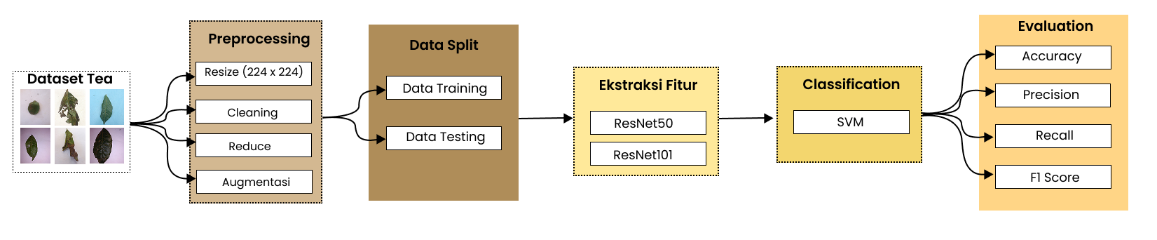
Introduction: Tea leaf diseases can substantially reduce crop quality and productivity, making early and accurate diagnosis important for effective disease management. This study compares ResNet50 and ResNet101 as pretrained deep feature extractors combined with Support Vector Machine (SVM) to determine whether a deeper residual architecture can improve discrimination among visually similar tea leaf disease classes. Method: Images were obtained from the Kaggle “Identifying Disease in Tea Leaves” dataset comprising eight classes. Data augmentation increased each class to 800 images, yielding 6,400 images that were divided into training and testing sets using an 80:20 ratio. ResNet50 and ResNet101 pretrained on ImageNet were used as fixed feature extractors, and the resulting feature vectors were standardized and classified using an RBF-kernel SVM. Results and Discussion: ResNet101–SVM achieved the best performance with 97.97% accuracy and precision, recall, and F1-score of 98%, substantially outperforming ResNet50–SVM, which achieved 89.15% accuracy, 90% precision, 89% recall, and 89% F1-score. The deeper ResNet101 architecture provided more discriminative representations for visually similar disease patterns, although a small number of misclassifications remained. Conclusion: ResNet101 combined with SVM provides a more accurate and reliable framework than ResNet50–SVM for multi-class tea leaf disease classification and offers a promising foundation for automated disease diagnosis systems.
Downloads
References
[1] D. K. and M. F. F. Mintarsih, “Comparative Analysis of Data Augmentation Techniques on MobileNetV2 Performance in Tea Leaf Disease Classification,” in 12th International Conference on Cyber and IT Service Management (CITSM), 2024, pp. 1–5, doi: https://doi.org/10.1109/CITSM64103.2024.10775557.
[2] N. IBRAHIM et al., “Klasifikasi Tingkat Kematangan Pucuk Daun Teh menggunakan Metode Convolutional Neural Network,” ELKOMIKA J. Tek. Energi Elektr. Tek. Telekomun. Tek. Elektron., vol. 10, no. 1, p. 162, 2022, doi: https://doi.org/10.26760/elkomika.v10i1.162.
[3] N. Hardi, “Komparasi Algoritma MobileNet Dan Nasnet Mobile Pada Klasifikasi Penyakit Daun Teh,” Reputasi J. Rekayasa Perangkat Lunak, vol. 3, no. 1, pp. 50–55, 2022, doi: https://doi.org/10.31294/reputasi.v3i1.1313.
[4] Mustikasari, A. R. Ramli, and A. K. Gibran, “Analisis Kinerja Algoritma Machine Learning Untuk Deteksi Penyakit Daun Teh Dengan Particle Swarm Optimization,” J. Embed. Syst. Secur. Intell. Syst., vol. 4, no. November, pp. 97–106, 2023, doi: https://doi.org/10.59562/jessi.v4i2.708.
[5] M. M. Azizah LN, Istiqomah IN, “Pemanfaatan teh sebagai hasil pertanian untuk pencegahan penyakit kronis pada masyarakat di wilayah Gunung Gambir Jember.,” in Prosiding Seminar Nasional Pengabdian Kepada Masyarakat: Peduli Masyarakat, 2022, pp. 151–154.
[6] S. Salni, J. Juswardi, E. Junaidi, M. Kamal, and S. Triwardana, “Pelatihan Pembuatan Teh Herbal Dan Jamu Dari Daun Kardia (Bellucia Pentamera) Dalam Upaya Pencegahan Penyakit Degeneratif,” J. Altifani Penelit. dan Pengabdi. Kpd. Masy., vol. 4, no. 2, pp. 114–121, 2024, doi: https://doi.org/10.59395/altifani.v4i2.527.
[7] D. Gaffar, A. W. M., Azmi, N., Alwi, E. I., Abdullah, S. M., Adawiyah, R., & Widyawati, “Optimizing Brain Tumor Classification with ResNet-50 Feature Extraction and Machine Learning Algorithms,” 2025, pp. 1–7, doi: https://doi.org/10.1109/IMCOM64595.2025.10857486.
[8] Faiz Nashrullah, Suryo Adhi Wibowo, and Gelar Budiman, “The Investigation of Epoch Parameters in ResNet-50 Architecture for Pornographic Classification,” J. Comput. Electron. Telecommun., vol. 1, no. 1, pp. 1–8, 2020, doi: https://doi.org/10.52435/complete.v1i1.51.
[9] C. L. Lin and K. C. Wu, “Development of revised ResNet-50 for diabetic retinopathy detection,” BMC Bioinformatics, vol. 24, no. 1, pp. 1–18, 2023, doi: https://doi.org/10.1186/s12859-023-05293-1.
[10] H. Darwis, R. Puspitasari, Purnawansyah, W. Astuti, D. Atmajaya, and M. Hasnawi, “A Deep Learning Approach for Improving Waste Classification Accuracy with ResNet50 Feature Extraction,” Proc. 2025 19th Int. Conf. Ubiquitous Inf. Manag. Commun. IMCOM 2025, 2025, doi: https://doi.org/10.1109/IMCOM64595.2025.10857536.
[11] N. Hanun, M. Sarosa, and R. Andrie Asmara, “Pemanfaatan Algoritma Faster R-CNN ResNet-101 Untuk Deteksi Potongan Tubuh Manusia,” J. Elektron. dan Otomasi Ind., vol. 10, no. 1, pp. 94–103, 2023, doi: https://doi.org/10.33795/elkolind.v10i1.2754.
[12] G. W. Wicaksono and Andreawan, “ResNet101 Model Performance Enhancement in Classifying Rice Diseases with Leaf Images,” J. RESTI, vol. 7, no. 2, pp. 345–352, 2023, doi: https://doi.org/10.29207/resti.v7i2.4575.
[13] Ulfah Nur Oktaviana, Ricky Hendrawan, Alfian Dwi Khoirul Annas, and Galih Wasis Wicaksono, “Klasifikasi Penyakit Padi berdasarkan Citra Daun Menggunakan Model Terlatih Resnet101,” J. RESTI (Rekayasa Sist. dan Teknol. Informasi), vol. 5, no. 6, pp. 1216–1222, 2021, doi: https://doi.org/10.29207/resti.v5i6.3607.
[14] S. Rabbani, D. Safitri, N. Rahmadhani, A. A. F. Sani, and M. K. Anam, “Perbandingan Evaluasi Kernel SVM untuk Klasifikasi Sentimen dalam Analisis Kenaikan Harga BBM,” MALCOM Indones. J. Mach. Learn. Comput. Sci., vol. 3, no. 2, pp. 153–160, 2023, doi: https://doi.org/10.57152/malcom.v3i2.897.
[15] A. Zalvadila, “Klasifikasi Penyakit Tanaman Bawang Merah Menggunakan Metode SVM dan CNN,” J. Inform. J. Pengemb. IT, vol. 8, no. 3, pp. 255–260, 2023, doi: https://doi.org/10.30591/jpit.v8i3.5341.
[16] S. Begum, E. Naresh, and N. N. Srinidhi, “A hybrid deep learning model for robust and efficient plant leaf disease detection using ResNet50, PCA, and SVM,” Sci. Rep., vol. 16, art. no. 15805, 2026, doi: https://doi.org/10.1038/s41598-026-46085-w.
[17] A. Usha Ruby, J. George Chellin Chandran, B. N. Chaithanya, et al., “Wheat leaf disease classification using modified ResNet50 convolutional neural network model,” Multimed. Tools Appl., vol. 83, pp. 62875–62893, 2024, doi: https://doi.org/10.1007/s11042-023-18049-z.
[18] P. K. Sethy, L. Korada, S. K. Behera, A. Shirole, R. Amat, and A. Nanthaamornphong, “Maximizing steel slice defect detection: Integrating ResNet101 deep features with SVM via Bayesian optimization,” Syst. Soft Comput., vol. 6, p. 200170, 2024, doi: https://doi.org/10.1016/j.sasc.2024.200170.
[19] J. Sharma, A. A. Al-Huqail, A. Almogren, H. Doshi, B. Jayaprakash, B. Bharathi, A. Ur Rehman, and S. Hussen, “Deep learning based ensemble model for accurate tomato leaf disease classification by leveraging ResNet50 and MobileNetV2 architectures,” Sci. Rep., vol. 15, no. 1, p. 13904, 2025, doi: https://doi.org/10.1038/s41598-025-98015-x.
[20] S. A. Preanto, M. T. Ahad, Y. R. Emon, S. Mustofa, and M. Alamin, “A study on deep feature extraction to detect and classify Acute Lymphoblastic Leukemia (ALL),”, 2024.
[21] K. Kalita, K. Medhi, S. K. Borah, A. Deka, and S. Baruah, “Multi class tea leaf disease classification using feature level and output level ensemble strategies with Grad-CAM visualization,” Plant Sci. Today, vol. 13, no. 1, 2026, doi: https://doi.org/10.14719/pst.11513.
[22] M. Bhagat and D. Kumar, “Kernelized SVM with deep learning features for tea leaf disease prediction,” Multimed. Tools Appl., vol. 83, no. 13, pp. 39117–39134, 2024, doi: https://doi.org/10.1007/s11042-023-17172-1.
[23] P. Bhuyan, P. K. Singh, and S. K. Das, “Res4net-CBAM: a deep CNN with convolution block attention module for tea leaf disease diagnosis,” Multimed. Tools Appl., vol. 83, pp. 48925–48947, 2024, doi: https://doi.org/10.1007/s11042-023-17472-6.
[24] Q. Heng, S. Yu, and Y. Zhang, “A new AI-based approach for automatic identification of tea leaf disease using deep neural network based on hybrid pooling,” Heliyon, vol. 10, no. 5, p. e26465, 2024, doi: https://doi.org/10.1016/j.heliyon.2024.e26465.
[25] M. J. A. Soeb et al., “Tea leaf disease detection and identification based on YOLOv7,” Sci. Rep., vol. 13, p. 6078, 2023, doi: https://doi.org/10.1038/s41598-023-33270-4.
Downloads
Published
Issue
Section
License
Copyright (c) 2026 Wistiani Astuti, Erick Irawadi Alwi , Farniwati Fattah, Tasrif Hasanuddin, Julisa, Ulfa Sari, Ainur Rahma Almagfirah

This work is licensed under a Creative Commons Attribution-NonCommercial 4.0 International License.
Authors retain copyright and full publishing rights to their articles. Upon acceptance, authors grant Indonesian Journal of Data and Science a non-exclusive license to publish the work and to identify itself as the original publisher.
Self-archiving. Authors may deposit the submitted version, accepted manuscript, and version of record in institutional or subject repositories, with citation to the published article and a link to the version of record on the journal website.
Commercial permissions. Uses intended for commercial advantage or monetary compensation are not permitted under CC BY-NC 4.0. For permissions, contact the editorial office at ijodas.journal@gmail.com.
Legacy notice. Some earlier PDFs may display “Copyright © [Journal Name]” or only a CC BY-NC logo without the full license text. To ensure clarity, the authors maintain copyright, and all articles are distributed under CC BY-NC 4.0. Where any discrepancy exists, this policy and the article landing-page license statement prevail.