Integrating Clustering Models and RCA to Identify Emerging Textile Export Destinations for Indonesia
DOI:
https://doi.org/10.56705/ijodas.v6i3.337Keywords:
Clustering, RCA, International Market Segmentation, Textile, ExportAbstract
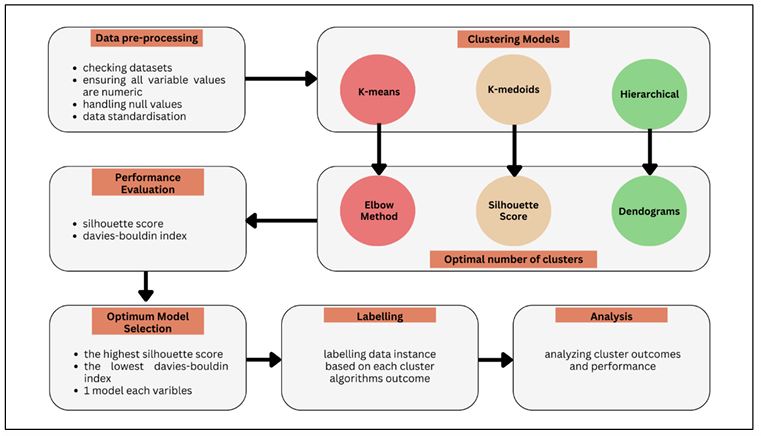
This research investigates the strategic identification of new export destinations for Indonesian textile products by integrating international market segmentation and product competitiveness analysis. The study employs clustering techniques (K-Means, K-Medoids, and Hierarchical) validated through Silhouette and Davies-Bouldin indices to classify 149 countries based on trade indicators (import growth, trade balance, global market share), economic indicators (population, purchasing power parity, industrial proportion to GDP), and trade barrier indicators (logistics performance index, geographic distance, free trade agreements). Complementarily, the Revealed Comparative Advantage (RCA) framework is applied to evaluate Indonesia’s product-level competitiveness in the global textile market. The results reveal that export opportunities are can be concentrated in 20 countries across Europe, Asia, Africa, the Caribbean, and Melanesia, characterized by positive import growth, significant trade deficits, large market capacities, and relatively low trade barriers. Moreover, Indonesia demonstrates high comparative advantages in artificial and synthetic fibbers, wigs, and leather footwear, while apparel products such as suits, shirts, knitwear, and brassieres represent moderately competitive but globally demanded items. The study concludes that Indonesia’s export strategy should balance high purchasing power markets and emerging economies with high import dependency.
Downloads
References
[1] N. E. Ratnasari, W. S. Sumadinata, and E. Susanti, “Revive Textile and Product Textile Industry Performance Through Improved Implementation of Key Spatial Utilization Program Policies,” Perspektif, vol. 13, no. 2, pp. 571–588, 2024, doi: 10.31289/perspektif.v13i2.10768.
[2] Badan Pusat Statistik, “[Seri 2010] PDB Menurut Lapangan Usaha Seri 2010 (Milyar Rupiah), 2020 - 2024.”
[3] United Nations Statistical Division (UN Comtrade), “Country Trade by Product,” The Growth Lab, Harvard Kennedy School.
[4] United Nations Statistical Division (UN Comtrade), “List of products at 4 digits level exported by Indonesia in 2024,” Trade Map International Trade Centre.
[5] A. Rifa’i, “The impact of import tariff protectionism on Indonesia textile industry: GTAP model,” J. Text. Inst., vol. 0, no. 0, pp. 1–13, 2025, doi: 10.1080/00405000.2025.2480240.
[6] Badan Pusat Statistik, “Keadaan Angkatan Kerja Di Indonesia Agustus 2024,” 2024.
[7] I. N. Jelita, “Hampir 1 Juta Pekerja Indonesia Terkena PHK, Industri Tekstil Paling Banyak,” MetroTV News.
[8] F. J. Contractor, “Assessing the economic impact of tariffs: adaptations by multinationals and traders to mitigate tariffs,” Rev. Int. Bus. Strateg., vol. 35, no. 2–3, pp. 190–213, 2025, doi: 10.1108/RIBS-01-2025-0013.
[9] Muhlisah Lubis and Balakrishnan Muniapan, “International Market Development Strategies for Enhancing Global Expansion in the Export Industry,” Involv. Int. J. Bus., vol. 1, no. 1, pp. 14–28, 2024, doi: 10.62569/iijb.v1i1.3.
[10] M. Muchtar, H. Asy’ari, A. Rodoni, E. Amalia, and M. N. Hosen, “Does a Free Trade Agreement’s Impact on the Export of Halal Food to OIC Countries Matter? Evidence from Indonesia,” Etikonomi, vol. 23, no. 1, pp. 147–166, 2024, doi: 10.15408/etk.v23i1.32951.
[11] D. J. P. P. Internasional, “Free Trade Agreement,” FTA Center.
[12] C. Chen, Q. Wang, I. Martek, and H. Li, “International Market Selection Model for Large Chinese Contractors,” J. Constr. Eng. Manag., vol. 142, no. 10, pp. 1–11, 2016, doi: 10.1061/(asce)co.1943-7862.0001122.
[13] A. Naglič, P. Tominc, and K. Logozar, “The Impact of Industry 4.0 on Export Market Orientation, Market Diversification, and Export Performance,” Organizacija, vol. 53, no. 3, pp. 227–244, 2020, doi: 10.2478/orga-2020-0015.
[14] P. Khodakarami, Z. Zakaria, R. Jamil, T. S. Teck, H. D. Mohammed, and M. Najmaei, “The Effect of Business Technology Strategy on Inward Export Performance in the Malaysian Higher Education Industry,” Sustain., vol. 14, no. 15, pp. 1–15, 2022, doi: 10.3390/su14159307.
[15] X. Le Thi, U. V. T. Le, and H. N. Minh, “Assessment of Competitiveness for Vietnam’s Frozen Yellowfin Tuna Export Industry,” Int. J. Sci. Adv., vol. 3, no. 3, pp. 421–430, 2022, doi: 10.51542/ijscia.v3i3.22.
[16] R. Serrano, J. R. Ferrer, S. Abella, and V. Pinilla, “Market entry strategy and export destination in the Spanish wine industry,” Agric. Econ. (Czech Republic), vol. 70, no. 12, pp. 621–632, 2024, doi: 10.17221/107/2024-AGRICECON.
[17] J. J. Baena-Rojas, D. A. López-Cadavid, T. M. Mackenzie-Torres, and C. L. Muñoz-Parra, “Hybrid multicriteria technique for international markets selection based on the analytic hierarchy process,” Rev. Adm. Mackenzie, vol. 23, no. 2, 2022, doi: 10.1590/1678-6971/eRAMR220038.en.
[18] U. Rangana Jayathilaka, “International Segmentation Of Countries Using Unsupervised Machine Learning Algorithms,” Empir. Quests Manag. Essences, vol. 1, no. 1, pp. 100–115, 2021.
[19] A. Schühly and H. Tenzer, “A Multidimensional Approach to International Market Selection and Nation Branding in Sub-saharan Africa,” Africa J. Manag., vol. 3, no. 3–4, pp. 236–279, 2017, doi: 10.1080/23322373.2017.1375812.
[20] D. G. Budeva and M. R. Mullen, “International market segmentation: Economics, national culture and time,” Eur. J. Mark., vol. 48, no. 7–8, pp. 1209–1238, 2014, doi: 10.1108/EJM-07-2010-0394.
[21] C. Gaston-Breton and O. M. Martín, “International market selection and segmentation: A two-stage model,” Int. Mark. Rev., vol. 28, no. 3, pp. 267–290, 2011, doi: 10.1108/02651331111132857.
[22] S. Y. Sheng and M. R. Mullen, “A hybrid model for export market opportunity analysis,” Int. Mark. Rev., vol. 28, no. 2, pp. 163–182, 2011, doi: 10.1108/02651331111122650.
[23] P. S. Machado and A. B. Trigg, “On absolute and comparative advantage in international trade: A Pasinetti pure labour approach,” Struct. Chang. Econ. Dyn., vol. 59, pp. 375–383, 2021, doi: 10.1016/j.strueco.2021.09.005.
[24] M. A. Rahman, “David Ricardo’s Principle of Comparative Cost Advantage inspires International Trade,” SSRN Electron. J., pp. 1–15, 2023, doi: 10.2139/ssrn.4519038.
[25] K. Munir and M. Sultan, “Export competitiveness with border-sharing countries: an assessment of Pakistan,” Compet. Rev., vol. 29, no. 2, pp. 96–118, 2019, doi: 10.1108/CR-08-2017-0046.
[26] Z. Saki, M. Moore, I. Kandilov, L. Rothenberg, and A. B. Godfrey, “Revealed comparative advantage for US textiles and apparel,” Compet. Rev., vol. 29, no. 4, pp. 462–478, 2019, doi: 10.1108/CR-03-2018-0025.
[27] B. Sadeghi, “Clustering in geo-data science: Navigating uncertainty to select the most reliable method,” Ore Geol. Rev., vol. 181, p. 106591, 2025, doi: 10.1016/j.oregeorev.2025.106591.
[28] World Bank, “Population, total,” World Development Indicators.
[29] World Bank, “GDP, PPP (current international $) (NY.GDP.MKTP.PP.CD),” World Development Indicators.
[30] World Bank, “Industry (including construction), value added (% of GDP) (NV.IND.TOTL.ZS),” World Development Indicators.
[31] World Bank, “Logistics Performance Index, Overall (LP.LPI.OVRL.XQ),” World Development Indicators.
[32] CEPII (Centre d’Études Prospectives et d’Informations Internationales), “GeoDist Database,” CEPII Databases – Indicators.
Downloads
Published
Issue
Section
License
Copyright (c) 2025 Muhammad Glenn Yunifer, Samidi

This work is licensed under a Creative Commons Attribution-NonCommercial 4.0 International License.
Authors retain copyright and full publishing rights to their articles. Upon acceptance, authors grant Indonesian Journal of Data and Science a non-exclusive license to publish the work and to identify itself as the original publisher.
Self-archiving. Authors may deposit the submitted version, accepted manuscript, and version of record in institutional or subject repositories, with citation to the published article and a link to the version of record on the journal website.
Commercial permissions. Uses intended for commercial advantage or monetary compensation are not permitted under CC BY-NC 4.0. For permissions, contact the editorial office at ijodas.journal@gmail.com.
Legacy notice. Some earlier PDFs may display “Copyright © [Journal Name]” or only a CC BY-NC logo without the full license text. To ensure clarity, the authors maintain copyright, and all articles are distributed under CC BY-NC 4.0. Where any discrepancy exists, this policy and the article landing-page license statement prevail.