Smart Waste Bin Prototype for University Waste Management
DOI:
https://doi.org/10.56705/ijodas.v6i3.324Keywords:
Smart Waste Bin, Machine Learning, LoRa Communication, Waste -Classification, Internet of Things, Automated-Segregation, GPSAbstract
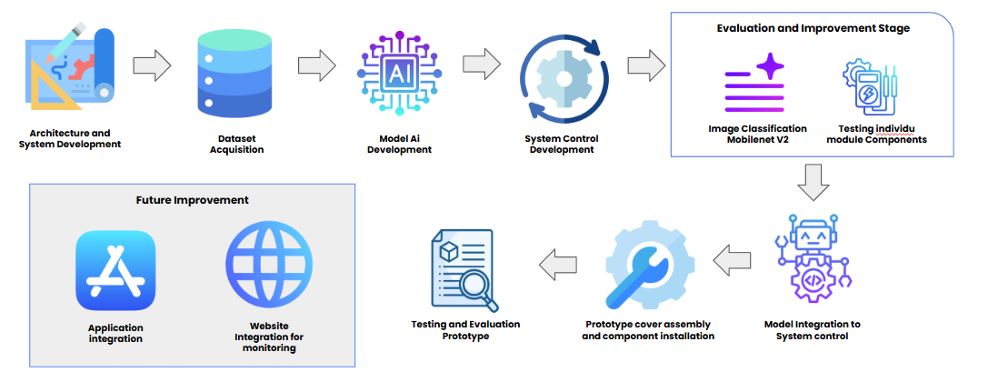
Background: Waste mismanagement remains a critical issue in Indonesian campuses, where ineffective segregation and collection practices contribute to environmental pollution. Smart technologies offer opportunities to improve waste handling efficiency and monitoring in university environments. Methods: This study developed a smart waste bin prototype that integrates Internet of Things (IoT) sensors, machine learning–based image classification (MobileNetV2 with TensorFlow Lite), GPS tracking, and LoRa communication. The system was designed to classify three types of waste—plastic bottles, snack packaging, and cans—while enabling fill-level monitoring, automated sorting, and real-time location reporting. Results: Experimental results showed strong classification accuracy for plastic bottles (100%), but lower performance for snack packaging (53–80%) and cans (40–67%), especially in low-light conditions or with darker materials. The overall real-time testing accuracy reached 45.1%. LoRa communication provided long-range connectivity but was affected by electromagnetic interference, while GPS tracking was reliable in open areas but inconsistent indoors. Conclusions: The prototype demonstrates the feasibility of integrating AI and IoT for scalable campus waste management. Despite environmental and hardware limitations, it offers a modular framework that can be refined with improved lighting, EMI shielding, and enhanced datasets. This research contributes a practical model for smart campus initiatives and supports the adoption of sustainable waste management practices in higher education environments.
Downloads
References
[1] O. Eka, C. Regina, A. Rasha, S. Agnes, S. Nur, and A. Nuraisyah, “Waste Bank in Indonesia: Problem and Opportunities,” 2023, pp. 284–290. doi: 10.2991/978-94-6463-144-9_27.
[2] Yefta. A. K. N. S. N. Jony. O. H. Lanita Winata, “A Model of Waste Management Improvement in Indonesia,” Jurnal Akuntansi, vol. 23, no. 3, p. 393, Jan. 2020, doi: 10.24912/ja.v23i3.604.
[3] M. Helmy and D. Trisyanti, “Editorial Team Ministry of Environment and Forestry, Republic of Indonesia (KLHK): (Rosa Vivien Ratnawati, Novrizal Tahar, Ujang Solihin Sidik) IGES Centre Collaborating with UNEP on Environmental Technologies (CCET): (Kazunobu Onogawa, Premakumara Jagath Dickella Gamaralalage, Tsukiji Makoto) Sustainable Waste Indonesia (SWI): ( Citation Ministry of Environment and Forestry (2020): National Plastic Waste Reduction Strategic Actions for Indonesia, Republic of Indonesia.”
[4] S. Supangkat and H. Herdiansyah, “Analysis Correlation of Municipal Solid Waste Generation and Population: Environmental Perspective,” in IOP Conference Series: Earth and Environmental Science, Institute of Physics Publishing, Jul. 2020. doi: 10.1088/1755-1315/519/1/012056.
[5] F. Cahya Alam et al., “A Model of Sustainable Waste Management Based on Climate Village Program in Pasaran Island, Lampung Province, Indonesia,” Jurnal Pengelolaan Sumberdaya Alam dan Lingkungan, vol. 15, no. 2, pp. 300–312, 2025, doi: 10.29244/jpsl.15.2.300.
[6] F. Lavigne et al., “The 21 February 2005, catastrophic waste avalanche at Leuwigajah dumpsite, Bandung, Indonesia,” Geoenvironmental Disasters, vol. 1, no. 1, Dec. 2014, doi: 10.1186/s40677-014-0010-5.
[7] “The World Bank Improvement of Solid Waste Management to Support Regional and Metropolitan Cities (P157245).”
[8] T. Sipola, J. Alatalo, T. Kokkonen, and M. Rantonen, “Artificial Intelligence in the IoT Era: A Review of Edge AI Hardware and Software,” in 2022 31st Conference of Open Innovations Association (FRUCT), IEEE, Apr. 2022, pp. 320–331. doi: 10.23919/FRUCT54823.2022.9770931.
[9] R. Tosepu, S. Z. A. Nazar, and N. Yuniar, “The Internet of Things (IoT) is being used to Control the Implementation of Water, Sanitation, and Hygiene (WaSH) Practices during the COVID-19 Era in Indonesia,” WSEAS Transactions on Computer Research, vol. 11, pp. 376–384, 2023, doi: 10.37394/232018.2023.11.34.
[10] D. Indra, F. Umar, F. Fattah, H. Azis, and A. Rachman Manga, The Spirit of Recovery: IT Perspectives,Experiences, and Applications during the COVID-19 Pandemic. CRC Press, 2024. doi: https://doi.org/10.1201/9781003331674.
[11] T. Kadus, P. Nirmal, and K. Kulkarni, “Smart Waste Management System using IOT,” International Journal of Engineering Research & Technology (IJERT), vol. 9, 2020, doi: 10.17577/IJERTV9IS040490.
[12] A. Z. Azmi, N. M. Sahar, and M. T. Islam, “Smart Waste Management System Using Lora Technology,” in E3S Web of Conferences, EDP Sciences, Jan. 2025. doi: 10.1051/e3sconf/202459904007.
[13] S. Vishnu et al., “IoT-enabled solid waste management in smart cities,” Smart Cities, vol. 4, no. 3, pp. 1004–1017, Sep. 2021, doi: 10.3390/smartcities4030053.
[14] S. Dubey, P. Singh, P. Yadav, and K. K. Singh, “Household Waste Management System Using IoT and Machine Learning,” in Procedia Computer Science, Elsevier B.V., 2020, pp. 1950–1959. doi: 10.1016/j.procs.2020.03.222.
[15] E. Longo, F. A. Sahin, A. E. C. Redondi, P. Bolzan, M. Bianchini, and S. Maffei, “A 5g-enabled smart waste management system for university campus,” Sensors, vol. 21, no. 24, Dec. 2021, doi: 10.3390/s21248278.
[16] Md. M. Islam, S. Nooruddin, F. Karray, and G. Muhammad, “Internet of Things: Device Capabilities, Architectures, Protocols, and Smart Applications in Healthcare Domain,” IEEE Internet Things J, vol. 10, no. 4, pp. 3611–3641, Feb. 2023, doi: 10.1109/JIOT.2022.3228795.
[17] M. K. Hasan, M. A. Khan, G. F. Issa, A. Atta, A. S. Akram, and M. Hassan, “Smart Waste Management and Classification System for Smart Cities using Deep Learning,” in 2022 International Conference on Business Analytics for Technology and Security, ICBATS 2022, Institute of Electrical and Electronics Engineers Inc., 2022. doi: 10.1109/ICBATS54253.2022.9759087.
[18] H. Kusumah, M. R. Nurholik, C. P. Riani, and I. R. Nur Rahman, “Deep Learning for Pothole Detection on Indonesian Roadways,” Journal Sensi, vol. 9, no. 2, pp. 175–186, Aug. 2023, doi: 10.33050/sensi.v9i2.2911.
[19] H. Briouya, A. Briouya, and A. Choukri, “Surveying Lightweight Neural Network Architectures for Enhanced Mobile Performance,” 2024, pp. 187–199. doi: 10.1007/978-3-031-77043-2_15.
[20] Q. Xia and X. Bai, “Intelligent garbage sorting system based on MobileNetV2,” in 7th International Symposium on Advances in Electrical, Electronics, and Computer Engineering, T. Zhang, Ed., SPIE, Oct. 2022, p. 53. doi: 10.1117/12.2639707.
[21] A. N. Bakti and N. H. Shabrina, “Plastic Waste Identification using ResNet-50: A Deep Learning Approach,” Rekayasa, vol. 17, no. 3, pp. 380–386, Dec. 2024, doi: 10.21107/rekayasa.v17i3.26456.
[22] Y. Rayhan and A. Pratama Rifai, “Multi-class Waste Classification Using Convolutional Neural Network,” Applied Environmental Research, Jun. 2024, doi: 10.35762/AER.2024021.
[23] H. Sun, S. Zhang, R. Ren, and L. Su, “Maturity Classification of ‘Hupingzao’ Jujubes with an Imbalanced Dataset Based on Improved MobileNet V2,” Agriculture, vol. 12, no. 9, p. 1305, Aug. 2022, doi: 10.3390/agriculture12091305.
[24] M. Khoiruddin and S. Tena, “Fruit and Vegetable Classification using Convolutional Neural Network with MobileNetV2,” Journal of Applied Research In Computer Science and Information Systems, vol. 2, no. 2, pp. 203–210, Dec. 2024, doi: 10.61098/jarcis.v2i2.197.
[25] M. T. R et al., “Transformative Breast Cancer Diagnosis using CNNs with Optimized ReduceLROnPlateau and Early Stopping Enhancements,” International Journal of Computational Intelligence Systems, vol. 17, no. 1, p. 14, Jan. 2024, doi: 10.1007/s44196-023-00397-1.
[26] D. N. K. Vu, “A Low-Cost Fire Alarm System Using Raspberry Pi,” 2025, pp. 355–366. doi: 10.1007/978-981-97-5337-6_30.
[27] J. Lim, J. Joo, and S. C. Kim, “Ultrasonic Based Outdoor Localization Using Threshold Crossing,” in 2024 International Conference on Artificial Intelligence in Information and Communication (ICAIIC), IEEE, Feb. 2024, pp. 117–119. doi: 10.1109/ICAIIC60209.2024.10463264.
[28] M. Yassir et al., “Performance Analysis of LoRaWAN Communication Utilizing the RFM96 Module,” ILKOM Jurnal Ilmiah, vol. 16, no. 3, pp. 255–270, Dec. 2024, doi: 10.33096/ilkom.v16i3.2326.255-270.
[29] D. Loukatos, A. Fragkos, G. Kargas, and K. G. Arvanitis, “Implementation and Evaluation of a Low-Cost Measurement Platform over LoRa and Applicability for Soil Monitoring,” Future Internet, vol. 16, no. 12, p. 443, Nov. 2024, doi: 10.3390/fi16120443.
[30] M. S. A. Zuhair, A. Widiyanto, and S. Nugroho, “Comparison of tensorflow and tensorflow lite for object detection on Raspberry Pi 4,” 2023, p. 020129. doi: 10.1063/5.0120245.
[31] A. H. M. Alaidi, Z. A. Ramadhan, J. S. Alrubaye, H. TH. S. ALRikabi, H. A. Mutar, and I. Svyd, “AI-based monkeypox detection model using Raspberry Pi 5 AI Kit,” Sustainable Engineering and Innovation, vol. 7, no. 1, pp. 1–14, Jan. 2025, doi: 10.37868/sei.v7i1.id393.
[32] F. Zhang et al., “Exploring LoRa for Long-range Through-wall Sensing,” Proc ACM Interact Mob Wearable Ubiquitous Technol, vol. 4, no. 2, pp. 1–27, Jun. 2020, doi: 10.1145/3397326.
[33] A. N. De São José, V. Deniau, C. Gransart, T. Vantroys, A. Boé, and E. P. Simon, “Susceptibility of LoRa Communications to Intentional Electromagnetic Interference with Different Sweep Periods,” Sensors, vol. 22, no. 13, Jul. 2022, doi: 10.3390/s22135015.
[34] M. Y. Iqbal Basheer, A. M. Ali, N. H. Abdul Hamid, M. A. Mohd Ariffin, R. Osman, and S. Nordin, “Detecting Anomaly in IoT Devices using Multi-Threaded Autonomous Anomaly Detection,” in 2021 4th International Symposium on Agents, Multi-Agent Systems and Robotics (ISAMSR), IEEE, Sep. 2021, pp. 111–118. doi: 10.1109/ISAMSR53229.2021.9567894.
Downloads
Published
Issue
Section
License
Copyright (c) 2025 Fauzy Fathrurahman, Dolly Indra, Tasrif Hasanuddin, Herdianti Darwis, Tanaka Kazuaki

This work is licensed under a Creative Commons Attribution-NonCommercial 4.0 International License.
Authors retain copyright and full publishing rights to their articles. Upon acceptance, authors grant Indonesian Journal of Data and Science a non-exclusive license to publish the work and to identify itself as the original publisher.
Self-archiving. Authors may deposit the submitted version, accepted manuscript, and version of record in institutional or subject repositories, with citation to the published article and a link to the version of record on the journal website.
Commercial permissions. Uses intended for commercial advantage or monetary compensation are not permitted under CC BY-NC 4.0. For permissions, contact the editorial office at ijodas.journal@gmail.com.
Legacy notice. Some earlier PDFs may display “Copyright © [Journal Name]” or only a CC BY-NC logo without the full license text. To ensure clarity, the authors maintain copyright, and all articles are distributed under CC BY-NC 4.0. Where any discrepancy exists, this policy and the article landing-page license statement prevail.