Website-Based Boycott Product Detection System using Convolutional Neural Network: A comparison of YOLOv8 and VGG16
DOI:
https://doi.org/10.56705/ijodas.v7i2.317Keywords:
Boycott Product Detection, Convolutional Neural Network, YOLOv8, VGG16, Image ClassificationAbstract
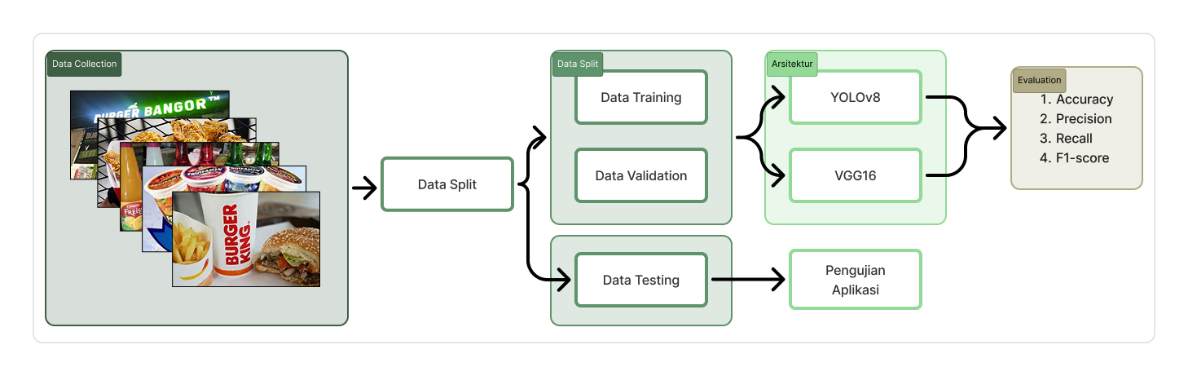
Introduction: Product boycotts have become a common form of social response in the digital era, yet manual identification of boycotted products can be slow and inaccurate. This study develops a website-based system and compares YOLOv8 and VGG16 for automated identification of boycott and non-boycott products from images. Method: A dataset of 4,250 food and beverage product images, comprising 3,638 boycott and 612 non-boycott products, was collected from internet sources and divided into 70% training, 20% validation, and 10% testing sets. YOLOv8 was trained using 640×640-pixel inputs as a one-stage object detector, while VGG16 used 224×224-pixel inputs with transfer learning as an image classifier. Both models were integrated into a website-based detection system and evaluated using accuracy, precision, recall, and F1-score. Results and Discussion: On 425 test images, YOLOv8 achieved 91.7% accuracy, 99.7% precision, 90.3% recall, and a 94.9% F1-score, substantially outperforming VGG16, which achieved 51.3% accuracy, 81.6% precision, 55.7% recall, and a 66.2% F1-score. YOLOv8 demonstrated greater robustness to variations in background, lighting, and product appearance because of its object-localization capability. Conclusion: YOLOv8 is more effective than VGG16 for website-based boycott product detection and provides a stronger foundation for practical real-time identification systems.
Downloads
References
[1] A. M. A. Ausat, “The role of social media in shaping public opinion and its influence on economic decisions,” Technol. Soc. Perspect., vol. 1, no. 1, pp. 35–44, 2023.
[2] E. Battisti, S. Alfiero, and E. Leonidou, “Remote working and digital transformation during the COVID-19 pandemic: Economic–financial impacts and psychological drivers for employees,” J. Bus. Res., vol. 150, pp. 38–50, Nov. 2022, doi: https://doi.org/10.1016/j.jbusres.2022.06.010.
[3] V. Kaputa, E. Loučanová, and F. A. Tejerina-Gaite, “Digital transformation in higher education institutions as a driver of social oriented innovations,” Soc. Innov. High. Educ., vol. 61, pp. 81–85, 2022.
[4] B. J. Bronnenberg and J. P. Dubé, “Comment on ‘Frontiers: Spilling the Beans on Political Consumerism: Do Social Media Boycotts and Buycotts Translate to Real Sales Impact?,’” Mark. Sci., vol. 42, no. 1, pp. 28–31, 2023, doi: https://doi.org/10.1287/mksc.2022.1426.
[5] K. Mady, M. Salaheldeen, H. Refaat, and M. Battour, “The impact of social media on consumer boycotts: Mediating roles of animosity, behavioral control, and efficacy,” Soc. Sci. Humanit. Open, vol. 12, p. 102041, 2025, doi: https://doi.org/10.1016/j.ssaho.2025.102041.
[6] S. Boulianne, “Socially mediated political consumerism,” Information, Commun. Soc., vol. 25, no. 5, pp. 609–617, Apr. 2022, doi: https://doi.org/10.1080/1369118X.2021.2020872.
[7] N. A. Fitriani, S. Alam, M. Taufik, S. B. Digital, and F. Ekonomi, “Sentiment Analysis on Social Media Regarding the Boycott of Pro-Israel Products Using Machine Learning,” vol. 4, no. 2, pp. 132–143, 2025, doi: 10.26740/jdbim.v4i2.70633.
[8] P. Wang, E. Fan, and P. Wang, “Comparative analysis of image classification algorithms based on traditional machine learning and deep learning,” Pattern Recognit. Lett., vol. 141, pp. 61–67, 2021.
[9] Y. Wei, S. Tran, S. Xu, B. Kang, and M. Springer, “Deep Learning for Retail Product Recognition: Challenges and Techniques,” Comput. Intell. Neurosci., vol. 2020, pp. 1–23, Nov. 2020, doi: https://doi.org/10.1155/2020/8875910.
[10] H. Babaei, M. Zamani, and S. Mohammadi, “The impact of data splitting methods on machine learning models: A case study for predicting concrete workability,” Mach. Learn. Comput. Sci. Eng., vol. 1, no. 1, p. 21, 2025.
[11] Z. Li, F. Liu, W. Yang, S. Peng, and J. Zhou, “A Survey of Convolutional Neural Networks: Analysis, Applications, and Prospects,” IEEE Trans. Neural Networks Learn. Syst., vol. 33, no. 12, pp. 6999–7019, Dec. 2022, doi: https://doi.org/10.1109/TNNLS.2021.3084827.
[12] J. Terven, D.-M. Córdova-Esparza, and J.-A. Romero-González, “A Comprehensive Review of YOLO Architectures in Computer Vision: From YOLOv1 to YOLOv8 and YOLO-NAS,” Mach. Learn. Knowl. Extr., vol. 5, no. 4, pp. 1680–1716, Nov. 2023, doi: https://doi.org/10.3390/make5040083.
[13] M. Hussain, “YOLOv1 to v8: Unveiling Each Variant–A Comprehensive Review of YOLO,” IEEE Access, vol. 12, pp. 42816–42833, 2024, doi: https://doi.org/10.1109/ACCESS.2024.3378568.
[14] J. Yang, Z. Liang, M. Qin, X. Tong, F. Xiong, and H. An, “Lightweight object detection model for food freezer warehouses,” Sci. Rep., vol. 15, no. 1, p. 2350, Jan. 2025, doi: https://doi.org/10.1038/s41598-025-86662-z.
[15] E. G. Addisu, T. G. Yirga, H. G. Yirga, and A. D. Yehuala, “Transfer learning-based hybrid VGG16-machine learning approach for heart disease detection with explainable artificial intelligence,” Front. Artif. Intell., vol. 8, Feb. 2025, doi: https://doi.org/10.3389/frai.2025.1504281.
[16] K. Simonyan and A. Zisserman, “Very Deep Convolutional Networks for Large-Scale Image Recognition,” 3rd Int. Conf. Learn. Represent. ICLR 2015 - Conf. Track Proc., Sep. 2014, Accessed: Dec. 10, 2025.
[17] A. Thakkar and R. Lohiya, “A survey on intrusion detection system: feature selection, model, performance measures, application perspective, challenges, and future research directions,” Artif. Intell. Rev., vol. 55, no. 1, pp. 453–563, 2022.
[18] Ž. Vujović, “Classification model evaluation metrics,” Int. J. Adv. Comput. Sci. Appl., vol. 12, no. 6, pp. 599–606, 2021.
[19] Z. Zou, K. Chen, Z. Shi, Y. Guo, and J. Ye, “Object Detection in 20 Years: A Survey,” Proc. IEEE, vol. 111, no. 3, pp. 257–276, Mar. 2023, doi: https://doi.org/10.1109/JPROC.2023.3238524.
[20] G. Naidu, T. Zuva, and E. M. Sibanda, “A review of evaluation metrics in machine learning algorithms,” in Computer science on-line conference, Springer, 2023, pp. 15–25.
[21] V. Amarnadh and N. R. Moparthi, “Range control-based class imbalance and optimized granular elastic net regression feature selection for credit risk assessment,” Knowl. Inf. Syst., vol. 66, no. 9, pp. 5281–5310, 2024.
[22] H. Lu, L. Ehwerhemuepha, and C. Rakovski, “A comparative study on deep learning models for text classification of unstructured medical notes with various levels of class imbalance,” BMC Med. Res. Methodol., vol. 22, no. 1, p. 181, 2022.
[23] Z. J. Khow, Y.-F. Tan, H. A. Karim, and H. A. A. Rashid, “Improved YOLOv8 model for a comprehensive approach to object detection and distance estimation,” IEEE Access, vol. 12, pp. 63754–63767, 2024.
[24] J. Zhao, Y. Mei, X. Gao, J. Yang, and J. Shang, “Multi-Objective Optimization for EE-SE Tradeoff in Space-Air-Ground Internet of Things Networks,” Electronics, vol. 12, no. 12, p. 2585, Jun. 2023, doi: https://doi.org/10.3390/electronics12122585.
[25] H. Lou et al., “DC-YOLOv8: Small-Size Object Detection Algorithm Based on Camera Sensor,” Electronics, vol. 12, no. 10, p. 2323, May 2023, doi: https://doi.org/10.3390/electronics12102323.
[26] A. A. Adegun, J. V. Fonou Dombeu, S. Viriri, and J. Odindi, “State-of-the-art deep learning methods for objects detection in remote sensing satellite images,” Sensors, vol. 23, no. 13, p. 5849, 2023.
[27] Z.-P. Jiang, Y.-Y. Liu, Z.-E. Shao, and K.-W. Huang, “An Improved VGG16 Model for Pneumonia Image Classification,” Appl. Sci., vol. 11, no. 23, p. 11185, Nov. 2021, doi: https://doi.org/10.3390/app112311185.
[28] W. Liu, F. Zhu, and C.-L. Liu, “Multi-scale Unified Network for Image Classification,” Mar. 2024, Accessed: Dec. 10, 2025.
[29] A. A. Mustapha, S. ‘Atifah Saruchi, H. Supriyono, and M. I. Solihin, “A Hybrid Deep Learning Model for Waste Detection and Classification Utilizing YOLOv8 and CNN,” in The 8th Mechanical Engineering, Science and Technology International Conference, Basel Switzerland: MDPI, Mar. 2025, p. 82. doi: https://doi.org/10.3390/engproc2025084082.
[30] J. Peng, C. Xiao, and Y. Li, “RP2K: A Large-Scale Retail Product Dataset for Fine-Grained Image Classification,” Sep. 2021, Accessed: Dec. 10, 2025.
Downloads
Published
Issue
Section
License
Copyright (c) 2026 Mariani Ani, Dolly Indra, Sitti Rahma Jabir

This work is licensed under a Creative Commons Attribution-NonCommercial 4.0 International License.
Authors retain copyright and full publishing rights to their articles. Upon acceptance, authors grant Indonesian Journal of Data and Science a non-exclusive license to publish the work and to identify itself as the original publisher.
Self-archiving. Authors may deposit the submitted version, accepted manuscript, and version of record in institutional or subject repositories, with citation to the published article and a link to the version of record on the journal website.
Commercial permissions. Uses intended for commercial advantage or monetary compensation are not permitted under CC BY-NC 4.0. For permissions, contact the editorial office at ijodas.journal@gmail.com.
Legacy notice. Some earlier PDFs may display “Copyright © [Journal Name]” or only a CC BY-NC logo without the full license text. To ensure clarity, the authors maintain copyright, and all articles are distributed under CC BY-NC 4.0. Where any discrepancy exists, this policy and the article landing-page license statement prevail.