Implementation of Latent Dirichlet Allocation (LDA) to Identify National Pride in YouTube Comments
DOI:
https://doi.org/10.56705/ijodas.v7i1.313Keywords:
National Pride, Text Mining, Topic Modelling, Latent Dirichlet Allocation, YouTube CommentsAbstract
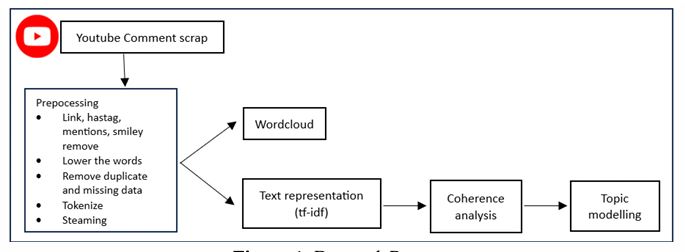
Sports can trigger a strong sense of national pride, a psychological factor that contributes positively to collective behavior and societal cohesion. One key source of this pride is the success of athletes in prestigious international competitions. With the growing use of the internet, expressions of national pride are increasingly visible on social media, particularly in the comment sections of content related to national achievements. Previous studies on sports and national pride have mainly relied on survey methods. This study takes a different approach by analyzing expressions of national pride among Indonesian netizens in YouTube comments related to the success of Indonesian athletes in international sporting events. A case study was conducted using videos covering Indonesian achievements at the Paris Olympics 2024 in weightlifting, badminton, and rock climbing. Data were collected from 12 YouTube news videos using Mozdeh, yielding 11,972 comments, of which 10,610 were analyzed after preprocessing. The study applied Latent Dirichlet Allocation (LDA) to identify hidden topics, with the optimal number of topics determined as two based on coherence values. Term frequency–inverse document frequency (TF-IDF) was used for data representation. The results revealed two main themes: gratitude, reflecting thankfulness to God for achievements, and national pride, indicating public pride in Indonesia due to athletes’ success. These findings demonstrate that LDA effectively captures expressions of national pride in social media data and highlight the role of sports achievements in strengthening national pride online
Downloads
References
[1] T. Pawlowski, P. Downward, and S. Rasciute, “Does national pride from international sporting success contribute to well-being? An international investigation,” Sport Management Review, vol. 17, no. 2, pp. 121–132, Apr. 2014, doi: 10.1016/j.smr.2013.06.007.
[2] S. Shibli, G. Ramchandani, and L. Davies, “The impact of British sporting achievements on national pride among adults in England,” European Sport Management Quarterly, vol. 21, no. 5, pp. 658–676, Oct. 2021, doi: 10.1080/16184742.2021.1916553.
[3] P. K. H. Mo et al., “Dualistic determinants of COVID-19 vaccination intention among university students in China: From perceived personal benefits to external reasons of perceived social benefits, collectivism, and national pride,” Vaccines (Basel), vol. 9, no. 11, p. 1323, 2021.
[4] Șerban Olah, “The National Identity, the National Pride and the Willingness to Fight for the Country. A Study Case of the Ukraine-Russia Conflict,” Eurolimes, vol. 31, no. 31–32, pp. 165–173, 2022.
[5] V. Rutkauskas, “Factors affecting willingness to fight for one’s own country: The case of baltic states,” Special Operations Journal, vol. 4, no. 1, pp. 48–62, 2018.
[6] W.-C. Wu, “Distributive Unfairness, National Pride, and Willingness to Fight: Evidence From Taiwan,” J Asian Afr Stud, p. 00219096231168047, 2023.
[7] A. Macintyre, H. F. Chan, M. Schaffner, and B. Torgler, “National pride and tax compliance: A laboratory experiment using a physiological marker,” PLoS One, vol. 18, no. 1, p. e0280473, 2023.
[8] M. Hjerm, “National identities, national pride and xenophobia: A comparison of four Western countries,” Acta sociologica, vol. 41, no. 4, pp. 335–347, 1998.
[9] R. Kurniawan et al., “Sport and national pride: A literature review,” Retos: nuevas tendencias en educación física, deporte y recreación, no. 65, pp. 44–54, 2025.
[10] A. Luksyte and D. R. Avery, “The Effects of citizenship dissimilarity and national pride on attitudes toward immigrants: Investigating mediators and moderators of intergroup contact,” International Journal of Intercultural Relations, vol. 34, no. 6, pp. 629–641, Nov. 2010, doi: 10.1016/j.ijintrel.2010.04.001.
[11] H. Tajfel and J. C. Turner, “The social identity theory of intergroup behavior,” in Political psychology (Key Readings in Social Psychology), 1st ed., John. T. Jost and J. Sidanius, Eds., Psychology Press, 2004, pp. 276–293. doi: https://psycnet.apa.org/doi/10.4324/9780203505984-16.
[12] T. W. Smith and S. Kim, “National pride in comparative perspective: 1995/96 and 2003/04,” Int J Public Opin Res, vol. 18, no. 1, pp. 127–136, 2006.
[13] L. R. Rosenzweig and Y.-Y. Zhou, “Team and Nation: Sports, Nationalism, and Attitudes Toward Refugees,” Comp Polit Stud, vol. 54, no. 12, pp. 2123–2154, Oct. 2021, doi: 10.1177/0010414021997498.
[14] T. Shimokubo, “Hosting Olympic Games under a state of emergency: are people still proud of their country?,” International Journal of Sport Policy and Politics, vol. 15, no. 1, pp. 147–161, Jan. 2023, doi: 10.1080/19406940.2022.2162102.
[15] F. Gassmann, J. Haut, and E. Emrich, “The effect of the 2014 and 2018 FIFA World Cup tournaments on German national pride. A natural experiment,” Appl Econ Lett, vol. 27, no. 19, pp. 1541–1545, Nov. 2020, doi: 10.1080/13504851.2019.1696448.
[16] V. Halldorsson, “National sport success and the emergent social atmosphere: The case of Iceland,” Int Rev Sociol Sport, vol. 56, no. 4, pp. 471–492, Jun. 2021, doi: 10.1177/1012690220912415.
[17] L. Brown, S. Richards, and I. Jones, “Sojourner perceptions of the St George Cross flag during the FIFA 2010 World Cup: A symbol of carnival or menace?,” Int Rev Sociol Sport, vol. 49, no. 1, pp. 102–120, Feb. 2014, doi: 10.1177/1012690212450647.
[18] K. Hallmann, C. Breuer, and B. Kühnreich, “Happiness, pride and elite sporting success: What population segments gain most from national athletic achievements?,” Sport Management Review, vol. 16, no. 2, pp. 226–235, Apr. 2013, doi: 10.1016/j.smr.2012.07.001.
[19] We are social, “Digital 2025: Indonesia,” https://datareportal.com/reports/digital-2025-indonesia.
[20] M. Deori, M. K. Verma, and V. Kumar, “Sentiment analysis of users’ comments on Indian Hindi news channels using Mozdeh: An evaluation based on YouTube Videos,” Journal of Creative Communications, p. 09732586211049232, 2021.
[21] A. Elling, I. Van Hilvoorde, and R. Van Den Dool, “Creating or awakening national pride through sporting success: A longitudinal study on macro effects in the Netherlands,” Int Rev Sociol Sport, vol. 49, no. 2, pp. 129–151, Apr. 2014, doi: 10.1177/1012690212455961.
[22] I. van Hilvoorde, A. Elling, and R. Stokvis, “How to influence national pride? The Olympic medal index as a unifying narrative,” Int Rev Sociol Sport, vol. 45, no. 1, pp. 87–102, Mar. 2010, doi: 10.1177/1012690209356989.
[23] H. E. Meier and M. Mutz, “Political regimes and sport-related national pride: a cross-national analysis,” International Journal of Sport Policy and Politics, vol. 10, no. 3, pp. 525–548, Jul. 2018, doi: 10.1080/19406940.2018.1447498.
[24] R. K. Storm and T. G. Jakobsen, “National pride, sporting success and event hosting: An analysis of intangible effects related to major athletic tournaments,” International Journal of Sport Policy and Politics, vol. 12, no. 1, pp. 163–178, Jan. 2020, doi: 10.1080/19406940.2019.1646303.
[25] M. Kosinski, “Using Big Data,” in The Handbook of Social Psychology, 6th ed., D. T. Gilbert, S. T. Fiske, E. J. Finkel, and W. B. Mendes, Eds., Situational Press, 2025, ch. 6.
[26] J. Žižka, F. Dařena, and A. Svoboda, Text mining with machine learning: principles and techniques. Crc Press, 2019.
[27] D. Wilkinson and M. Thelwall, “Researching personal information on the public web: Methods and ethics,” Soc Sci Comput Rev, vol. 29, no. 4, pp. 387–401, 2011.
[28] Z. Antić, Python Natural Language Processing Cookbook: Over 50 recipes to understand, analyze, and generate text for implementing language processing tasks. Packt Publishing Ltd, 2021.
[29] Hobson. Lane, Cole. Howard, and H. Max. Hapke, Natural language processing in action: Understanding, analyzing, and generating text with Python. Manning, 2019.
[30] J. Silge and D. Robinson, “tidytext: Text mining and analysis using tidy data principles in R,” J Open Source Softw, vol. 1, no. 3, p. 37, 2016.
[31] J. Silge and D. Robinson, Text mining with R: A tidy approach. “ O’Reilly Media, Inc.,” 2017.
[32] J. Atkinson-Abutridy, Text Analytics: An Introduction to the Science and Applications of Unstructured Information Analysis. Chapman and Hall/CRC, 2022.
[33] M. Röder, A. Both, and A. Hinneburg, “Exploring the Space of Topic Coherence Measures,” in Proceedings of the Eighth ACM International Conference on Web Search and Data Mining, New York, NY, USA: ACM, Feb. 2015, pp. 399–408. doi: 10.1145/2684822.2685324.
[34] J. Albrecht, S. Ramachandran, and C. Winkler, Blueprints for text analytics using Python. “ O’Reilly Media, Inc.,” 2020.
[35] D. Maier et al., “Applying LDA topic modeling in communication research: Toward a valid and reliable methodology,” in Computational methods for communication science, Routledge, 2021, pp. 13–38.
[36] D. M. Blei, A. Y. Ng, and M. I. Jordan, “Latent dirichlet allocation,” Journal of machine Learning research, vol. 3, no. Jan, pp. 993–1022, 2003.
[37] R Core Team, R: A language and environment for statistical computing. R Foundation for Statistical Computing. Vienna, 2022.
[38] B. Grün and K. Hornik, “topicmodels: An R package for fitting topic models,” J Stat Softw, vol. 40, pp. 1–30, 2011.
[39] T. H. Baek and S. Yoon, “Pride and gratitude: Egoistic versus altruistic appeals in social media advertising,” J Bus Res, vol. 142, pp. 499–511, Mar. 2022, doi: 10.1016/j.jbusres.2021.12.066.
[40] M. J. J. Wubben, D. De Cremer, and E. van Dijk, “Is pride a prosocial emotion? Interpersonal effects of authentic and hubristic pride,” Cogn Emot, vol. 26, no. 6, pp. 1084–1097, Sep. 2012, doi: 10.1080/02699931.2011.646956.
[41] M. E. McCullough, S. D. Kilpatrick, R. A. Emmons, and D. B. Larson, “Is gratitude a moral affect?,” Psychol Bull, vol. 127, no. 2, pp. 249–266, 2001.
[42] N. T. Gabana, J. Steinfeldt, Y. J. Wong, Y. B. Chung, and D. Svetina, “Attitude of Gratitude: Exploring the Implementation of a Gratitude Intervention with College Athletes,” J Appl Sport Psychol, vol. 31, no. 3, pp. 273–284, Jul. 2019, doi: 10.1080/10413200.2018.1498956.
[43] L. H. Chen, “Gratitude and Adolescent Athletes’ Well-Being: The Multiple Mediating Roles of Perceived Social Support from Coaches and Teammates,” Soc Indic Res, vol. 114, no. 2, pp. 273–285, Nov. 2013, doi: 10.1007/s11205-012-0145-2.
[44] A. Akbar et al., “Individual psychological characteristics of under-17 football players in Indonesia and Malaysia: sport psychology approach,” Retos, vol. 58, pp. 368–376, Jul. 2024, doi: 10.47197/retos.v58.107674.
[45] A. Akbar et al., “The Role of Mental Toughness in Improving Achievement: The Perspective of Sport Psychology on Student-Athletes,” International Journal of Human Movement and Sports Sciences, vol. 11, no. 6, pp. 1376–1382, Nov. 2023, doi: 10.13189/saj.2023.110623.
[46] A. Kiarostami, M. Jeddi, S. Roohinezhad, and R. Hakimi, “The Effectiveness of Positive Thinking Training on Mental Toughness and Social Well-being in Derelict Adolescents,” Iranian Evolutionary and Educational Psychology, vol. 4, no. 2, pp. 398–409, May 2022, doi: 10.52547/ieepj.4.2.398.
Downloads
Published
Issue
Section
License
Copyright (c) 2026 Rizal Kurniawan, Amin Akbar, Rinaldi Rinaldi, Aflah Zakinov Irta

This work is licensed under a Creative Commons Attribution-NonCommercial 4.0 International License.
Authors retain copyright and full publishing rights to their articles. Upon acceptance, authors grant Indonesian Journal of Data and Science a non-exclusive license to publish the work and to identify itself as the original publisher.
Self-archiving. Authors may deposit the submitted version, accepted manuscript, and version of record in institutional or subject repositories, with citation to the published article and a link to the version of record on the journal website.
Commercial permissions. Uses intended for commercial advantage or monetary compensation are not permitted under CC BY-NC 4.0. For permissions, contact the editorial office at ijodas.journal@gmail.com.
Legacy notice. Some earlier PDFs may display “Copyright © [Journal Name]” or only a CC BY-NC logo without the full license text. To ensure clarity, the authors maintain copyright, and all articles are distributed under CC BY-NC 4.0. Where any discrepancy exists, this policy and the article landing-page license statement prevail.