Automated Waste Image Classification with Weighted Scoring Using MobileNetV2 on the OLSAM Platform
DOI:
https://doi.org/10.56705/ijodas.v6i3.295Keywords:
Convolutional Neural Network, MobileNetV2, Smart Waste Management, Waste Classification, Weighted ApproachAbstract
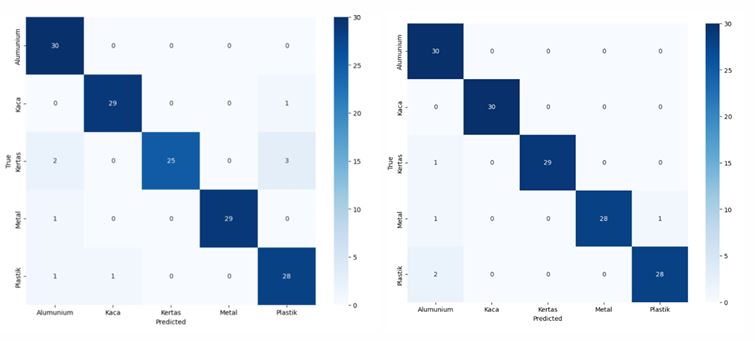
This study presents the development of an automated waste image classification system for the OLSAM platform to enhance community participation in waste management. The objective is to integrate a lightweight CNN-based classifier with a weighted point calculation mechanism for five waste categories. A dataset of 1,500 images was used, split into 80% training, 10% validation, and 10% testing. The MobileNetV2 architecture was applied to perform image classification, while a weighted reward mechanism assigned points based on the detected waste type and its weight. The model achieved its best performance at epoch 65, reaching an accuracy of 96.67% and a weighted F1-score of 0.97. These results indicate that combining CNN-based recognition with a weighted point system effectively supports user engagement and promotes sustainable waste-sorting behavior within community waste management systems.
Downloads
References
[1] L. Labibah and M. A. Pulungan, “Evaluasi Pengelolaan Sampah Menggunakan Pemodelan Sistem Dinamis di Kabupaten Ponorogo,” J. Al-AZHAR Indones. SERI SAINS DAN Teknol., vol. 10, no. 1, p. 24, 2025, doi: 10.36722/sst.v10i1.3316.
[2] D. K. Ponorogo, “Data Statistik Sektoral Kabupaten Ponorogo. Komunikasi Informatika dan Statistik Kabupaten Ponorogo.” Accessed: Feb. 22, 2025.
[3] P. Maheswari, “MangoYieldNet: Fruit yield estimation for mango orchards using DeepLabv3 + with ResNet18 architecture,” Multimed. Tools Appl., 2025, doi: 10.1007/s11042-025-20791-5.
[4] N. Ferronato and V. Torretta, “Waste mismanagement in developing countries: A review of global issues,” Int. J. Environ. Res. Public Health, vol. 16, no. 6, 2019, doi: 10.3390/ijerph16061060.
[5] O. Adedeji, O. Adedeji, and Z. Wang, “Intelligent waste classification system using deep learning convolutional neural network,” Procedia Manuf., vol. 35, pp. 607–612, 2019, doi: 10.1016/j.promfg.2019.05.086.
[6] L. Yong, L. Ma, D. Sun, and L. Du Id, “Application of MobileNetV2 to waste classification,” pp. 1–16, 2023, doi: 10.1371/journal.pone.0282336.
[7] F. Gurcan and A. Soylu, “Automated waste classification for smart recycling: A multi-class CNN approach with transfer learning and pre-trained models,” Environ. Technol. Innov., p. 104673, 2025, doi: 10.1016/j.eti.2025.104673.
[8] H. Jerbi, V. G. A. Gnana, S. Ben, and R. Abbassi, “Optimizing waste management in smart Cities : An IoT-Based approach using dynamic bald eagle search optimization algorithm ( DBESO ) and machine learning,” J. Urban Manag., no. May, 2025, doi: 10.1016/j.jum.2025.05.015.
[9] A. A. Mabalay, “Gamification for sustainability: A systematic review of applications, trends, and opportunities,” Comput. Human Behav., vol. 165, p. 108529, Apr. 2025, doi: 10.1016/J.CHB.2024.108529.
[10] S. S. Yadav and S. K. Gupta, “Development of smart and automated solid waste management systems,” p. 33145, 2026, doi: https://doi.org/10.1016/B978-0-443-33145-9.00020-1.
[11] S. S. Guo et al., “Development of an Automated Body Temperature Detection Platform for Face Recognition in Cattle with YOLO V3-Tiny Deep Learning and Infrared Thermal Imaging,” Appl. Sci., vol. 12, no. 8, pp. 129–137, 2022, doi: 10.3390/app12084036.
[12] M. K. Anwar, S. A. R. Shah, and H. Alhazmi, “Recycling and utilization of polymers for road construction projects: An application of the circular economy concept,” Polymers (Basel)., vol. 13, no. 8, pp. 1–11, 2021, doi: 10.3390/polym13081330.
[13] A. Riduan, F. Panjaitan, S. Rizal, N. Huda, and S. D. Purnamasari, “Detection of Inorganic Waste Using Convolutional Neural Network Method,” J. Inf. Syst. Informatics, vol. 6, no. 1, pp. 290–300, 2024, doi: 10.51519/journalisi.v6i1.662.
[14] A. Tasic, L. Jovanovic, M. Popovic, N. Bacanin, M. Zivkovic, and M. Dobrojevic, “Waste classification using convolutional neural networks tuned by modified metaheuristics algorithm,” p. 27374, 2025, doi: https://doi.org/10.1016/B978-0-443-27374-2.00009-1.
[15] F. Nekouei, “Garbage Image Dataset,” 2023. Accessed: Mar. 24, 2025.
[16] Y. Rayhan and A. P. Rifai, “Multi-class Waste Classification Using Convolutional Neural Network,” Appl. Environ. Res., vol. 46, no. 2, 2024, doi: 10.35762/AER.2024021.
[17] K. R. Ariawan, A. A. G. Ekayana, I. P. Y. Indrawan, K. R. Winatha, and I. N. A. F. Setiawan, “Performance Comparasion of DenseNet-121 and MobileNetV2 for Cacao Fruit Disease Image Classification,” Indones. J. Data Sci., vol. 6, no. 1, pp. 30–38, 2025, doi: 10.56705/ijodas.v6i1.233.
[18] D. Efendi, J. Jasril, S. Sanjaya, F. Syafria, and E. Budianita, “Penerapan Algoritma Convolutional Neural Network Arsitektur ResNet-50 untuk Klasifikasi Citra Daging Sapi dan Babi,” JURIKOM (Jurnal Ris. Komputer), vol. 9, no. 3, p. 607, 2022, doi: 10.30865/jurikom.v9i3.4176.
[19] Sunardi, A. Yudhana, and M. Fahmi, “Improving Waste Classification Using Convolutional Neural Networks: An Application of Machine Learning for Effective Environmental Management,” Rev. d’Intelligence Artif., vol. 37, no. 4, pp. 845–855, 2023, doi: 10.18280/ria.370404.
[20] E. Hamed, I. Eliwa, and T. A. El-hafeez, “Deep learning for sustainable agriculture : automating rice and paddy ripeness classification for enhanced food security,” Egypt. Informatics J., vol. 32, no. September, p. 100785, 2025, doi: 10.1016/j.eij.2025.100785.
[21] D. Varma, A. Nehansh, and P. Swathy, “Data Preprocessing Toolkit : An Approach to Automate Data Preprocessing,” Interantional J. Sci. Res. Eng. Manag., vol. 07, no. 03, pp. 1–5, 2023, doi: 10.55041/ijsrem18270.
[22] T. Agustin, I. A. Saputro, and M. L. Rahmadi, “Optimizing Rice Plant Disease Classification Using Data Augmentation with GANs on Convolutional Neural Networks,” INTENSIF J. Ilm. Penelit. dan Penerapan Teknol. Sist. Inf., vol. 9, no. 1, pp. 97–114, 2025, doi: 10.29407/intensif.v9i1.23834.
[23] T. Kurniawan and R. Kusumaningrum, “An Efficient Model for Waste Image Classification Using EfficientNet-B0,” J. Tek. Inform., vol. 6, no. 3, pp. 2723–3863, 2025.
[24] L. Stephen Pieters, “Development of Automatic Waste Classification System Using Cnn Based Deep Learning To Support Smart Waste Management Pengembangan Sistem Klasifikasi Sampah Otomatis Menggunakan Deep Learning Berbasis Cnn Untuk Mendukung Smart Waste Management,” J. Inovtek Polbeng, vol. 10, no. 1, p. 1, 2025.
[25] M. Haqqi, L. Rochmah, A. D. Safitri, R. A. Pratama, and Tarwoto, “Implementation Of Machine Learning To Identify Types Of Waste Using CNN Algorithm,” J. Fasilkom, vol. 14, no. 3, pp. 761–765, 2024, doi: 10.37859/jf.v14i3.8116.
[26] H. Zheng and Y. Gu, “Encnn-upmws: Waste classification by a CNN ensemble using the UPM weighting strategy,” Electron., vol. 10, no. 4, pp. 1–21, 2021, doi: 10.3390/electronics10040427.
[27] V. A. Saputra and S. A. Arnomo, “Penerapan Metode Machine Learning Dalam Mengidentifikasi Berita Hoaks,” Comput. Based Inf. Syst. J., vol. 12, no. 1, pp. 112–121, 2024, doi: 10.33884/cbis.v12i1.8442.
[28] Dio Ariadi and Kartika Fithriasari, “Klasifikasi Berita Indonesia Menggunakan Metode Naive Bayesian Classification dan Support Vector Machine dengan Confix Stripping Stemmer,” J. Sains Dan Seni Its, vol. 4, no. 2, pp. 2337–3520, 2015.
[29] M. A. Mutasodirin and F. M. Falakh, “Efficient Weather Classification Using DenseNet and EfficientNet,” J. Inform. J. Pengemb. IT, vol. 9, no. 2, pp. 173–179, 2024, doi: 10.30591/jpit.v9i2.7539.
[30] Z. L. Mulyani, “Implementasi Metode Convolutional Neural Network (Cnn) Pada Klasifikasi Citra Serat Kayu (Skripsi),” p. 22, 2023.
[31] B. A. Maulana and N. Hidayati, “Churn Prediction in Credit Customers Using Random Forest and XGBoost Methods,” Indones. J. Data Sci., vol. 6, no. 1, pp. 82–90, 2025, doi: 10.56705/ijodas.v6i1.215.
Downloads
Published
Issue
Section
License
Copyright (c) 2025 Kartika Nur Anggraeni, Arin Yuli Astuti, Ismail Abdurrozzaq Zulkarnain

This work is licensed under a Creative Commons Attribution-NonCommercial 4.0 International License.
Authors retain copyright and full publishing rights to their articles. Upon acceptance, authors grant Indonesian Journal of Data and Science a non-exclusive license to publish the work and to identify itself as the original publisher.
Self-archiving. Authors may deposit the submitted version, accepted manuscript, and version of record in institutional or subject repositories, with citation to the published article and a link to the version of record on the journal website.
Commercial permissions. Uses intended for commercial advantage or monetary compensation are not permitted under CC BY-NC 4.0. For permissions, contact the editorial office at ijodas.journal@gmail.com.
Legacy notice. Some earlier PDFs may display “Copyright © [Journal Name]” or only a CC BY-NC logo without the full license text. To ensure clarity, the authors maintain copyright, and all articles are distributed under CC BY-NC 4.0. Where any discrepancy exists, this policy and the article landing-page license statement prevail.