Classification Of Bougainvillea Flower Varieties Using Variant Of CNN: Resnet50
DOI:
https://doi.org/10.56705/ijodas.v6i2.266Keywords:
ResNet50, Image Augmentation, Deep Learning, Transfer Learning, K-Fold Cross Validation, Bougainvillea ClassificationAbstract
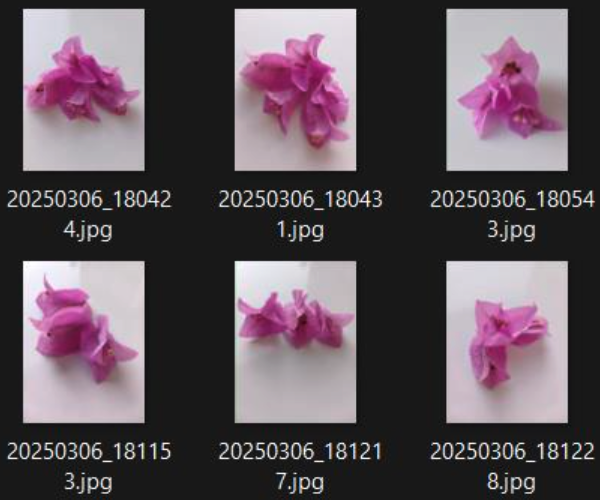
Bougainvillea is a tropical ornamental plant renowned for its vibrant colors and variety of cultivars, yet classifying its species remains challenging due to morphological similarities. This study aims to develop an automated classification system using the ResNet50 deep learning architecture to identify Bougainvillea flower varieties based on visual imagery. The dataset consists of 700 images from seven distinct classes, captured under natural lighting using a smartphone camera. The research process includes image preprocessing (resizing to 224x224 pixels), geometric data augmentation to increase dataset diversity, and evaluation using K-Fold Cross Validation to ensure robust model assessment. The model was trained using transfer learning, and its performance was compared between augmented and non-augmented datasets through evaluation metrics such as accuracy, precision, recall, and F1-score. The results show that augmentation significantly improved the model's performance, achieving an average accuracy of 99.67% on augmented data compared to 93.39% on non-augmented data. The augmented model also exhibited greater consistency across all folds, with several achieving perfect scores. These findings highlight that combining ResNet50 with transfer learning and image augmentation produces a highly accurate and reliable Bougainvillea classification system. This research contributes to the field of AI-based plant phenotyping and lays the groundwork for future applications in horticulture, biodiversity conservation, and education. Further development is recommended to explore larger and more diverse datasets, investigate advanced architectures such as EfficientNet or Vision Transformers, and build real-time mobile-based classification tools for practical field usage
Downloads
References
M. Feng, “Research on key technologies in the field of computer vision based on deep learning,” in Journal of Physics: Conference Series, IOP Publishing Ltd, May 2021. doi: 10.1088/1742-6596/1915/2/022063.
K. Xu, J. Chen, Y. Ning, and W. Tang, “Deep Learning in Image Classification: An Overview,” in 2023 4th International Conference on Computer Vision, Image and Deep Learning (CVIDL), 2023, pp. 81–93. doi: 10.1109/CVIDL58838.2023.10167276.
P. Tiwari and D. A. K. Sahu, “A Comprehensive Study on Image Classification Using Deep Learning Techniques,” Int. Res. J. Comput. Sci., 2024, doi: 10.26562/irjcs.2024.v1102.05.
J. Qiu, J. Liu, and Y. Shen, “Computer Vision Technology Based on Deep Learning,” in 2021 IEEE 2nd International Conference on Information Technology, Big Data and Artificial Intelligence (ICIBA), 2021, pp. 1126–1130. doi: 10.1109/ICIBA52610.2021.9687873.
P. Jampa, U. K. Kolluri, P. Venkat, and G. L. Sumalata, “Image Classification using Deep Learning Models in Computer Vision,” in 2024 3rd International Conference on Applied Artificial Intelligence and Computing (ICAAIC), 2024, pp. 511–515. doi: 10.1109/ICAAIC60222.2024.10575085.
E. Alam, A. Sufian, A. K. Das, A. Bhattacharya, M. F. Ali, and M. M. H. Rahman, “Leveraging Deep Learning for Computer Vision: A Review,” in 2021 22nd International Arab Conference on Information Technology (ACIT), 2021, pp. 1–8. doi: 10.1109/ACIT53391.2021.9677361.
S. Xin, “Application of Deep learning in computer vision,” Highlights Sci. Eng. Technol., 2022, doi: 10.54097/hset.v16i.2494.
P. Kumar and P. K. Shukla, “Deep Learning in Computer Vision: A Critical Review,” J. Electr. Syst., vol. 20, no. 3, pp. 5540–5562, 2024, doi: 10.1007/978-3-031-06761-7.
D. A. van Strien, K. Beelen, M. Wevers, T. Smits, and K. McDonough, “Computer Vision for the Humanities: An Introduction to Deep Learning for Image Classification (Part 1),” Program. Hist., 2022, doi: 10.46430/phen0101.
T. Soni, “Enhancing Flower Classification Accuracy: A Case Study of MobileNetV2 vs. ResNet50,” 2024 Glob. Conf. Commun. Inf. Technol., pp. 1–4, 2024, doi: 10.1109/GCCIT63234.2024.10861989.
T. Zhang, “Performance Analysis of Residual Networks for Pneumonia Diagnosis on Chest X-Rays,” Appl. Comput. Eng., 2025, doi: 10.54254/2755-2721/2025.21363.
H. Jiang, H. Polsani, and Y. Liu, “DeepGray: Malware Classification Using Grayscale Images with Deep Learning,” Int. FLAIRS Conf. Proc., 2024, doi: 10.32473/flairs.37.1.135366.
B. Liu, L. Yu, C. Che, Q. Lin, H. Hu, and X. Zhao, “Integration and Performance Analysis of Artificial Intelligence and Computer Vision Based on Deep Learning Algorithms,” ArXiv, vol. abs/2312.1, 2023, doi: 10.48550/arXiv.2312.12872.
Y. Chen, S. Wang, L. Lin, Z. Cui, and Y. Zong, “Computer Vision and Deep Learning Transforming Image Recognition and Beyond,” Int. J. Comput. Sci. Inf. Technol., vol. 2, no. 1, pp. 45–51, Mar. 2024, doi: 10.62051/ijcsit.v2n1.06.
F. Ramezani et al., “Automatic 2D material detection in optical images using deep-learning-based computer vision,” in OPTO, 2023. doi: 10.1117/12.2647425.
E. Bertino, Xiaorui Zhang, Xingming Sun, and Zhihua Xia, Advances in Artificial Intelligence and Security. 2022. doi: 10.1007/978-3-031-06761-7.
N. Alamsyah and R. Y. R. Alamsyah, “Activation Function In Lstm For Improved Forecasting Of,” vol. 10, no. 1, pp. 100–107, 2024, doi: 10.33480/jitk.v10i1.5258.INTRODUCTION.
M. N. Ruhil, “Investigating the Impact of Data Augmentation Techniques on Deep Learning-Based Image Captioning,” Int. J. Res. Appl. Sci. Eng. Technol., 2024, doi: 10.22214/ijraset.2024.61877.
J. Im, J. Y. L. Kasahara, H. Maruyama, H. Asama, and A. Yamashita, “Advanced Random Mix Augmentation : Data Augmentation Method for Improving Performance of Image Classification in Deep Learning Using Unduplicated Image Processing Combinations,” J. Japan Soc. Precis. Eng., 2023, doi: 10.5220/0010972500003116.
K. Kislay, S. Singh, S. Joshi, R. Dutta, J. S. G. Flint, and K. Zhu, “Evaluating K-Fold Cross Validation for Transformer Based Symbolic Regression Models,” ArXiv, vol. abs/2410.2, 2024, doi: 10.48550/arXiv.2410.21896.
K. Suzuki, Y. Kambayashi, and T. Matsuzawa, “CrossSiam: k-Fold Cross Representation Learning,” in International Conference on Agents and Artificial Intelligence, 2022. doi: 10.5220/0010972500003116.
Z. Lin, J. Lai, X. Chen, L. Cao, and J. Wang, “Curriculum Reinforcement Learning Based on K-Fold Cross Validation,” Entropy, vol. 24, 2022, doi: 10.3390/e24121787.
G. Singh, K. Guleria, and S. Sharma, “Advanced Fruit Sorting: Pre-trained ResNet50 Model for Rotten and Fresh Fruit Classification,” 2024 4th Asian Conf. Innov. Technol., pp. 1–5, 2024, doi: 10.1109/ASIANCON62057.2024.10837782.
T. Soni, “Deep Learning for Accurate Grape Disease Classification with ResNet50,” 2024 5th Int. Conf. Smart Electron. Commun., pp. 816–820, 2024, doi: 10.1109/ICOSEC61587.2024.10722684.
Y. Liang, H. Ren, Z. Wan, and R. Zhou, “Research on Art Classification Based on the Improved Resnet50 Network,” Theor. Nat. Sci., 2024, doi: 10.54254/2753-8818/52/2024ch0133.
P. K. Das and S. S. Rupa, “ResNet for Leaf-based Disease Classification in Strawberry Plant,” Int. J. Appl. Methods Electron. Comput., 2023, doi: 10.58190/ijamec.2023.42.
A. Jeelani, C. Vaishnawi, and R. K. Yadav, “Leveraging Deep Learning Techniques for Profiling and Categorizing Lung and Pancreatic Tumors,” 2023 Int. Conf. Recent Adv. Sci. Eng. Technol., pp. 1–6, 2023, doi: 10.1109/ICRASET59632.2023.10420133.
L.-E. Pommé, R. Bourqui, R. Giot, and D. Auber, “Relative Confusion Matrix: Efficient Comparison of Decision Models,” 2022 26th Int. Conf. Inf. Vis., pp. 98–103, 2022, doi: 10.1109/IV56949.2022.00025.
T. Sureshkumar, J. Charanya, T. Kumaresan, G. Rajeshkumar, P. K. Kumar, and B. Anuj, “Envisioning Educational Success Through Advanced Analytics and Intelligent Performance Prediction,” 2024 10th Int. Conf. Commun. Signal Process., pp. 1649–1654, 2024, doi: 10.1109/ICCSP60870.2024.10544164.
R. Shan, “A Hybrid Ensemble Approach for Depression Detection: Combining Deep Learning and Machine Learning,” 2024 IEEE 4th Int. Conf. Data Sci. Comput. Appl., pp. 311–316, 2024, doi: 10.1109/ICDSCA63855.2024.10859567.
E. Q. Shahra, W. Wu, S. Basurra, and S. Rizou, “Deep Learning for Water Quality Classification in Water Distribution Networks,” in International Conference on Engineering Applications of Neural Networks, 2021. doi: 10.1007/978-3-030-80568-5_13.
Downloads
Published
Issue
Section
License
Copyright (c) 2025 I Gede Agung Chandra Wijaya, I Gusti Agung Indrawan , I Nyoman Anom Fajaraditya, Ayu Gede Wildahlia, Ida Bagus Ary Indra Iswara

This work is licensed under a Creative Commons Attribution-NonCommercial 4.0 International License.
Authors retain copyright and full publishing rights to their articles. Upon acceptance, authors grant Indonesian Journal of Data and Science a non-exclusive license to publish the work and to identify itself as the original publisher.
Self-archiving. Authors may deposit the submitted version, accepted manuscript, and version of record in institutional or subject repositories, with citation to the published article and a link to the version of record on the journal website.
Commercial permissions. Uses intended for commercial advantage or monetary compensation are not permitted under CC BY-NC 4.0. For permissions, contact the editorial office at ijodas.journal@gmail.com.
Legacy notice. Some earlier PDFs may display “Copyright © [Journal Name]” or only a CC BY-NC logo without the full license text. To ensure clarity, the authors maintain copyright, and all articles are distributed under CC BY-NC 4.0. Where any discrepancy exists, this policy and the article landing-page license statement prevail.