Hybrid CNN-LSTM and Cox Model for Bipolar Risk Analysis Using Social Media Data
DOI:
https://doi.org/10.56705/ijodas.v6i2.265Keywords:
Bipolar, CNN-LSTM, Cox Proportional Hazard, Mental Health, Risk AnalysisAbstract
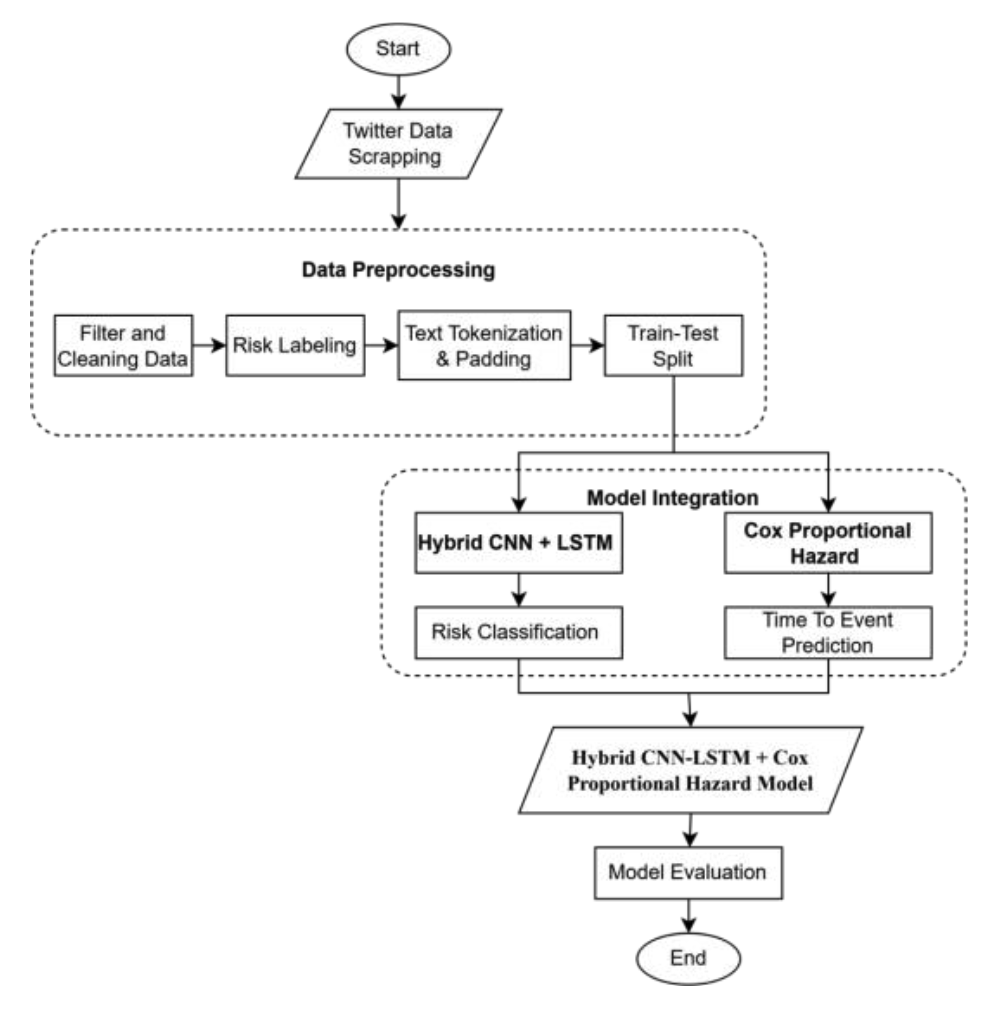
Introduction: Mental disorders such as bipolar disorder are becoming increasingly prominent, particularly with the rise of emotional expression through social media. Early detection remains a significant challenge due to the lack of non-invasive, real-time assessment methods. Methods: This study proposes a hybrid deep learning approach combining Convolutional Neural Network–Long Short-Term Memory (CNN-LSTM) and the Cox Proportional Hazards (Cox PH) model to analyze the risk and timing of bipolar disorder onset. A dataset of 3,511 tweets from 517 Twitter users was collected. The CNN-LSTM model classified bipolar risk levels based on text data, while the Cox PH model estimated the time-to-event for high-risk conditions using behavioral features and predicted risk labels. Results: The hybrid model demonstrated strong predictive performance. The risk label significantly influenced the time to high-risk condition (hazard ratio = 5.39, p < 0.005). The model achieved a concordance index (C-index) of 0.816, indicating high reliability in survival prediction. Conclusions: This case study highlights the potential of integrating deep learning and survival analysis for early bipolar disorder detection using social media data. The proposed non-invasive method can support mental health monitoring while raising awareness of ethical and privacy considerations
Downloads
References
N. Hartini, N. A. Fardana, A. D. Ariana, and N. D. Wardana, “Stigma toward people with mental health problems in Indonesia,” Psychol Res Behav Manag, vol. Volume 11, pp. 535–541, Oct. 2018, doi: 10.2147/PRBM.S175251.
The National Academies Press, Selected Health Conditions and Likelihood of Improvement with Treatment. Washington, D.C.: National Academies Press, 2020. doi: 10.17226/25662.
V. Vasu and M. Indiramma, “A Survey on Bipolar Disorder Classification Methodologies using Machine Learning,” in 2020 International Conference on Smart Electronics and Communication (ICOSEC), IEEE, Sep. 2020, pp. 335–340. doi: 10.1109/ICOSEC49089.2020.9215334.
R. Safa, S. A. Edalatpanah, and A. Sorourkhah, “Predicting mental health using social media: A roadmap for future development,” in Deep Learning in Personalized Healthcare and Decision Support, Elsevier, 2023, pp. 285–303. doi: 10.1016/B978-0- 443-19413-9.00014-X.
A. B. Syahputri and Y. Sibaroni, “Comparative Analysis of CNN and LSTM Performance for Hate Speech Detection on Twitter,” in 2023 11th International Conference on Information and Communication Technology (ICoICT), IEEE, Aug. 2023, pp. 190–195. doi: 10.1109/ICoICT58202.2023.10262656.
M. Kang, S. Shin, J. Jung, and Y. T. Kim, “Classification of Mental Stress Using CNN- LSTM Algorithms with Electrocardiogram Signals,” J Healthc Eng, vol. 2021, pp. 1– 11, Jun. 2021, doi: 10.1155/2021/9951905.
J. L. Katzman, U. Shaham, A. Cloninger, J. Bates, T. Jiang, and Y. Kluger, “DeepSurv: personalized treatment recommender system using a Cox proportional hazards deep neural network,” BMC Med Res Methodol, vol. 18, no. 1, p. 24, Dec. 2018, doi: 10.1186/s12874-018-0482-1.
C.-C. Shen, A. C. Yang, J.-H. Hung, L.-Y. Hu, Y.-Y. Chiang, and S.-J. Tsai, “Risk of psychiatric disorders following pelvic inflammatory disease: a nationwide population- based retrospective cohort study,” Journal of Psychosomatic Obstetrics & Gynecology, vol. 37, no. 1, pp. 6–11, Jan. 2016, doi: 10.3109/0167482X.2015.1124852.
S. D. Ross, T. Lachmann, S. Jaarsveld, S. G. Riedel-Heller, and F. S. Rodriguez, “Creativity across the lifespan: changes with age and with dementia,” BMC Geriatr, vol. 23, no. 1, p. 160, Mar. 2023, doi: 10.1186/s12877-023-03825-1.
D. Nickson, C. Meyer, L. Walasek, and C. Toro, “Prediction and diagnosis of depression using machine learning with electronic health records data: a systematic review,” BMC Med Inform Decis Mak, vol. 23, no. 1, p. 271, Nov. 2023, doi: 10.1186/s12911-023- 02341-x.
M. Irigoyen et al., “Predictors of re-attempt in a cohort of suicide attempters: A survival analysis,” J Affect Disord, vol. 247, pp. 20–28, Mar. 2019, doi: 10.1016/j.jad.2018.12.050.
L. Lac, C. K. Leung, and P. Hu, “Computational frameworks integrating deep learning and statistical models in mining multimodal omics data,” J Biomed Inform, vol. 152, p. 104629, Apr. 2024, doi: 10.1016/j.jbi.2024.104629.
R. Zhang, J. Jiang, and X. Shi, “Modeling Long Sequences in Bladder Cancer Recurrence: A Comparative Evaluation of LSTM,Transformer,and Mamba,” Jul. 2024, [Online]. Available: http://arxiv.org/abs/2405.18518
J. S. L. Figuerêdo, A. L. L. M. Maia, and R. T. Calumby, “Early depression detection in social media based on deep learning and underlying emotions,” Online Soc Netw Media, vol. 31, p. 100225, Sep. 2022, doi: 10.1016/j.osnem.2022.100225.
Z. Wang et al., “Survival modeling using deep learning, machine learning and statistical methods: A comparative analysis for predicting mortality after hospital admission,” Mar. 2024.
Y. Huang, J. Li, M. Li, and R. R. Aparasu, “Application of machine learning in predicting survival outcomes involving real-world data: a scoping review,” BMC Med Res Methodol, vol. 23, no. 1, p. 268, Nov. 2023, doi: 10.1186/s12874-023-02078-1.
P. McInerney, A. Ajith, D. Pretorius, and S. Mabizela, “Considerations for choosing a research design,” Wits J Clin Med, vol. 6, no. 3, 2024, doi: 10.18772/26180197.2024.v6n3a11.
K. Wisenthige, “Research Design,” 2023, pp. 74–93. doi: 10.4018/978-1-6684-6859- 3.ch006.
S. P. Wasti, P. Simkhada, E. van Teijlingen, B. Sathian, and I. Banerjee, “The Growing Importance of Mixed-Methods Research in Health,” Nepal J Epidemiol, vol. 12, no. 1, pp. 1175–1178, Mar. 2022, doi: 10.3126/nje.v12i1.43633.
Y. Qi and Z. Shabrina, “Sentiment analysis using Twitter data: a comparative application of lexicon- and machine-learning-based approach,” Soc Netw Anal Min, vol. 13, no. 1, p. 31, Feb. 2023, doi: 10.1007/s13278-023-01030-x.
N. M. Diaa, S. S. Ahmed, H. M. Salman, and W. A. Sajid, “Statistical Challenges in Social Media Data Analysis Sentiment Tracking and Beyond,” Journal of Ecohumanism, vol. 3, no. 5, pp. 365–384, Sep. 2024, doi: 10.62754/joe.v3i5.3912.
J. R. Jim, M. A. R. Talukder, P. Malakar, M. M. Kabir, K. Nur, and M. F. Mridha, “Recent advancements and challenges of NLP-based sentiment analysis: A state-of-the- art review,” Natural Language Processing Journal, vol. 6, p. 100059, Mar. 2024, doi: 10.1016/j.nlp.2024.100059.
S. Indolia, A. K. Goswami, S. P. Mishra, and P. Asopa, “Conceptual Understanding of Convolutional Neural Network- A Deep Learning Approach,” Procedia Comput Sci, vol. 132, pp. 679–688, 2018, doi: 10.1016/j.procs.2018.05.069.
B. Ghojogh and A. Ghodsi, “Recurrent Neural Networks and Long Short-Term Memory Networks: Tutorial and Survey,” Apr. 2023.
H. Kvamme, Ø. Borgan, and I. Scheel, “Time-to-Event Prediction with Neural Networksand Cox Regression,” Sep. 2019.
Downloads
Published
Issue
Section
License
Copyright (c) 2025 Rizki Amanda, Jasmine Aulia

This work is licensed under a Creative Commons Attribution-NonCommercial 4.0 International License.
Authors retain copyright and full publishing rights to their articles. Upon acceptance, authors grant Indonesian Journal of Data and Science a non-exclusive license to publish the work and to identify itself as the original publisher.
Self-archiving. Authors may deposit the submitted version, accepted manuscript, and version of record in institutional or subject repositories, with citation to the published article and a link to the version of record on the journal website.
Commercial permissions. Uses intended for commercial advantage or monetary compensation are not permitted under CC BY-NC 4.0. For permissions, contact the editorial office at ijodas.journal@gmail.com.
Legacy notice. Some earlier PDFs may display “Copyright © [Journal Name]” or only a CC BY-NC logo without the full license text. To ensure clarity, the authors maintain copyright, and all articles are distributed under CC BY-NC 4.0. Where any discrepancy exists, this policy and the article landing-page license statement prevail.