Classifying Honors Class Eligibility Using SVM
DOI:
https://doi.org/10.56705/ijodas.v6i3.261Keywords:
Classification, Support Vector Machine, Academic Achievement, Supervised Learning, Elite ClassAbstract
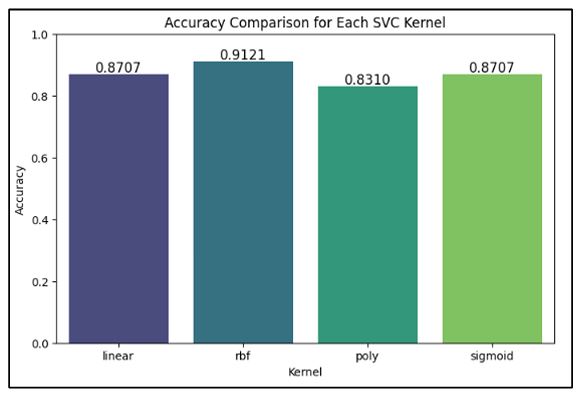
Introduction: The honors class program aims to group outstanding students, but an objective data-based classification system is not yet available. This can result in high-potential students going undetected due to the selection process relying on self-registration and causing a lack of student interest. Method: This research uses the Support Vector Machine (SVM) algorithm to classify the eligibility of students to participate in the honors program based on academic and non-academic data. The dataset consists of 453 entries with an imbalanced class distribution, which was then balanced using the SMOTE technique. The model was trained using GridSearchCV to find the optimal parameters and compared with four types of SVM kernels: linear, polynomial, sigmoid, and radial basis function (RBF). Result: The RBF kernel achieved the best performance with an accuracy of 84%, precision of 0.77, recall of 0.84, and an F1-score of 0.79. However, it was found that the precision in the minority class (high-achieving students) is still lower than in the majority class. Conclusion: The SVM model, particularly with the RBF kernel, has proven effective in automating the classification of students for the honors program. However, further improvements are needed to enhance performance on the minority class to make the selection system fairer and more accurate
Downloads
References
[2] N. L. W. S. R. Ginantra et al., Data Mining dan Penerapan Algoritma, vol. 1. Yayasan Kita Menulis, 2021.
[3] A. Bozkurt, “Educational Technology Research Patterns in the Realm of the Digital Knowledge Age,” J. Interact. Media Educ., vol. 2020, no. 1, hal. 18, Sep 2020, doi: 10.5334/jime.570.
[4] N. Bianchi, Y. Lu, dan H. Song, “The Effect Of Computer-Assisted Learning On Students’ Long-Term Development,” Cambridge, MA, 28180, Des 2020.
[5] A. M. R. B. Makkaraka, Akbar Iskandar, dan Wang Yang, “Design of Web-Based Student Academic Information System,” Ceddi J. Educ., vol. 3, no. 2, hal. 9–15, Des 2024, doi: 10.56134/cje.v3i2.102.
[6] A. Salam, J. Zeniarja, dan D. M. Anthareza, “Student Graduation Prediction Model using Deep Learning Convolutional Neural Network (CNN),” in 2022 International Seminar on Application for Technology of Information and Communication (iSemantic), IEEE, Sep 2022, hal. 362–366. doi: 10.1109/iSemantic55962.2022.9920449.
[7] N. Por, C. Say, dan S. Mov, “FACTORS INFLUENCING STUDENTS’ DECISION IN CHOOSING UNIVERSITIES: BUILD BRIGHT UNIVERSITY STUDENTS,” J. As-Salam, vol. 8, no. 1, hal. 1–15, Jan 2024, doi: 10.37249/assalam.v8i1.646.
[8] Z. Lazić, A. Đorđević, dan A. Gazizulina, “Improvement of Quality of Higher Education Institutions as a Basis for Improvement of Quality of Life,” Sustainability, vol. 13, no. 8, hal. 4149, Apr 2021, doi: 10.3390/su13084149.
[9] W. Zhao, “Honor classes in China’s higher education: perspectives from four universities,” Natl. Sci. Rev., vol. 9, no. 3, Mar 2022, doi: 10.1093/nsr/nwac002.
[10] Sumiyatun, Y. Cahyadi, dan E. Faizal, “Implementation of Support Vector Machine Algorithm for Classification of Study Period and Graduation Predicate of Students,” Indones. J. Data Sci., vol. 6, no. 1, hal. 56–64, Mar 2025, doi: 10.56705/ijodas.v6i1.214.
[11] R. Hazra, M. Banerjee, dan L. Badia, “Machine Learning for Breast Cancer Classification With ANN and Decision Tree,” in 2020 11th IEEE Annual Information Technology, Electronics and Mobile Communication Conference (IEMCON), IEEE, Nov 2020, hal. 0522–0527. doi: 10.1109/IEMCON51383.2020.9284936.
[12] Y. Wang, H. Wang, dan Z. Peng, “Rice diseases detection and classification using attention based neural network and bayesian optimization,” Expert Syst. Appl., vol. 178, hal. 114770, Sep 2021, doi: 10.1016/j.eswa.2021.114770.
[13] G. Manikandan, B. Pragadeesh, V. Manojkumar, A. L. Karthikeyan, R. Manikandan, dan A. H. Gandomi, “Classification models combined with Boruta feature selection for heart disease prediction,” Informatics Med. Unlocked, vol. 44, hal. 101442, 2024, doi: 10.1016/j.imu.2023.101442.
[14] M. S, A. Sharma, S. P. Singh, V. Solanki, S. Sethuramalingam, dan S. P. Singh, “RETRACTED ARTICLE: SVM-based compliance discrepancies detection using remote sensing for organic farms,” Arab. J. Geosci., vol. 14, no. 14, hal. 1334, Jul 2021, doi: 10.1007/s12517-021-07700-4.
[15] M. B. Haile, A. O. Salau, B. Enyew, dan A. J. Belay, “Detection and classification of gastrointestinal disease using convolutional neural network and SVM,” Cogent Eng., vol. 9, no. 1, Des 2022, doi: 10.1080/23311916.2022.2084878.
[16] W. Wu et al., “An Intelligent Diagnosis Method of Brain MRI Tumor Segmentation Using Deep Convolutional Neural Network and SVM Algorithm,” Comput. Math. Methods Med., vol. 2020, hal. 1–10, Jul 2020, doi: 10.1155/2020/6789306.
[17] P. Purnawansyah et al., “Comparative Study of Herbal Leaves Classification using Hybrid of GLCM-SVM and GLCM-CNN,” Ilk. J. Ilm., vol. 15, no. 2, hal. 382–389, Agu 2023, doi: 10.33096/ilkom.v15i2.1759.382-389.
[18] C. Chen, H. Seo, C. H. Jun, dan Y. Zhao, “Pavement crack detection and classification based on fusion feature of LBP and PCA with SVM,” Int. J. Pavement Eng., vol. 23, no. 9, hal. 3274–3283, Jul 2022, doi: 10.1080/10298436.2021.1888092.
[19] E. Ahmed, “Student Performance Prediction Using Machine Learning Algorithms,” Appl. Comput. Intell. Soft Comput., vol. 2024, no. 1, Jan 2024, doi: 10.1155/2024/4067721.
[20] L. Peng, Z. Lu, T. Lei, dan P. Jiang, “Dual-Structure Elements Morphological Filtering and Local Z-Score Normalization for Infrared Small Target Detection against Heavy Clouds,” Remote Sens., vol. 16, no. 13, hal. 2343, Jun 2024, doi: 10.3390/rs16132343.
[21] M. Sholeh dan E. K. Nurnawati, “Comparison of Z-score, min-max, and no normalization methods using support vector machine algorithm to predict student’s timely graduation,” 2024, hal. 040003. doi: 10.1063/5.0202505.
[22] N. Mamat, S. F. Mohd Razali, dan F. B. Hamzah, “Enhancement of water quality index prediction using support vector machine with sensitivity analysis,” Front. Environ. Sci., vol. 10, Jan 2023, doi: 10.3389/fenvs.2022.1061835.
[23] A. A. Kayode, N. O. Akande, A. A. Adegun, dan M. O. Adebiyi, “<p>An automated mammogram classification system using modified support vector machine</p>,” Med. Devices Evid. Res., vol. Volume 12, hal. 275–284, Agu 2019, doi: 10.2147/MDER.S206973.
[24] G. H. Coffie dan S. K. F. Cudjoe, “Toward predictive modelling of construction cost overruns using support vector machine techniques,” Cogent Eng., vol. 10, no. 2, Des 2023, doi: 10.1080/23311916.2023.2269656.
[25] V. Patel dan H. Bhavsar, “Optimizing Kernel Transformations to Handle Binary Class Imbalanced Dataset Classification,” Appl. Artif. Intell., vol. 38, no. 1, Des 2024, doi: 10.1080/08839514.2024.2408933.
[26] O. Oyedele, “Determining the optimal number of folds to use in a K-fold cross-validation: A neural network classification experiment,” Res. Math., vol. 10, no. 1, Des 2023, doi: 10.1080/27684830.2023.2201015.
[27] F. Westin, “Time Period Categorization in Fiction: A Comparative Analysis of Machine Learning Techniques,” Cat. Classif. Q., vol. 62, no. 2, hal. 124–153, Feb 2024, doi: 10.1080/01639374.2024.2315548.
[28] H. A. Abdelaziz, M. Sallah, A. Elgarayhi, dan F. E. Al-Tahhan, “Accurate automatic classification system for 3D CT images of some vertebrate remains from Egypt,” J. Taibah Univ. Sci., vol. 16, no. 1, hal. 632–645, Des 2022, doi: 10.1080/16583655.2022.2096391.
[29] M. Stusek et al., “Accuracy Assessment and Cross-Validation of LPWAN Propagation Models in Urban Scenarios,” IEEE Access, vol. 8, hal. 154625–154636, 2020, doi: 10.1109/ACCESS.2020.3016042.
[30] Z. A. Haq, Z. A. Jaffery, dan S. Mehfuz, “Precision harvesting: comparative analysis of machine learning and generative AI-based classifiers for guava fruit maturity assessment using thermal imaging,” CyTA - J. Food, vol. 22, no. 1, Des 2024, doi: 10.1080/19476337.2024.2401588.
[31] P. Kartikasari, I. T. Utami, S. Suparti, dan S. D. F. Rahman, “BREAST CANCER CLASSIFICATION USING SUPPORT VECTOR MACHINE (SVM) AND LIGHT GRADIENT BOOSTING MACHINE (LIGHTGBM) MODELS,” MEDIA Stat., vol. 16, no. 2, hal. 182–193, Mei 2024, doi: 10.14710/medstat.16.2.182-193.
[32] M. S. Darweesh et al., “Early breast cancer diagnostics based on hierarchical machine learning classification for mammography images,” Cogent Eng., vol. 8, no. 1, Jan 2021, doi: 10.1080/23311916.2021.1968324.
[33] L. Dai, L. Chen, dan M. Luo, “Optimization model and application of linear and nonlinear MBSVM based on pinball loss function,” Math. Comput. Model. Dyn. Syst., vol. 30, no. 1, hal. 898–923, Des 2024, doi: 10.1080/13873954.2024.2424854.
[34] B.-E. Boudriki Semlali, C. Molina, H. Park, dan A. Camps, “Association of land surface temperature anomalies from GOES/ABI, MSG/SEVIRI, and Himawari-8/AHI with land earthquakes between 2010 and 2021,” Geomatics, Nat. Hazards Risk, vol. 15, no. 1, Des 2024, doi: 10.1080/19475705.2024.2324982.
Downloads
Published
Issue
Section
License
Copyright (c) 2025 Khulfani Hendrawan, Ika Arfiani

This work is licensed under a Creative Commons Attribution-NonCommercial 4.0 International License.
Authors retain copyright and full publishing rights to their articles. Upon acceptance, authors grant Indonesian Journal of Data and Science a non-exclusive license to publish the work and to identify itself as the original publisher.
Self-archiving. Authors may deposit the submitted version, accepted manuscript, and version of record in institutional or subject repositories, with citation to the published article and a link to the version of record on the journal website.
Commercial permissions. Uses intended for commercial advantage or monetary compensation are not permitted under CC BY-NC 4.0. For permissions, contact the editorial office at ijodas.journal@gmail.com.
Legacy notice. Some earlier PDFs may display “Copyright © [Journal Name]” or only a CC BY-NC logo without the full license text. To ensure clarity, the authors maintain copyright, and all articles are distributed under CC BY-NC 4.0. Where any discrepancy exists, this policy and the article landing-page license statement prevail.