Optimization of Nglegena Javanese Script Recognition With Machine Learning Based on Zoning And Normalization of Feature Extraction
DOI:
https://doi.org/10.56705/ijodas.v6i2.256Keywords:
Javanese Script Recognition, Nglegena Script, Optical Character Recognition (OCR), Machine Learning, Data NormalizationAbstract
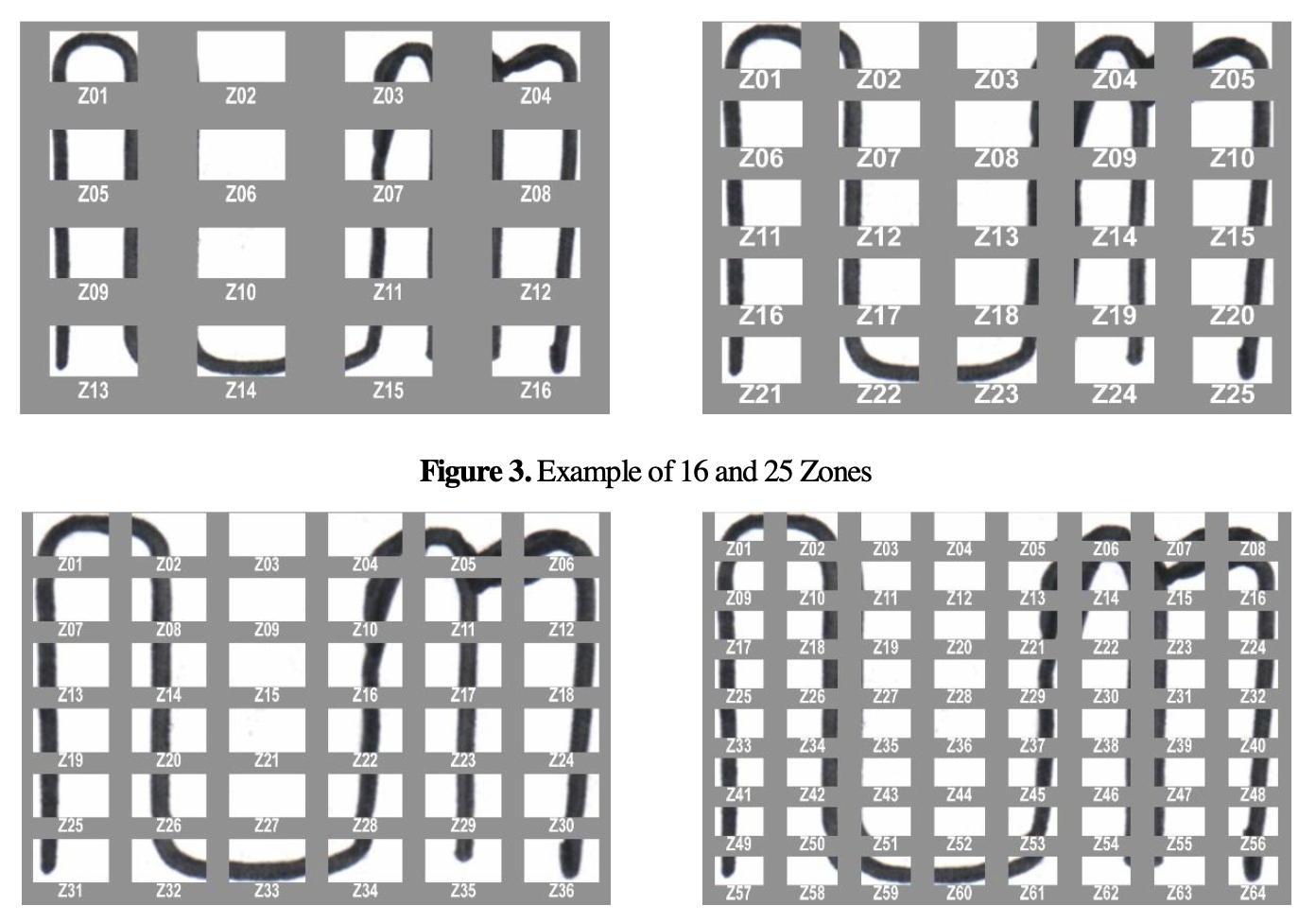
Machine learning offers promising solutions for the recognition of handwritten Javanese Nglegena script, which is crucial for preserving Indonesia's cultural heritage. This study explores the application of several supervised learning algorithms-K-Nearest Neighbors (KNN), Naïve Bayes, Decision Tree, and Random Forest-for classifying handwritten images of Nglegena Javanese script. Feature extraction is performed using a zoning technique, where each character image is divided into multiple zones (16, 25, 36, and 64) to capture local details. The extracted features are further processed using normalization methods, including Min-Max, Z-Score, and Binary normalization, to ensure uniform data distribution. The dataset, consisting of 600 images representing Javanese Nglegena characters, is split into training and testing sets using various ratios. Experimental results show that the combination of Naïve Bayes classification, 36-zone feature extraction, and Min-Max or Z-Score normalization achieves the highest accuracy of 65%. These findings demonstrate that optimizing zoning and normalization can significantly enhance the accuracy of machine learning models for Javanese script recognition. The research contributes to developing Optical Character Recognition (OCR) technology for Javanese script, supporting the digital preservation of Indonesia's historical and cultural heritage.
Downloads
References
A. Budiman, A. Fadlil, and R. Umar, “Improving The Results of Learning Nglegena Javanese Handwriting Using Backpropagation Artificial Neural Network,” Edunesia: Jurnal Ilmiah Pendidikan, vol. 4, no. 1, pp. 259–269, Jan. 2023, doi: 10.51276/edu.v4i1.339.
F. T. Anggraeny, Y. V. Via, and R. Mumpuni, “Image preprocessing analysis in handwritten Javanese character recognition,” Bulletin of Electrical Engineering and Informatics, vol. 12, no. 2, pp. 860–867, Apr. 2023, doi: 10.11591/eei.v12i2.4172.
R. Sutjiadi, T. J. Pattiasina, and P. Santoso, “The Implementation of Deep Learning Technique in Mobile Application as a Preservation and Learning Media of Javanese Letter,” 2024, pp. 161–169. doi: 10.1007/978-3-031-48453-7_16.
M. M. Al Haromainy, A. N. Sihananto, D. A. Prasetya, A. P. Sari, M. Alfyando, and R. Purnomo, “Classification Of Javanese Script Using Convolutional Neural Network With Data Augmentation,” in 2022 IEEE 8th Information Technology International Seminar (ITIS), IEEE, Oct. 2022, pp. 288–291. doi: 10.1109/ITIS57155.2022.10010262.
M. H. Faishal, M. D. Sulistiyo, and A. F. Ihsan, “Javanese Script Letter Detection Using Faster R-CNN,” Indonesian Journal of Artificial Intelligence and Data Mining, vol. 6, no. 2, p. 243, Aug. 2023, doi: 10.24014/ijaidm.v6i2.24641.
W. Torres, M. G. J. van den Brand, and A. Serebrenik, “Xamã : Optical character recognition for multi-domain model management,” Innov Syst Softw Eng, vol. 20, no. 3, pp. 225–249, Sep. 2024, doi: 10.1007/s11334-022-00453-7.
Irham Ferdiansyah Katili, Mochamad Arief Soeleman, and Ricardus Anggi Pramunendar, “Character Recognition of Handwriting of Javanese Character Image using Information Gain Based on the Comparison of Classification Method,” Jurnal RESTI (Rekayasa Sistem dan Teknologi Informasi), vol. 7, no. 1, pp. 193–200, Feb. 2023, doi: 10.29207/resti.v7i1.4488.
R. Najam and S. Faizullah, “Analysis of Recent Deep Learning Techniques for Arabic Handwritten-Text OCR and Post-OCR Correction,” Applied Sciences, vol. 13, no. 13, p. 7568, Jun. 2023, doi: 10.3390/app13137568.
M. Li et al., “TrOCR: Transformer-Based Optical Character Recognition with Pre-trained Models,” Proceedings of the AAAI Conference on Artificial Intelligence, vol. 37, no. 11, pp. 13094–13102, Jun. 2023, doi: 10.1609/aaai.v37i11.26538.
G. N. Adli Kesaulya, A. Fariza, and T. Karlita, “Javanese Script Text Image Recognition Using Convolutional Neural Networks,” in 2022 International Electronics Symposium (IES), IEEE, Aug. 2022, pp. 534–539. doi: 10.1109/IES55876.2022.9888527.
I. H. Sarker, “Machine Learning: Algorithms, Real-World Applications and Research Directions,” SN Comput Sci, vol. 2, no. 3, p. 160, May 2021, doi: 10.1007/s42979-021-00592-x.
J. Huang, I. U. Haq, C. Dai, S. Khan, S. Nazir, and M. Imtiaz, “Isolated Handwritten Pashto Character Recognition Using a K‐NN Classification Tool based on Zoning and HOG Feature Extraction Techniques,” Complexity, vol. 2021, no. 1, Jan. 2021, doi: 10.1155/2021/5558373.
I. K. A. G. Wiguna and I. M. D. P. Asana, “Implementasi Zoning Dan Fitur Arah Sebagai Ekstraksi Fitur Pada Pengenalan Tulisan Tangan Aksara Bali,” Jurnal RESISTOR (Rekayasa Sistem Komputer), vol. 4, no. 1, pp. 85–92, Apr. 2021, doi: 10.31598/jurnalresistor.v4i1.751.
M. Mazziotta and Pareto Adriano, “Everything you always wanted to know about normalization (but were afraid to ask),” Riv Ital Econ Demogr Stat, vol. 75, no. 1, pp. 41–52, 2021.
A. N. Handayani, H. W. Herwanto, K. L. Chandrika, and K. Arai, “Recognition of Handwritten Javanese Script using Backpropagation with Zoning Feature Extraction,” Knowledge Engineering and Data Science, vol. 4, no. 2, p. 117, Dec. 2021, doi: 10.17977/um018v4i22021p117-127.
H. W. Herwanto, A. N. Handayani, K. L. Chandrika, and A. P. Wibawa, “Zoning Feature Extraction for Handwritten Javanese Character Recognition,” in 2019 International Conference on Electrical, Electronics and Information Engineering (ICEEIE), IEEE, Oct. 2019, pp. 264–268. doi: 10.1109/ICEEIE47180.2019.8981462.
H. W. Herwanto, A. N. Handayani, A. P. Wibawa, K. L. Chandrika, and K. Arai, “Comparison of Min-Max, Z-Score and Decimal Scaling Normalization for Zoning Feature Extraction on Javanese Character Recognition,” in 2021 7th International Conference on Electrical, Electronics and Information Engineering (ICEEIE), IEEE, Oct. 2021, pp. 1–3. doi: 10.1109/ICEEIE52663.2021.9616665.
I. Izonin, R. Tkachenko, N. Shakhovska, B. Ilchyshyn, and K. K. Singh, “A Two-Step Data Normalization Approach for Improving Classification Accuracy in the Medical Diagnosis Domain,” Mathematics, vol. 10, no. 11, p. 1942, Jun. 2022, doi: 10.3390/math10111942.
H. Henderi, “Comparison of Min-Max normalization and Z-Score Normalization in the K-nearest neighbor (kNN) Algorithm to Test the Accuracy of Types of Breast Cancer,” IJIIS: International Journal of Informatics and Information Systems, vol. 4, no. 1, pp. 13–20, Mar. 2021, doi: 10.47738/ijiis.v4i1.73.
A. Onan, “SRL-ACO: A text augmentation framework based on semantic role labeling and ant colony optimization,” Journal of King Saud University - Computer and Information Sciences, vol. 35, no. 7, p. 101611, Jul. 2023, doi: 10.1016/j.jksuci.2023.101611.
Q. H. Nguyen et al., “Influence of Data Splitting on Performance of Machine Learning Models in Prediction of Shear Strength of Soil,” Math Probl Eng, vol. 2021, pp. 1–15, Feb. 2021, doi: 10.1155/2021/4832864.
A. Susanto, I. U. W. Mulyono, C. A. Sari, E. H. Rachmawanto, and R. R. Ali, “Javanese Character Recognition Based on K-Nearest Neighbor and Linear Binary Pattern Features,” Kinetik: Game Technology, Information System, Computer Network, Computing, Electronics, and Control, Sep. 2022, doi: 10.22219/kinetik.v7i3.1491.
M. Bansal, A. Goyal, and A. Choudhary, “A comparative analysis of K-Nearest Neighbor, Genetic, Support Vector Machine, Decision Tree, and Long Short Term Memory algorithms in machine learning,” Decision Analytics Journal, vol. 3, p. 100071, Jun. 2022, doi: 10.1016/j.dajour.2022.100071.
M. Suyal and P. Goyal, “A Review on Analysis of K-Nearest Neighbor Classification Machine Learning Algorithms based on Supervised Learning,” International Journal of Engineering Trends and Technology, vol. 70, no. 7, pp. 43–48, Jul. 2022, doi: 10.14445/22315381/IJETT-V70I7P205.
Zena Lusi, Ayu Eka Saputri, and Tri Basuki Kurniawan, “Identifikasi Komentar Spam Pada Sosial Media,” Neptunus: Jurnal Ilmu Komputer Dan Teknologi Informasi, vol. 2, no. 2, pp. 71–76, May 2024, doi: 10.61132/neptunus.v2i2.100.
K. Wabang, Oky Dwi Nurhayati, and Farikhin, “Application of The Naïve Bayes Classifier Algorithm to Classify Community Complaints,” Jurnal RESTI (Rekayasa Sistem dan Teknologi Informasi), vol. 6, no. 5, pp. 872–876, Nov. 2022, doi: 10.29207/resti.v6i5.4498.
B. Charbuty and A. Abdulazeez, “Classification Based on Decision Tree Algorithm for Machine Learning,” Journal of Applied Science and Technology Trends, vol. 2, no. 01, pp. 20–28, Mar. 2021, doi: 10.38094/jastt20165.
M.M Jibril et al., “An overview of streamflow prediction using random forest algorithm,” GSC Advanced Research and Reviews, vol. 13, no. 1, pp. 050–057, Oct. 2022, doi: 10.30574/gscarr.2022.13.1.0112.
P. Mekha and N. Teeyasuksaet, “Image Classification of Rice Leaf Diseases Using Random Forest Algorithm,” in 2021 Joint International Conference on Digital Arts, Media and Technology with ECTI Northern Section Conference on Electrical, Electronics, Computer and Telecommunication Engineering, IEEE, Mar. 2021, pp. 165–169. doi: 10.1109/ECTIDAMTNCON51128.2021.9425696.
M. A. Rasyidi, T. Bariyah, Y. I. Riskajaya, and A. D. Septyani, “Classification of handwritten Javanese script using random forest algorithm,” Bulletin of Electrical Engineering and Informatics, vol. 10, no. 3, pp. 1308–1315, Jun. 2021, doi: 10.11591/eei.v10i3.3036.
D. Murphy, “Using Random Forest Machine Learning Methods to Identify Spatiotemporal Patterns of Cheatgrass Invasion through Landsat Land Cover Classification in the Great Basin from 1984 - 2011,” Apr. 2019, doi: 10.13140/RG.2.2.36786.86723.
Downloads
Published
Issue
Section
License
Copyright (c) 2025 Manuel Tanbica Graciello, Anik Nur Handayani, Aji Prasetya Wibawa

This work is licensed under a Creative Commons Attribution-NonCommercial 4.0 International License.
Authors retain copyright and full publishing rights to their articles. Upon acceptance, authors grant Indonesian Journal of Data and Science a non-exclusive license to publish the work and to identify itself as the original publisher.
Self-archiving. Authors may deposit the submitted version, accepted manuscript, and version of record in institutional or subject repositories, with citation to the published article and a link to the version of record on the journal website.
Commercial permissions. Uses intended for commercial advantage or monetary compensation are not permitted under CC BY-NC 4.0. For permissions, contact the editorial office at ijodas.journal@gmail.com.
Legacy notice. Some earlier PDFs may display “Copyright © [Journal Name]” or only a CC BY-NC logo without the full license text. To ensure clarity, the authors maintain copyright, and all articles are distributed under CC BY-NC 4.0. Where any discrepancy exists, this policy and the article landing-page license statement prevail.