Performance Analysis of Random Forest and Naive Bayes Methods for Classifying Tomato Leaf Disease Datasets
DOI:
https://doi.org/10.56705/ijodas.v6i2.252Keywords:
Random Forest, Naive Bayes, Tomato Plant DiseaseAbstract
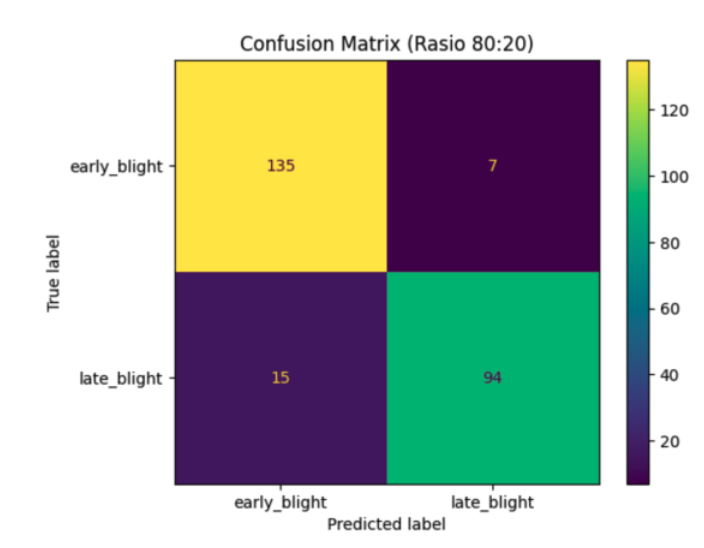
Tomato productivity is often disrupted by diseases affecting tomato plants, such as early blight and late blight, which can significantly reduce crop yields. Early detection of these diseases is crucial to prevent greater losses. This study compares two machine learning-based classification methods, namely Random Forest and Naïve Bayes, in identifying diseases on tomato leaves. The dataset used consists of 1,255 images obtained from Kaggle, with the data divided into two classes: early blight with 627 images and late blight with 628 images, which then underwent preprocessing and data splitting with three ratio scenarios (70:30, 80:20, and 90:10) for training and testing. This study shows that it only achieved an accuracy of 76.98%, while the Random Forest method had the highest accuracy of 92.86% in the 90:10 data ratio scenario. Thus, the Random Forest method proves to be more effective in classifying tomato leaf diseases compared to Naïve Bayes. The implementation of this model can help farmers detect diseases more quickly and accurately, thereby increasing agricultural productivity.
Downloads
References
A. Nainggolan, H. Rumapea, A. P. Silalahi, and L. Sidauruk, “Identifikasi Penyakit Tanaman Tomat Berdasarkan Citra Penyakit Menggunakan Metode GLCM dan Naïve Bayes Classifier,” J. Ilm. Tek. Inform., vol. 2, no. 1, pp. 22–28, 2022.
R. H. Saputra, R. Cipta, and S. Hariyono, “Deteksi Penyakit Tomat Melalui Citra Daun menggunakan Metode Convolutional Neural Network,” Aviat. Electron. Inf. Technol. Telecommun. Electr. Control., vol. 5, no. 1, pp. 43–51, 2023.
R. Soekarta, N. Nurdjan, and A. Syah, “Klasifikasi Penyakit Tanaman Tomat Menggunakan Metode Convolutional Neural Network (CNN),” Insect (Informatics Secur. J. Tek. Inform., vol. 8, no. 2, pp. 143–151, 2023, doi: 10.33506/insect.v8i2.2356.
P. Palupiningsih, A. R. Sujiwanto, and R. R. B. P. Prawirodirjo, “Analisis Perbandingan Performa Model Klasifikasi Kesehatan Daun Tomat menggunakan arsitektur VGG, MobileNet, dan Inception V3,” J. Ilmu Komput. dan Agri-Informatika, vol. 10, no. 1, pp. 98–110, 2023, doi: 10.29244/jika.10.1.98-110.
P. P. E. Indarbensyah and N. Rochmawati, “Penerapan N-Gram menggunakan Algoritma Random Forest dan Naïve Bayes Classifier pada Analisis Sentimen Kebijakan PPKM 2021,” J. Informatics Comput. Sci., vol. 2, no. 04, pp. 235–244, 2021, doi: 10.26740/jinacs.v2n04.p235-244.
U. Khultsum and A. Subekti, “Penerapan Algoritma Random Forest dengan Kombinasi Ekstraksi Fitur Untuk Klasifikasi Penyakit Daun Tomat,” J. Media Inform. Budidarma, vol. 5, no. 1, p. 186, 2021, doi: 10.30865/mib.v5i1.2624.
Dian, Purnawansyah, H. Darwis, and L. Nurhayati, “Klasifikasi Penyakit Bawang Merah Menggunakan Naïve Bayes dan Convolutional Neural Network,” Indones. J. Comput. Sci., vol. 12, no. 4, pp. 1932–1943, 2023, doi: 10.33022/ijcs.v12i4.3265.
M. Habibullah, H. Fahmi, and E. Herawati, “Penerapan Metode Segmentasi Gabor Filter Dan Algoritma Support Vector Machine Untuk Pendeteksian Penyakit Daun Tomat,” J. Ris. Mhs. Mat., vol. 2, no. 6, pp. 221–232, 2023, doi: 10.18860/jrmm.v2i6.22023.
A. F. Azmi, “Prediksi Churn Nasabah Bank Menggunakan Klasifikasi Random Forest Dan Decision Tree Dengan Evaluasi Confusion Matrix,” Komputa J. Ilm. Komput. dan Inform., vol. 13, no. 1, pp. 111–119, 2024, [Online]. Available: https://ojs.unikom.ac.id/index.php/komputa/article/view/12639
U. Suriani, “Penerapan Data Mining untuk Memprediksi Tingkat Kelulusan Mahasiswa Menggunakan Algoritma Decision Tree C4.5,” Journalcisa, vol. 3, no. 2, pp. 55–66, 2023, [Online]. Available: http://jesik.web.id/index.php/jesik/article/view/91
I. Ilham, “Predicting Plant Growth Stages Using Random Forest Classifier: A Machine Learning Approach,” Indones. J. Data Sci., vol. 5, no. 2, pp. 155–165, 2024, doi: 10.56705/ijodas.v5i2.167.
J. M. Informatika, S. I. Misi, A. K. Fajar, and M. Z. Mutaqin, “KLASIFIKASI KANKER PAYUDARA MENGGUNAKAN ALGORITMA NEURAL NETWORK DAN RANDOM FOREST,” J. Manaj. Inform. Sist. Inf., vol. 7, pp. 74–80, 2024.
Marlina Haiza, Elmayati, Zulius Antoni, and Wijaya Harma Oktafia Lingga, “Penerapan Algoritma Random Forest Dalam Klasifikasi Penjurusan Di SMA Negeri Tugumulyo,” BRAHMANA J. Penerapan Kecerdasan Buatan, vol. 4, no. 2, pp. 138–143, 2023.
A. K. Ermy Pily, Oktavianda, F. Aprilia, Rahmaddeni, and L. Efrizoni, “Komparasi Algoritma K-Nearest Neighbors dan Naïve Bayes dalam Klasifikasi Penyakit Diabetes Gestasional,” Indones. J. Comput. Sci., vol. 13, no. 1, pp. 1195–1209, 2024, doi: 10.33022/ijcs.v13i1.3714.
Ericha Apriliyani and Y. Salim, “Analisis performa metode klasifikasi Naïve Bayes Classifier pada Unbalanced Dataset,” Indones. J. Data Sci., vol. 3, no. 2, pp. 47–54, 2022, doi: 10.56705/ijodas.v3i2.45.
R. A. Saputra, “Klasifikasi Penyakit Padi Melalui Citra Daun,” JITET (Jurnal Inform. dan Tek. Elektro Ter., vol. 12, no. 2, 2024.
D. Normawati and S. A. Prayogi, “Implementasi Naïve Bayes Classifier Dan Confusion Matrix Pada Analisis Sentimen Berbasis Teks Pada Twitter,” J. Sains Komput. Inform. (J-SAKTI, vol. 5, no. 2, pp. 697–711, 2021.
Nurul A’ayunnisa, Y. Salim, and H. Azis, “Analisis Performa Metode Gaussian Naïve Bayes untuk Klasifikasi Citra Tulisan Tangan Karakter Arab,” Indones. J. Data Sci., vol. 3, no. 3, pp. 115–121, 2022, doi: 10.56705/ijodas.v3i3.54.
L. Britanthia Christina Tanuwijaya, B. Susanto, and A. Saragih, “Perbandingan Metode Regresi Logistik dan Random Forest untuk Klasifikasi Fitur Mode Audio Spotify,” Indones. J. Data Sci., vol. 1, no. 3, pp. 68–78, 2020.
Suci Amaliah, M. Nusrang, and A. Aswi, “Penerapan Metode Random Forest Untuk Klasifikasi Varian Minuman Kopi di Kedai Kopi Konijiwa Bantaeng,” VARIANSI J. Stat. Its Appl. Teach. Res., vol. 4, no. 3, pp. 121–127, 2022, doi: 10.35580/variansiunm31.
Downloads
Published
Issue
Section
License
Copyright (c) 2025 Rima Ananda, Lilis Nur Hayati, Irawati

This work is licensed under a Creative Commons Attribution-NonCommercial 4.0 International License.
Authors retain copyright and full publishing rights to their articles. Upon acceptance, authors grant Indonesian Journal of Data and Science a non-exclusive license to publish the work and to identify itself as the original publisher.
Self-archiving. Authors may deposit the submitted version, accepted manuscript, and version of record in institutional or subject repositories, with citation to the published article and a link to the version of record on the journal website.
Commercial permissions. Uses intended for commercial advantage or monetary compensation are not permitted under CC BY-NC 4.0. For permissions, contact the editorial office at ijodas.journal@gmail.com.
Legacy notice. Some earlier PDFs may display “Copyright © [Journal Name]” or only a CC BY-NC logo without the full license text. To ensure clarity, the authors maintain copyright, and all articles are distributed under CC BY-NC 4.0. Where any discrepancy exists, this policy and the article landing-page license statement prevail.