A Logarithmic Square Root Regression Model for The Average Blood Glucose Levels of The Drug Induced Diabetic Experimental Rats Treated with The Cissampelos Pareira L. (Menispermaceae) Root Extract
DOI:
https://doi.org/10.56705/ijodas.v6i3.237Keywords:
Diabetes, Cissampelos Pareire, Blood Glucose, Regression, Residual Probability Plot, Leverage, Kolmogorov-Smirnov StatisticAbstract
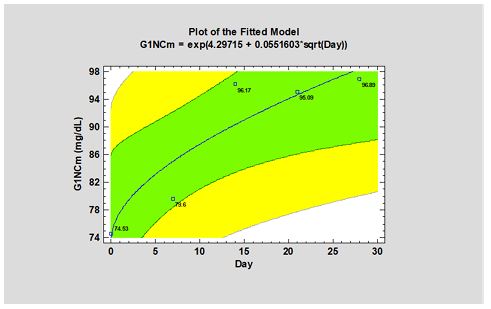
We formulate a nonlinear regression model for elucidating the average values of the blood glucose levels of the experimental rats categorized under the division Group 1 Normal Control (G1NC) in a recent study conducted by Ankit Kumar et al. (see, Ankit Kumar, Ravindra Semwal, Ashutosh Chauhan, Ruchi Badoni Semwal, Subhash Chandra, Debabrata Sircar, Partha Roy and Deepak Kumar Semwal, Evaluation of antidiabetic effect of Cissampelos pareira L. (Menispermaceae) root extract in streptozotocin-nicotinamide-induced diabetic rats via targeting SGLT2 inhibition, Phytomedicine Plus 2 (2022) 100374, 11pp., https://doi.org/10.1016/j.phyplu.2022.100374). By treating the recorded average blood glucose levels of the rats of the group G1NC (response), as a function of the number of days of the experiment (predictor), our projected model involves a linear relation between the logarithm of the response and the square root of the predictor and it explains about 85.6239% of the variability in the response.
Downloads
References
[1] “Diabetes – long-term effects,” Better Health Channel, Victoria: Department of Health
[2] P. T. O’Gara et al., “2013 ACCF/AHA guideline for the management of ST-elevation myocardial infarction: A report of the American College of Cardiology Foundation/American Heart Association Task Force on Practice Guidelines,” Circulation, vol. 127, no. 4, p. e368, Jan. 2013, doi: 10.1161/CIR.0b013e3182742cf6
[3] E. J. Wing and F. Schiffman, Cecil Essentials of Medicine, 10th ed. Pennsylvania: Elsevier, 2022, ISBN: 978-0-323-72271-1.
[4] Y.-J. Lee et al., “Common and unique factors and the bidirectional relationship between chronic kidney disease and nonalcoholic fatty liver in type 2 diabetes patients,” Diabetes, Metabolic Syndrome and Obesity, pp. 1203–1214, 2020, doi: 10.2147/DMSO.S237700.
[5] R. Gupta, S. P. S. Bhat, P. R. Gangadhar Rai, A. K. Kulamarva, and P. S. Prakash, “Study of liver function tests in patients with long standing type 2 diabetes mellitus in comparison to healthy individuals,” vol. 10, no. 5, pp. 289+, Feb. 2021.
[6] A. Kumar et al., “Evaluation of antidiabetic effect of Cissampelos pareira L. (Menispermaceae) root extract in streptozotocin-nicotinamide-induced diabetic rats via targeting SGLT2 inhibition,” Phytomedicine Plus, vol. 2, p. 100374, 2022, doi: 10.1016/j.phyplu.2022.100374.
[7] K. Shah, S. S. Qureshi, J. K. Gupta, N. Upmanyu, and N. S. Chauhan, “Ethnomedicinal uses, phytochemistry and pharmacology of Cissampelos pareira: A review,” in OMICS Group eBooks, B. Kshetrimayum, Ed., pp. 19.
[8] S. Kumari, Anmol, V. Bhatt, S. S. Patil, and U. Sharma, “Cissampelos pareira L.: A review of its traditional uses, phytochemistry, and pharmacology,” J. Ethnopharmacol., 2021, doi: 10.1016/j.jep.2021.113850.
[9] L. M. Upadhyaya and S. Aggarwal, “Viewing the blood glucose levels of the drug induced diabetic experimental rats treated with the Cissampelos pareira L. (Menispermaceae) root extract,” J. Adv. Res. Appl. Math. Stat., vol. 9, no. 1&2, pp. 5–15, 2024.
[10] L. M. Upadhyaya and S. Aggarwal, “Viewing the blood glucose levels of the drug induced diabetic experimental rats treated with the Cissampelos pareira L. (Menispermaceae) root extract – II,” Partners Universal Int. Res. J. (PUIRJ), vol. 3, no. 2, pp. 102–119, 2024, doi: 10.5281/zenodo.12553641.
[11] L. M. Upadhyaya and S. Aggarwal, “A Johnson distribution for the average blood glucose levels of the drug induced diabetic experimental rats treated with the Cissampelos pareira L. (Menispermaceae) root extract,” J. Adv. Res. Appl. Math. Stat., vol. 9, no. 3&4, pp. 13–31, 2024.
[12] L. M. Upadhyaya and S. Aggarwal, “A coup d’oeil of the average blood glucose and SGPT levels of drug induced diabetic experimental rats treated with the Cissampelos pareira L. (Menispermaceae) root extract,” Partners Universal Multidisciplinary Res. J. (PUMRJ), vol. 1, no. 4, pp. 69–95, 2024, doi: 10.5281/zenodo.14203060.
[13] L. M. Upadhyaya and S. Aggarwal, “A power model for the average blood glucose and SGPT levels of drug induced diabetic experimental rats treated with the Cissampelos pareira L. (Menispermaceae) root extract,” Partners Universal Multidisciplinary Res. J. (PUMRJ), vol. 1, no. 4, pp. 112–130, 2024, doi: 10.5281/zenodo.14210174.
[14] N. H. Bingham and J. M. Fry, Regression Linear Models in Statistics. London, Dordrecht, Heidelberg, New York: Springer, 2010, ISBN: 978-1-84882-968-8.
[15] R. B. Darlington and A. F. Hayes, Regression Analysis and Linear Models: Concepts, Applications, and Implementation, Methodology in the Social Sciences. New York, NY, USA: The Guilford Press, 2017, ISBN: 978-1-4625-2113-5.
[16] N. R. Draper and H. Smith, Applied Regression Analysis, 3rd ed. New York, NY, USA: John Wiley & Sons, 1998.
[17] J. Durbin and G. S. Watson, “Testing for serial correlation in least squares regression II,” Biometrika, vol. 38, pp. 159–178, 1951.
[18] “Kolmogorov–Smirnov test,” Wikipedia, The Free Encyclopedia.
[19] N. L. Johnson, “Systems of frequency curves generated by methods of translation,” Biometrika, vol. 36, pp. 149–176, 1949.
[20] “Johnson Distribution,” Wolfram Language Documentation.
[21] “Unusual observations, outlier, leverage, and influential points,” The Open Educator.
[22] “Using leverages to help identify extreme values,” Penn State Eberly College of Science, STAT 501.
Downloads
Published
Issue
Section
License
Copyright (c) 2025 Lalit Mohan Upadhyaya, Himanshu Pandey, Sudhanshu Aggarwal

This work is licensed under a Creative Commons Attribution-NonCommercial 4.0 International License.
Authors retain copyright and full publishing rights to their articles. Upon acceptance, authors grant Indonesian Journal of Data and Science a non-exclusive license to publish the work and to identify itself as the original publisher.
Self-archiving. Authors may deposit the submitted version, accepted manuscript, and version of record in institutional or subject repositories, with citation to the published article and a link to the version of record on the journal website.
Commercial permissions. Uses intended for commercial advantage or monetary compensation are not permitted under CC BY-NC 4.0. For permissions, contact the editorial office at ijodas.journal@gmail.com.
Legacy notice. Some earlier PDFs may display “Copyright © [Journal Name]” or only a CC BY-NC logo without the full license text. To ensure clarity, the authors maintain copyright, and all articles are distributed under CC BY-NC 4.0. Where any discrepancy exists, this policy and the article landing-page license statement prevail.