Analisis Klasifikasi Dataset Citra Penyakit Pneumonia menggunakan Metode K-Nearest Neighbor (KNN)
DOI:
https://doi.org/10.33096/ijodas.v2i1.23Keywords:
Tepi Sobel, Moment Invariant, K-Nearest Neighbor, Akurasi, Penyakit PneumoniaAbstract
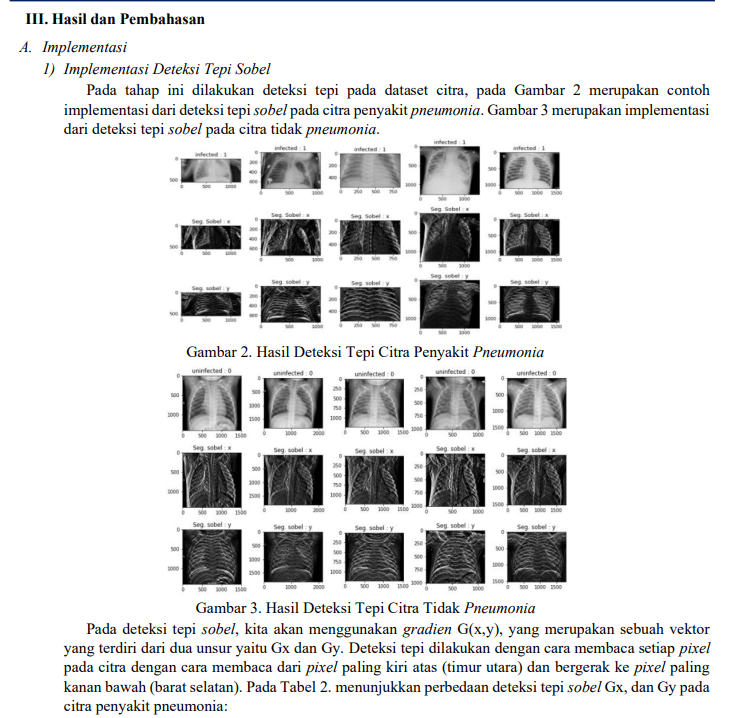
Pneumonia adalah peradangan paru yang menyebabkan nyeri saat bernafas dan keterbatasan intake oksigen. Pneumonia dapat disebabkan oleh bakteri, virus, dan jamur. Penelitian ini menggunakan 1000 dataset citra. Dataset citra tersebut dikelola oleh Paul Mooney yang dikumpulkan dari pasien anak berusia 1-5 tahun di Guangzhou Women and Children’s Medical Center, Guangzhou pada 22 Maret 2018 hingga 25 Maret 2018. Penelitian ini bertujuan untuk menganalisis nilai performa (akurasi, presisi, recall, dan f-measure) pada proses klasifikasi dataset citra penyakit pneumonia dan tidak pneumonia. Tahapan yang dilakukan yaitu membagi dataset dengan berbagai simulasi rasio, deteteksi tepi sobel, ektraksi fitur moment invariant, klasifikasi metode KNN, nilai K=2 sampai K=900. Hasil Penelitian menunjukkan performa terbaik terdapat pada simulasi rasio 20:80 dengan memperoleh nilai akurasi 96%, presisi 97%, recall 97%, f-measure 97% dengan menggunakan nilai K=3.
Downloads
References
Y. Farida, A. Trisna, and D. Nur, “Study of Antibiotic Use on Pneumonia Patient in Surakarta Referral Hospital Studi Penggunaan Antibiotik Pada Pasien Pneumonia di Rumah Sakit Rujukan Daerah Surakarta,” J. Pharm. Sci. Clin. Res., vol. 02, no. 01, pp. 44–52, 2017, doi: 10.20961/jpscr.v2i01.5240.
Kemenkes RI, “Pneumonia Balita.” Buletin Jendela Epidemiologi.
R. Rahmadewi and R. Kurnia, “Klasifikasi Penyakit Paru Berdasarkan Citra Rontgen dengan Metoda Segmentasi Sobel,” J. Nas. Tek. Elektro, vol. 5, no. 1, p. 7, 2016, doi: 10.25077/jnte.v5n1.174.2016.
A. Zalukhu, “Implementasi Metode Canny Dan Sobel Untuk Mendeteksi Tepi Citra,” J. Ris. Komput., vol. 3, no. 6, pp. 25–29, 2016.
F. Liantoni, “Klasifikasi Daun Dengan Perbaikan Fitur Citra Menggunakan Metode K-Nearest Neighbor,” J. Ultim., vol. 7, no. 2, pp. 98–104, 2016, doi: 10.31937/ti.v7i2.356.
S. H. A. Aini, Y. A. Sari, and A. Arwan, “Seleksi Fitur Information Gain untuk Klasifikasi Penyakit Jantung Menggunakan Kombinasi Metode K-Nearest Neighbor dan Naïve Bayes,” J. Pengemb. Teknol. Inf. dan Ilmu Komput. Univ. Brawijaya, vol. 2, 2018.
H. Zhang, “The optimality of Naive Bayes,” Proc. Seventeenth Int. Florida Artif. Intell. Res. Soc. Conf. FLAIRS 2004, vol. 2, pp. 562–567, 2004.
Hasran, “Klasifikasi Penyakit Jantung Menggunakan Metode K-Nearest Neighbor,” Indones. J. Data Sci., vol. 1, no. 1, pp. 1–4, 2020.
C. A. U. Hassan, M. S. Khan, and M. A. Shah, “Comparison of Machine Learning Algorithms in Data classification,” Int. Conf. Autom. Comput., 2018.
A. Maulida, “Penerapan Metode Klasifikasi K-Nearest Neigbor pada Dataset Penderita Penyakit Diabetes,” Indones. J. Data Sci., vol. 1, no. 2, pp. 29–33, 2020.
N. Fadhillah, H. Azis, and D. Lantara, “Validasi Pencarian Kata Kunci Menggunakan Algoritma Levenshtein Distance Berdasarkan Metode Approximate String Matching,” Pros. Semin. Nas. Ilmu Komput. dan Teknol. Inf, vol. 1, pp. 3–7.
A. A. Karim, H. Azis, and Y. Salim, “Kinerja Metode C4.5 dalam Penyaluran Bantuan Dana Bencana 1,” Pros. Semin. Nas. Ilmu Komput. dan Teknol. Inf., vol. 3, no. 2, pp. 84–87, 2018.
M. M. Baharuddin, T. Hasanuddin, and H. Azis, “Analisis Performa Metode K-Nearest Neighbor untuk Identifikasi Jenis Kaca,” Ilk. J. Ilm., vol. 11, no. 28, pp. 269–274, 2019.
D. Cahyanti, A. Rahmayani, and S. Ainy, “Analisis performa metode Knn pada Dataset pasien pengidap Kanker Payudara,” Indones. J. Data Sci., vol. 1, no. 2, pp. 39–43, 2020.
Y. Lukito and A. R. Chrismanto, “Perbandingan Metode-Metode Klasifikasi untuk Indoor Positioning System,” J. Tek. Inform. dan Sist. Inf., vol. 1, no. 2, pp. 123–131, 2015, doi: 10.28932/jutisi.v1i2.373.
Published
Issue
Section
License
Authors retain copyright and full publishing rights to their articles. Upon acceptance, authors grant Indonesian Journal of Data and Science a non-exclusive license to publish the work and to identify itself as the original publisher.
Self-archiving. Authors may deposit the submitted version, accepted manuscript, and version of record in institutional or subject repositories, with citation to the published article and a link to the version of record on the journal website.
Commercial permissions. Uses intended for commercial advantage or monetary compensation are not permitted under CC BY-NC 4.0. For permissions, contact the editorial office at ijodas.journal@gmail.com.
Legacy notice. Some earlier PDFs may display “Copyright © [Journal Name]” or only a CC BY-NC logo without the full license text. To ensure clarity, the authors maintain copyright, and all articles are distributed under CC BY-NC 4.0. Where any discrepancy exists, this policy and the article landing-page license statement prevail.