Performance Comparison of MobileNet and EfficientNet Architectures in Automatic Classification of Bacterial Colonies
DOI:
https://doi.org/10.56705/ijodas.v6i2.218Keywords:
Bacterial Colony Classification, Convolutional Neural Networks (CNNs), MobileNetV2, EfficientNet-B0, Image ClassificationAbstract
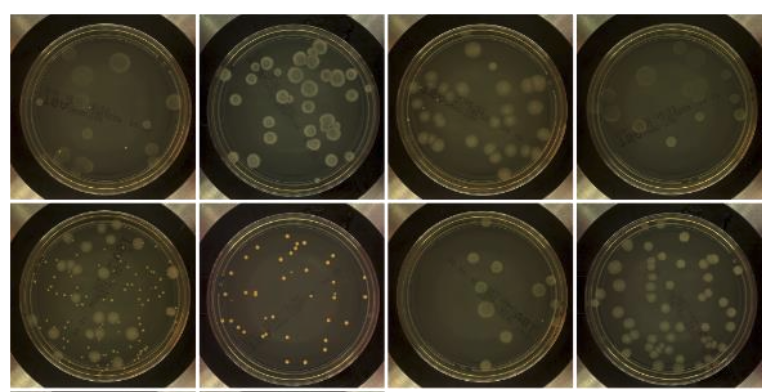
Bacterial colony classification is crucial in microbiology but remains labor-intensive and time-consuming when performed manually. Deep learning, particularly Convolutional Neural Networks (CNNs), enables automated classification, improving accuracy and efficiency. This study compares MobileNetV2 and EfficientNet-B0 for bacterial colony classification, evaluating the impact of data augmentation on model performance. Using the Neurosys AGAR dataset, preprocessing techniques such as histogram equalization, gamma correction, and Gaussian blur were applied, while data augmentation (rotation, noise addition, luminosity adjustments) improved model generalization. The dataset was split (80% training, 20% testing), and models were trained with learning rates (0.0001, 0.001) and epochs (100, 150, 200). Results show EfficientNet-B0 outperforms MobileNetV2, achieving higher validation accuracy and stability, with optimal performance at 150–200 epochs and a lower learning rate (0.0001). Data augmentation significantly improved accuracy and reduced overfitting. While MobileNetV2 remains a lightweight alternative, its performance is heavily reliant on augmentation. These findings highlight EfficientNet-B0 as the superior model, supporting the automation of microbiological diagnostics. Future research should explore hybrid CNN architectures, Vision Transformers (ViTs), and real-time implementation for improved classification efficiency.
Downloads
References
L. Z. Pipe, “Understanding Evolving Bacterial Colonies,” in Springer Handbook of Bio-/Neuroinformatics, N. Kasabov, Ed., Berlin, Heidelberg: Springer Berlin Heidelberg, 2014, pp. 93–112. doi: 10.1007/978-3-642-30574-0_7.
S. Patel, “Bacterial Colony Classification Using Atrous Convolution with Transfer Learning Authors,” Ann Rom Soc Cell Biol, pp. 1428–1441, Oct. 2021.
T. Beznik, P. Smyth, G. de Lannoy, and J. A. Lee, “Deep learning to detect bacterial colonies for the production of vaccines,” Neurocomputing, vol. 470, pp. 427–431, 2022, doi: https://doi.org/10.1016/j.neucom.2021.04.130.
Liu Shousheng et al., “Bacterial colonies detecting and counting based on enhanced CNN detection method,” E3S Web Conf., vol. 233, p. 2012, 2021, doi: 10.1051/e3sconf/202123302012.
S. G. Sambandam, R. Purushothaman, R. U. Baig, S. Javed, V. T. Hoang, and K. Tran-Trung, “Intelligent surface defect detection for submersible pump impeller using MobileNet V2 architecture,” The International Journal of Advanced Manufacturing Technology, vol. 124, no. 10, pp. 3519–3532, 2023, doi: 10.1007/s00170-022-10386-x.
M. Sandler, A. Howard, M. Zhu, A. Zhmoginov, and L.-C. Chen, “ MobileNetV2: Inverted Residuals and Linear Bottlenecks ,” in 2018 IEEE/CVF Conference on Computer Vision and Pattern Recognition (CVPR) , Los Alamitos, CA, USA: IEEE Computer Society, Jun. 2018, pp. 4510–4520. doi: 10.1109/CVPR.2018.00474.
L. Mpova, T. Shongwe, and A. Hasan, “Classification and Detection of Cyanosis Images on Lightly and Darkly Pigmented Individual Human Skins using a Fine-Tuned MobileNet Architecture,” in 2023 International Conference on Artificial Intelligence, Big Data, Computing and Data Communication Systems (icABCD), 2023, pp. 1–5. doi: 10.1109/icABCD59051.2023.10220464.
H. Pu and K. Yi, “A Comparative Analysis of EfficientNet and MobileNet Models’ Performance on Limited Datasets: An Example of American Sign Language Alphabet Detection,” Highlights in Science, Engineering and Technology, 2024, [Online]. Available: https://api.semanticscholar.org/CorpusID:270612497
A. Matthew, A. A. S. Gunawan, and F. I. Kurniadi, “Diabetic Retinopathy Diagnosis System Based on Retinal Biomarkers Using EfficientNet-B0 for Android Devices,” in 2023 IEEE International Conference on Communication, Networks and Satellite (COMNETSAT), 2023, pp. 207–212. doi: 10.1109/COMNETSAT59769.2023.10420736.
V.-D. and J. K.-H. Hoang Van-Thanh and Hoang, “Rethinking Mobile Inverted Bottleneck Convolution for EfficientNet,” in Computational Intelligence Methods for Green Technology and Sustainable Development, W.-J. and Q. H. A. and L. H.-G. and Q. H.-N. Huang Yo-Ping and Wang, Ed., Cham: Springer International Publishing, 2023, pp. 435–445.
T. M. and J. K.-H. Thanh Hoang Van and Phuong, “A Compact Version of EfficientNet,” in The 12th Conference on Information Technology and Its Applications, H. and H. C.-P. and N. Q.-V. Nguyen Ngoc Thanh and Le-Minh, Ed., Cham: Springer Nature Switzerland, 2023, pp. 297–305.
K. M. Ting, “Confusion Matrix,” in Encyclopedia of Machine Learning and Data Mining, G. I. Sammut Claude and Webb, Ed., Boston, MA: Springer US, 2017, p. 260. doi: 10.1007/978-1-4899-7687-1_50.
T. Renchin, D. Janchiv, and B. Sanjaa, “Comparative study of some methods for image processing,” in 2008 Third International Forum on Strategic Technologies, 2008, pp. 364–365. doi: 10.1109/IFOST.2008.4602858.
A. A. Kumar, N. Lal, and R. N. Kumar, “A Comparative Study of Various Filtering Techniques,” in 2021 5th International Conference on Trends in Electronics and Informatics (ICOEI), 2021, pp. 26–31. doi: 10.1109/ICOEI51242.2021.9453068.
Downloads
Published
Issue
Section
License
Authors retain copyright and full publishing rights to their articles. Upon acceptance, authors grant Indonesian Journal of Data and Science a non-exclusive license to publish the work and to identify itself as the original publisher.
Self-archiving. Authors may deposit the submitted version, accepted manuscript, and version of record in institutional or subject repositories, with citation to the published article and a link to the version of record on the journal website.
Commercial permissions. Uses intended for commercial advantage or monetary compensation are not permitted under CC BY-NC 4.0. For permissions, contact the editorial office at ijodas.journal@gmail.com.
Legacy notice. Some earlier PDFs may display “Copyright © [Journal Name]” or only a CC BY-NC logo without the full license text. To ensure clarity, the authors maintain copyright, and all articles are distributed under CC BY-NC 4.0. Where any discrepancy exists, this policy and the article landing-page license statement prevail.