Assessing the Predictive Power of Logistic Regression on Liver Disease Prevalence in the Indian Context
DOI:
https://doi.org/10.56705/ijodas.v5i1.121Keywords:
Logistic Regression, Liver Disease, Predictive Modelling, Machine Learning, Medical DiagnosticsAbstract
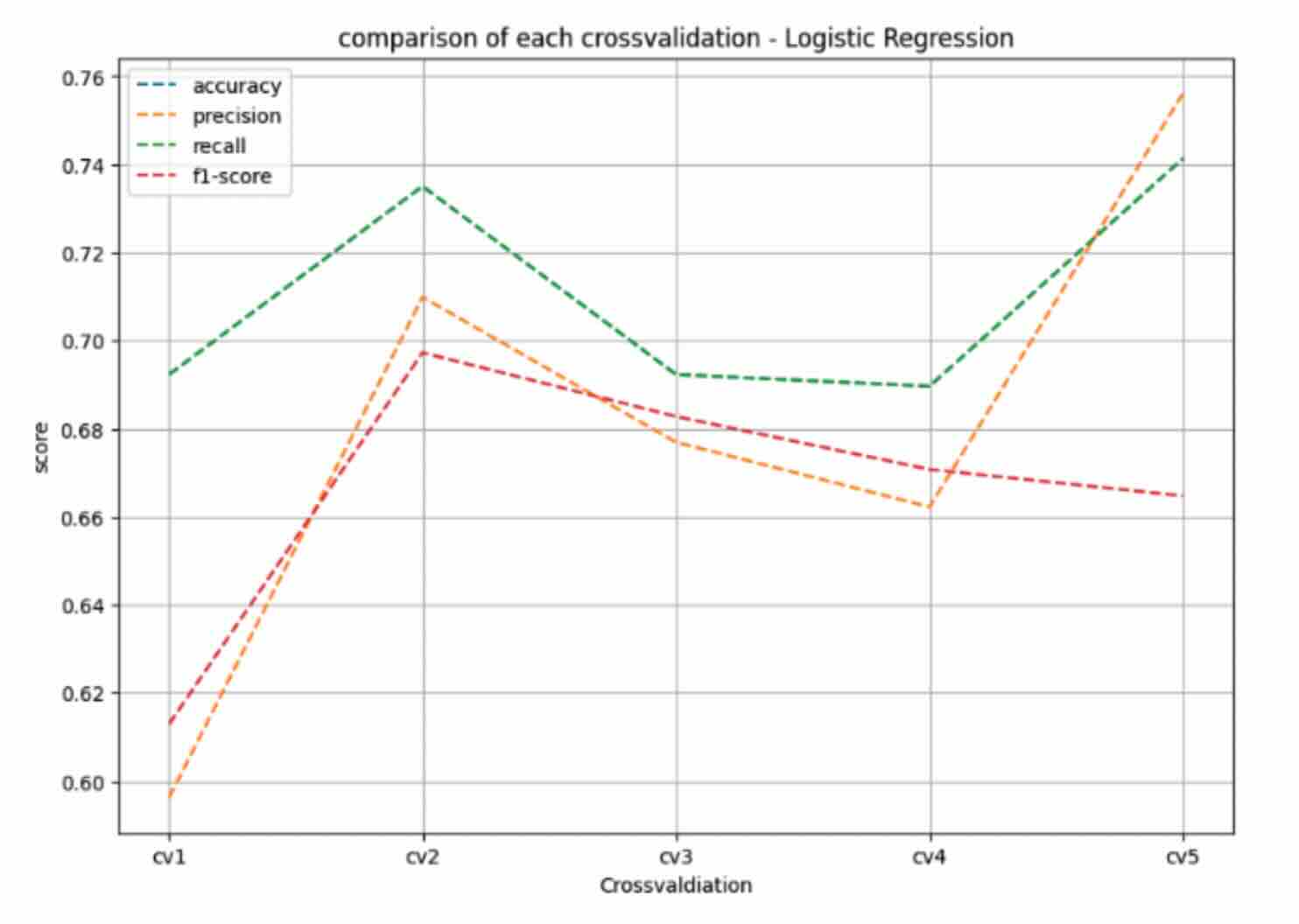
This study delves into the application of Logistic Regression through a Voting Classifier to predict liver disease prevalence within the Indian demographic, specifically analyzing data from the NorthEast of Andhra Pradesh. Employing a dataset encompassing 584 patient records, the research utilizes a 5-fold cross-validation approach to evaluate the model's performance across accuracy, precision, recall, and F1-Score metrics. The findings reveal accuracy rates ranging from 69.23% to 74.14%, with variable precision and recall, indicating a promising yet improvable predictive capability of the model. The study significantly contributes to the existing body of knowledge by demonstrating the potential of Logistic Regression in medical diagnostics, especially in the context of liver disease, and highlighting the critical role of machine learning models in enhancing diagnostic processes. Through a detailed discussion, the research aligns with previous studies on the efficacy of machine learning in healthcare, advocating for the integration of more comprehensive data and suggesting further exploration into the model's applicability across diverse populations. The study's implications extend to healthcare professionals and policymakers, underscoring the necessity for advanced diagnostic tools in the early detection of liver diseases.
Downloads
References
F. Huang, “Logistic Regression Fitting of Rainfall-Induced Landslide Occurrence Probability and Continuous Landslide Hazard Prediction Modelling,” Diqiu Kexue - Zhongguo Dizhi Daxue Xuebao/Earth Sci. - J. China Univ. Geosci., vol. 47, no. 12, pp. 4609–4628, 2022, doi: 10.3799/dqkx.2021.164.
L. S. Van Velzen, “Classification of suicidal thoughts and behaviour in children: results from penalised logistic regression analyses in the Adolescent Brain Cognitive Development study,” Br. J. Psychiatry, vol. 220, no. 4, pp. 210–218, 2022, doi: 10.1192/bjp.2022.7.
T. M. Jawa, “Logistic regression analysis for studying the impact of home quarantine on psychological health during COVID-19 in Saudi Arabia,” Alexandria Eng. J., vol. 61, no. 10, pp. 7995–8005, 2022, doi: 10.1016/j.aej.2022.01.047.
Y. Zhang, “Multi-label feature selection based on logistic regression and manifold learning,” Appl. Intell., vol. 52, no. 8, pp. 9256–9273, 2022, doi: 10.1007/s10489-021-03008-8.
B. Cao, “Performance analysis and comparison of PoW, PoS and DAG based blockchains,” Digit. Commun. Networks, vol. 6, no. 4, pp. 480–485, 2020, doi: 10.1016/j.dcan.2019.12.001.
S. Rahman, “Performance analysis of boosting classifiers in recognizing activities of daily living,” Int. J. Environ. Res. Public Health, vol. 17, no. 3, 2020, doi: 10.3390/ijerph17031082.
A. A. Ewees, “Performance analysis of Chaotic Multi-Verse Harris Hawks Optimization: A case study on solving engineering problems,” Eng. Appl. Artif. Intell., vol. 88, 2020, doi: 10.1016/j.engappai.2019.103370.
Z. Zhao, “Logistic Regression Analysis of Risk Factors and Improvement of Clinical Treatment of Traumatic Arthritis after Total Hip Arthroplasty (THA) in the Treatment of Acetabular Fractures,” Comput. Math. Methods Med., vol. 2022, 2022, doi: 10.1155/2022/7891007.
V. N. Vasu, “Prediction of Defective Products Using Logistic Regression Algorithm against Linear Regression Algorithm for Better Accuracy,” 2022 International Conference on Innovation and Intelligence for Informatics, Computing, and Technologies, 3ICT 2022. pp. 161–166, 2022, doi: 10.1109/3ICT56508.2022.9990653.
A. Bailly, “Effects of dataset size and interactions on the prediction performance of logistic regression and deep learning models,” Comput. Methods Programs Biomed., vol. 213, 2022, doi: 10.1016/j.cmpb.2021.106504.
G. Giri, I. A. Musdar, H. Angriani, and ..., “Enhancing Disease Management in Mango Cultivation: A Machine Learning Approach to Classifying Leaf Diseases,” Indones. J. …, 2023, doi:10.56705/ijodas.v4i3.111.
N. Rismayanti and A. P. Utami, “Improving Multi-Class Classification on 5-Celebrity-Faces Dataset using Ensemble Classification Methods,” Indones. J. Data …, 2023, doi: 10.56705/ijodas.v4i2.78.
S. Hidayat, H. M. T. Ramadhan, and ..., “Comparison of K-Nearest Neighbor and Decision Tree Methods using Principal Component Analysis Technique in Heart Disease Classification,” Indones. J. …, 2023, doi: 10.56705/ijodas.v4i2.70.
B. H. Reddy, “Classification of Fire and Smoke Images using Decision Tree Algorithm in Comparison with Logistic Regression to Measure Accuracy, Precision, Recall, F-score,” 14th International Conference on Mathematics, Actuarial Science, Computer Science and Statistics, MACS 2022. 2022, doi: 10.1109/MACS56771.2022.10022449.
S. Ortiz-Toquero, “Classification of Keratoconus Based on Anterior Corneal High-order Aberrations: A Cross-validation Study,” Optom. Vis. Sci., vol. 97, no. 3, pp. 169–177, 2020, doi: 10.1097/OPX.0000000000001489.
T. A. Reist, “Cross validation of aerodynamic shape optimization methodologies for aircraft wing-body optimization,” AIAA J., vol. 58, no. 6, pp. 2581–2595, 2020, doi: 10.2514/1.J059091.
Z. Xiong, “Evaluating explorative prediction power of machine learning algorithms for materials discovery using k-fold forward cross-validation,” Comput. Mater. Sci., vol. 171, 2020, doi: 10.1016/j.commatsci.2019.109203.
O. Karal, “Performance comparison of different kernel functions in SVM for different k value in k-fold cross-validation,” Proc. - 2020 Innov. Intell. Syst. Appl. Conf. ASYU 2020, 2020, doi: 10.1109/ASYU50717.2020.9259880.
M. Rafało, “Cross validation methods: Analysis based on diagnostics of thyroid cancer metastasis,” ICT Express, vol. 8, no. 2, pp. 183–188, 2022, doi: 10.1016/j.icte.2021.05.001.
S. Rahmah, H. Azis, D. Widyawati, and A. U. Tenripada, “Prediksi potensi donatur menggunakan model Logistic Regression,” Indones. J. Data Sci., vol. 4, no. 1, pp. 31–37, 2023, doi:10.56705/ijodas.v4i1.64.
H. Azis, D. Widyawati, and ..., “Prediksi potensi donatur menggunakan model Logistic Regression,” Indones. J. …, 2023, doi:10.56705/ijodas.v4i1.64.
H. Azis, F. T. Admojo, and E. Susanti, “Analisis Perbandingan Performa Metode Klasifikasi pada Dataset Multiclass Citra Busur Panah,” Techno.Com, vol. 19, no. 3, 2020, doi: 10.33633/tc.v19i3.3646.
Downloads
Published
Issue
Section
License
Copyright (c) 2024 Izmy Alwiah, Umar Zaky, Aris Wahyu Murdiyanto

This work is licensed under a Creative Commons Attribution-NonCommercial 4.0 International License.
Authors retain copyright and full publishing rights to their articles. Upon acceptance, authors grant Indonesian Journal of Data and Science a non-exclusive license to publish the work and to identify itself as the original publisher.
Self-archiving. Authors may deposit the submitted version, accepted manuscript, and version of record in institutional or subject repositories, with citation to the published article and a link to the version of record on the journal website.
Commercial permissions. Uses intended for commercial advantage or monetary compensation are not permitted under CC BY-NC 4.0. For permissions, contact the editorial office at ijodas.journal@gmail.com.
Legacy notice. Some earlier PDFs may display “Copyright © [Journal Name]” or only a CC BY-NC logo without the full license text. To ensure clarity, the authors maintain copyright, and all articles are distributed under CC BY-NC 4.0. Where any discrepancy exists, this policy and the article landing-page license statement prevail.