Design and Development of an ESP32-Based Bird Repellent Prototype with Dual Detection (PIR and Ultrasonic Sensors)
DOI:
https://doi.org/10.56705/ijonit.v2i2.418Keywords:
Bird Repellent , ESP32 , OR logic , Controlled Test Room , Dual SensorsAbstract
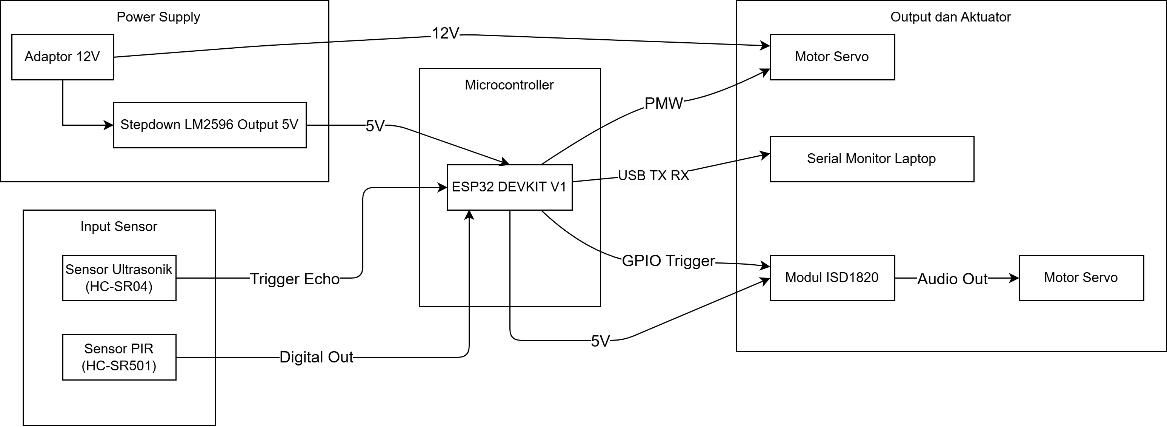
Attacks by seed-eating birds during the rice-ripening stage can reduce crop yields, while traditional repelling methods tend to be inconsistent. This study aims to design and evaluate an ESP32-based bird repellent prototype with dual detection using passive infrared and ultrasonic sensors with OR logic. The study adopts a design-and-development approach with applied experimentation in a controlled test room measuring 2 × 3 meters. The system integrates an HC-SR501 passive infrared sensor, an HC-SR04 ultrasonic sensor, an MG996R servo motor, an ISD1820 sound module, a speaker, and a reflective string as visual and audio actuators. Testing consisted of one test without birds and five sessions with test birds, with a maximum of seven birds. The results showed that the prototype was successfully implemented and all main system functions operated as designed. During testing with birds, the system recorded 171 triggers, with an average response time of 0.57 seconds and an average triggering distance of 232.14 cm. Following activation of the visual and audio actuators, the proportion of move-away responses was 68 percent. These results indicate that the developed prototype is suitable for preliminary validation of a bird repellent system in a controlled test environment.
References
[1] D. Kartikasari, A. Z. Abidin, C. S. Agustina, and I. Nurdianyoto, “Keanekaragaman dan Kelimpahan Burung Pemakan Biji di Area Persawahan Tanjungsari, Tulungagung,” LenteraBio, vol. 13, no. 2, pp. 262–269, May 2024.
[2] I. N. Bari, A. S. Santriyan, W. Kurniawan, R. Hindersah, T. Suganda, and V. K. Dewi, “Preferensi dan Waktu Aktif Harian Kunjungan Burung Bondol Jawa (Lonchura leucogastroides) terhadap Fase Pertumbuhan Padi (IR-36) di Lahan Sawah Jatinangor,” Jurnal Agrikultura, vol. 32, no. 1, pp. 72–76, May 2021.
[3] A. Kurniawan et al., “Pengendalian Hama Burung Pipit Menggunakan Gelombang Ultrasonik pada Lahan Sawah Musim Kemarau di Tasikmalaya,” Nanggroe: Jurnal Pengabdian Cendikia, vol. 2, no. 8, pp. 28–33, Nov. 2023, doi: 10.5281/zenodo.10085123.
[4] F. Rizky, S. Ch, and B. Darmawan, “Rancang Bangun Prototipe Pengusir Hama Burung Dan Tikus Sawah Berbasis IoT Terintergrasi Aplikasi Android,” JEITECH – Journal of Electrical Engineering and Information Technology, vol. 2, no. 1, pp. 61–69, Mar. 2024.
[5] E. Ernawati et al., “Inovasi Pertanian: Scarecrow Pintar Berbasis ESP32 untuk Mengusir Hama Secara Otomatis di Desa Tegal Waru Kecamatan Ciampea,” Jurnal Pengabdian Masyarakat INAIS, vol. 3, no. 2, pp. 57–65, Dec. 2024, doi: 10.56406/jsm.v3i02.616.
[6] A. H. Al Rasyid and A. L. Wardani, “Rancang Bangun Pengusir Hama Burung dan Belalang Pada Padi Menggunakan Gelombang Ultrasonik Berbasis LoRa,” ELPOSYS: Jurnal Sistem Kelistrikan, vol. 11, no. 3, pp. 219–224, Oct. 2024.
[7] A. Julisma M, J. Jamaluddin, and F. Fathahillah, “Modifikasi Alat Pengusir Hama Burung Berbasis Mikrokontroler Menggunakan Sensor PIR,” PATANI, vol. 6, no. 2, pp. 22–25, Sep. 2023.
[8] A. S. Alwi, R. A. Pratama, B. A. Ikawanty, E. S. Budi, and A. D. Risdhayanti, “Implementasi Sistem Pengusir Hama Burung Berbasis Arduino untuk Optimalisasi Pertanian: Kajian Monitoring Kelembapan Tanah,” Journal of Applied Smart Electrical Network and Systems (JASENS), vol. 4, no. 1, pp. 29–34, Jun. 2023.
[9] R. Hamdani, S. Ramadhan, and S. Syufrijal, “Prototipe Pengusir Hama Burung Berbasis Internet of Things,” Jurnal Autocracy, vol. 7, no. 2, pp. 80–86, Dec. 2020, doi: 10.21009/autocracy.072.6.
[10] S. M. Manurung, A. Wanto, and I. Gunawan, “Rancang Bangun Alat Pengusir Hama Burung Berbasis Arduino Uno,” Jurnal Ilmiah Teknik Elektro dan Komputer (JITEKH), vol. 10, no. 2, pp. 84–90, 2022.
[11] I. Sufaat and J. Juliandri, “Rancang Bangun Alat Pengusir Hama Burung pada Padi Sawah Petani Berbasis IoT,” Journal of Systems and Computer (JoSYC), vol. 5, no. 2, pp. 306–314, Feb. 2024, doi: 10.47065/josyc.v5i2.4921.
[12] A. N. Al Matsany and A. Martani, “Rancang Bangun Alat Deteksi Kebisingan Pengunjung Perpustakaan Menggunakan Mikrokontroler Berbasis Internet of Things (IoT),” JTEK: Jurnal Teknik Informatika, vol. 5, no. 1, pp. 648–660, Jun. 2025.
[13] A. Amaluddin, R. Satra, and A. W. M. Gaffar, “Pot Tanaman Pintar Berbasis Internet of Things (Studi Kasus: Aglonema),” LINIER: Literatur Informatika & Komputer, vol. 2, no. 2, pp. 267–275, Jun. 2025, doi: 10.33096/linier.v2i2.3135.
[14] A. Muh. F. Dzikrulkhair, R. Satra, and A. W. M. Gaffar, “Rancang Bangun Jemuran Pintar Otomatis Berbasis Internet of Things (IoT),” LINIER: Literatur Informatika & Komputer, vol. 2, no. 3, pp. 438–446, Sep. 2025, doi: 10.33096/linier.v2i3.3153.
[15] A. S. Nasrullah, T. Hasanuddin, and H. Azis, “Akses Kontrol Pintu Gerbang Otomatis Berbasis Arduino UNO,” LINIER: Literatur Informatika & Komputer, vol. 1, no. 1, pp. 74–78, 2024, doi: 10.33096/linier.v1i1.2484.
[16] M. A. Mubarak, F. Fattah, and H. Azis, “Prototipe Smart Home Berbasis ESP32 dengan Fitur Keamanan Pintu, Lampu, dan AC Otomatis Berbasis IoT,” LINIER: Literatur Informatika & Komputer, vol. 2, no. 3, pp. 421–437, Sep. 2025, doi: 10.33096/linier.v2i3.3152.
[17] I. As’ad, A. M. Rahmatullah, S. M. Abdullah, F. Fahmi, H. M. Pakka, and A. Andiyan, “Smart Clove Oil Distillation System using IoT and Ultrasonic Sensors,” Sistemasi: Jurnal Sistem Informasi, vol. 14, no. 5, pp. 2341–2349, Jul. 2025.