Design and Development of An Iot-Based Digital Scale for Measuring Cement Weight Using A Load Cell Sensor at Pt Semen Tonasa, Balikpapan Branch
DOI:
https://doi.org/10.56705/ijonit.v2i2.403Keywords:
Internet of Things, ESP32, Load Cell, Digital Scale, Local Web ServerAbstract
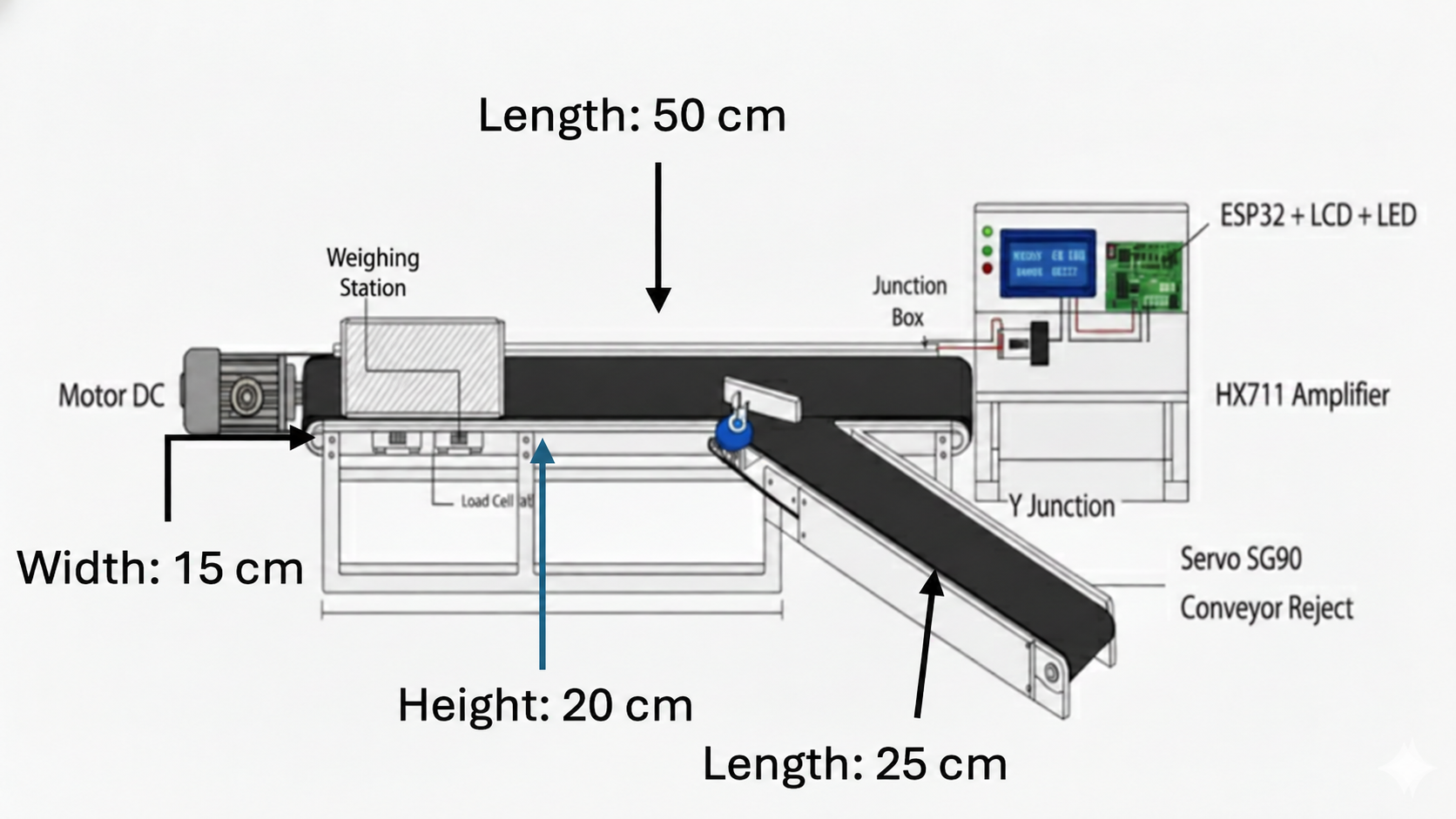
Manual cement weighing in the industrial environment of PT Semen Tonasa, Balikpapan Branch, is considered inefficient and prone to human error. This study aims to develop a prototype Internet of Things-based digital conveyor weighing system capable of automatically measuring, sorting, and monitoring the weight of cement packages. The system is controlled by an ESP32 microcontroller integrated with a load cell sensor and an HX711 amplifier module to read the dynamic weight of packages moving on the conveyor. The conveyor belt is driven by a DC motor with a BTS7960-series driver, while a servo motor serves as the sorting arm actuator. The system is programmed to recognize a target cement weight of 500 grams with a tolerance of 10 grams. Remote monitoring is performed through a local web server dashboard with a client–server architecture that displays indicators and weighing history charts without excessively burdening the microcontroller memory. Test results show that the system successfully identifies peak loads dynamically, allows on-target packages to proceed, and automatically removes nonconforming packages. The device demonstrates very high accuracy, with an average reading error of only 0.63%. The system exhibits substantially better precision and operational consistency than conventional weighing methods
References
[1] H. Q. Karima, M. A. Saputra, and F. Romadlon, “Analisis Kapasitas Produksi dan Pemenuhan Permintaan dengan Model Sistem Dinamis pada Industri Semen,” Feb. 2022.
[2] N. S. Sushmitha and H. P. Vinod Kumar, “Design and Implementation of IoT Based Smart Weighing Device for LPG Monitoring and Industrial Applications,” International Journal of Research in Engineering, Science and Management, vol. 3, no. Issue-5, May 2020.
[3] G. Supriyanto, Kumara Agung, and Suparman, “Rancang Bangun Timbangan Menggunakan Sensor Load Cell dan Mikrokontroler Berbasis Internet of Things (IoT),” AE INNOVATION: Agricultural Engineering Innovation Journal, vol. 2, no. 1, p. 1024, Jan. 2024, doi: 10.55180/aei.v2i1.1024.
[4] P. Rachmawati, “Perancangan Esp32 Design Of Digital Scales Simulation Using HX711 Sensor With Additional Buzzer Based On Esp32,” Semarang, 2023.
[5] M. N. Mansor, N. A. A. Talib, S. A. Saidi, W. A. Mustafa, and N. F. Zamri, “Arduino IOT Based Inventory Management System Using Load Cell and NodeMCU,” Journal of Advanced Research in Applied Sciences and Engineering Technology, vol. 32, no. 3, pp. 12–25, Nov. 2023, doi: 10.37934/araset.32.3.1225.
[6] S. Meenatchi Sundaram, J. R. Naik, M. Natarajan, and A. Acharya K, “Design and development of an IoT-based trolley for weighing the patient in lying condition,” Front. Digit. Health, vol. 6, p. 14, Sep. 2024, doi: 10.3389/fdgth.2024.1339184.
[7] S. W. Jannah, A. Muhtadi, M. D. Ridwan, and R. Kurlillah, “Design of an IoT-Based Automatic Weighing System for Catfish Farming to Support Smart Aquaculture,” TIERS Information Technology Journal, vol. 5, no. 2, pp. 111–118, Nov. 2024, doi: 10.38043/tiers.v6i2.5633.
[8] D. Zhou et al., “Development Of An Automatic Weighing Platform For Monitoring Bodyweight Of Broiler Chickens In Commercial Production,” Front. Agric. Sci. Eng., vol. 10, no. 3, pp. 363–373, 2023, doi: 10.15302/J-FASE-2023510.
[9] Y. A. Yunus, R. Satra, and F. Fattah, “Sistem Monitoring Suhu Pada Inkubator Penetas Telur Berbasis IoT,” Literatur Informatika & Komputer, vol. 1, no. 4, pp. 389–394, 2024, doi: 10.33096/linier.v1i4.2538.
[10] M. A. Mubarak, F. Fattah, and H. Azis, “Prototipe Smart Home Berbasis ESP32 dengan Fitur Keamanan pintu, Lampu, dan AC Otomatis Berbasis IoT,” LINIER: Literatur Informatika dan Komputer, vol. 2, no. 3, pp. 421–437, Oct. 2025, doi: 10.33096/linier.v2i3.3152.
[11] T. Gunawan, E. Hernawati, and B. R. Aditya, “IoT-Based Waste Height and Weight Monitoring System,” Journal of Computer Science, vol. 17, no. 11, pp. 1085–1092, Sep. 2021, doi: 10.3844/JCSSP.2021.1085.1092.
[12] D. Hercog, T. Lerher, M. Truntič, and O. Težak, “Design and Implementation of ESP32-Based IoT Devices,” Sensors, vol. 23, no. 15, Aug. 2023, doi: 10.3390/s23156739.
[13] S. Autsou, K. Kudelina, T. Vaimann, A. Rassõlkin, and A. Kallaste, “Principles and Methods of Servomotor Control: Comparative Analysis and Applications,” Mar. 01, 2024, Multidisciplinary Digital Publishing Institute (MDPI). doi: 10.3390/app14062579.
[14] K. G. Syamsuddina, R. Satra, and A. R. Manga, “Kipas Angin Otomatis Berbasis Arduino Uno Menggunakan Sensor DHT11,” LINIER: Literatur Informatika dan Komputer, vol. 1, no. 1, pp. 9–16, Nov. 2024, doi: 10.33096/linier.v1i1.2267.
[15] R. Satra and F. Fattah, “Buletin Sistem Informasi dan Teknologi Islam Monitoring Ketinggian Air Berbasis NodeMCU dengan Menggunakan Web Resposive INFORMASI ARTIKEL (10PT) ABSTRAK,” vol. 1, no. 1, p. 1, 2021.