Internet of Things for Web-Based Heart Rate and Body Temperature Monitoring
DOI:
https://doi.org/10.56705/ijonit.v2i2.402Keywords:
Internet of Things, Web Monitoring, ESP32, MAX30102, MLX90614Abstract
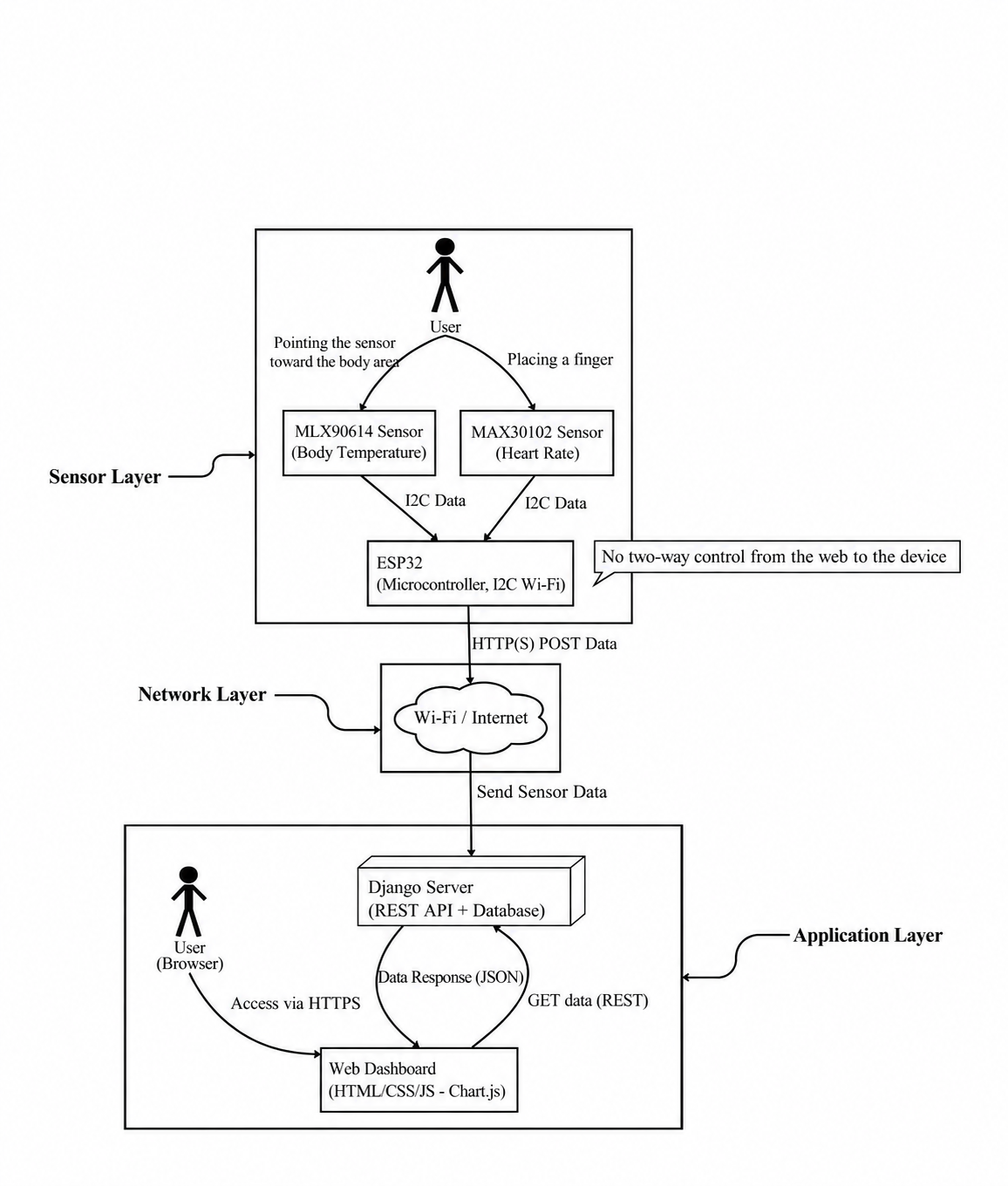
Independent health monitoring is important to support the early detection of changes in physical condition. This study aims to design an Internet of Things-based heart rate and body temperature monitoring system accessible through the web. The system uses an ESP32 microcontroller connected to a MAX30102 sensor to acquire heart rate data and an MLX90614 sensor to acquire body temperature data. The acquired data are transmitted over a WiFi network to a web server developed using the Django framework for storage and real-time display on a web dashboard. Testing was conducted by comparing sensor readings with an oximeter and a digital thermometer as reference instruments. The results showed that the MAX30102 sensor achieved an accuracy of 96.16% to 97.90%, while the MLX90614 sensor achieved an accuracy of 99.08% to 99.13%. In addition, black-box testing was used to evaluate the main functionalities of the web system, including real-time monitoring data display, graphical visualization, historical data, and data storage in the database. The results showed that all system features operated as designed, enabling the system to receive, store, and display monitoring data from the IoT device in an integrated manner through a web interface
References
[1] M. A. Adrian, M. R. Widiarto, and R. S. Kusumadiarti, “Health monitoring system dengan indikator suhu tubuh, detak jantung dan saturasi oksigen berbasis internet of things (IoT),” Jurnal PETIK, vol. 7, no. 2, pp. 108-118, Sep. 2021.
[2] M. A. Sahuri, D. H. R. S., A. Wisaksono, and Jamaaluddin, “Rancang bangun alat monitoring kondisi suhu tubuh dan jantung pasien saat perawatan berbasis internet (IoT),” DINAMIK, vol. 26, no. 2, pp. 68–79, 2021.
[3] T. M. J. Kulon, H. I. R. Mosey, and V. A. Suoth, “Pemantauan suhu tubuh dan detak jantung berbasis IoT dan terintegrasi ThingSpeak, SMS dan Telegram,” JURNAL MIPA, vol. 13, no. 1, pp. 23-28, Feb. 2024.
[4] A. A. Tanjung, A. Zahra, and S. C. HS, “Rancang bangun alat pendeteksi detak jantung dan suhu tubuh berbasis internet of things (IoT),” in Konferensi Nasional Social dan Engineering Politeknik Negeri Medan, Medan, 2024, pp. 752-759.
[5] N. A. Syhabudin, B. Darmawan, and Supriono, “Rancang bangun sistem alat ukur heart rate dan suhu tubuh menggunakan Esp 8266,” Journal of Information System Research (JOSH), vol. 6, no. 1, pp. 459-468, Oct. 2024, doi: 10.47065/josh.v611.6096.
[6] C. T. Salawali, R. Satra, and I. As’ad, “Penerapan Internet of Things (IoT) dalam sistem kontrol-monitoring proses transesterifikasi pembuatan biodiesel berbasis ESP32,” Buletin Sistem Informasi dan Teknologi Islam, vol. 4, no. 3, pp. 221–230, Aug. 2023.
[7] I. Y. Zaki, L. Anifah, F. Baskoro, and P. Puspitaningayu, “Rancang bangun sistem monitoring detak jantung, suhu tubuh, dan cairan infus berbasis internet of things,” Jurnal Teknik Elektro, vol. 12, no. 2, pp. 14–22, 2023.
[8] A. W. R. Gusti, R. Rokhana, Kemalasari, and V. K. Ningsih, “Sistem screening mandiri Covid-19 berbasis internet of things (IoT),” Indonesian Journal of Computer Science, vol. 12, no. 4, pp. 2000-2008, Aug. 2023.
[9] I. Rosima and U. Suwardoyo, “Monitoring detak jantung berbasis internet of things,” Jurnal Sintaks Logika, vol. 2, no. 3, pp. 17-22, Sep. 2022.
[10] F. A. Pratama, A. I. Pradana, and D. Hartanti, “Pengembangan aplikasi mobile untuk monitoring detak jantung, saturasi oksigen darah, dan suhu tubuh dengan integrasi IOT menggunakan ESP32,” INFOTECH: JOURNAL OF TECHNOLOGY INFORMATION, vol. 10, no. 1, pp. 27-36, Jun. 2024, doi: https://doi.org/10.37365/jti.v10i1.244.
[11] N. Rahayu, "Pengembangan aplikasi mobile untuk pemantauan kesehatan mental menggunakan Flutter," Jurnal Komputer, vol. 3, no. 1, pp. 25–30, Jul.–Dec. 2024.
[12] M. P. Toppany, D. Kurnia, Janizal, and R. P. H. Adji, “Integrasi framework bootstrap dan chart.js untuk visualisasi data sensor pada sistem hidroponik berbasis internet of things (IoT),” Jurnal Rekayasa Mekatronika (JRM), vol. 1, no. 2, pp. 11-21, Sep. 2024.
[13] E. J. Prihantoro, Sulistiyanto, and M. F. Efendi, “Perancangan smart klinik berbasis mikrokontroler NodeMCU ESP32,” JEECOM, vol. 3, no. 2, pp. 89-95, Oct. 2021.
[14] M. A. Saputra, W. C. Utomo, A. B. Setiawan, and I. K. Ramadhanu, “Pengamatan cuaca lokal secara multi node dengan internet of things dan django framework,” JITU: Journal Informatic Technology And Communication, vol. 8, no. 1, pp. 31-40, May 2024, doi: 10.36596/jitu.v8i1.1334.
[15] M. Muthmainnah and D. B. Tabriawan, “Prototipe alat ukur detak jantung menggunakan sensor MAX30102 berbasis Internet of Things (IoT) ESP8266 dan Blynk,” JISKA (Jurnal Informatika Sunan Kalijaga), vol. 7, no. 3, pp. 163–176, Sep. 2022