Internet of Things-Based Automatic Fish Feeding System Using ESP32 with Real-Time Monitoring
DOI:
https://doi.org/10.56705/ijonit.v2i2.400Keywords:
Internet of Things, Fish Feeding System, ESP32, Load Cell, Real-Time MonitoringAbstract
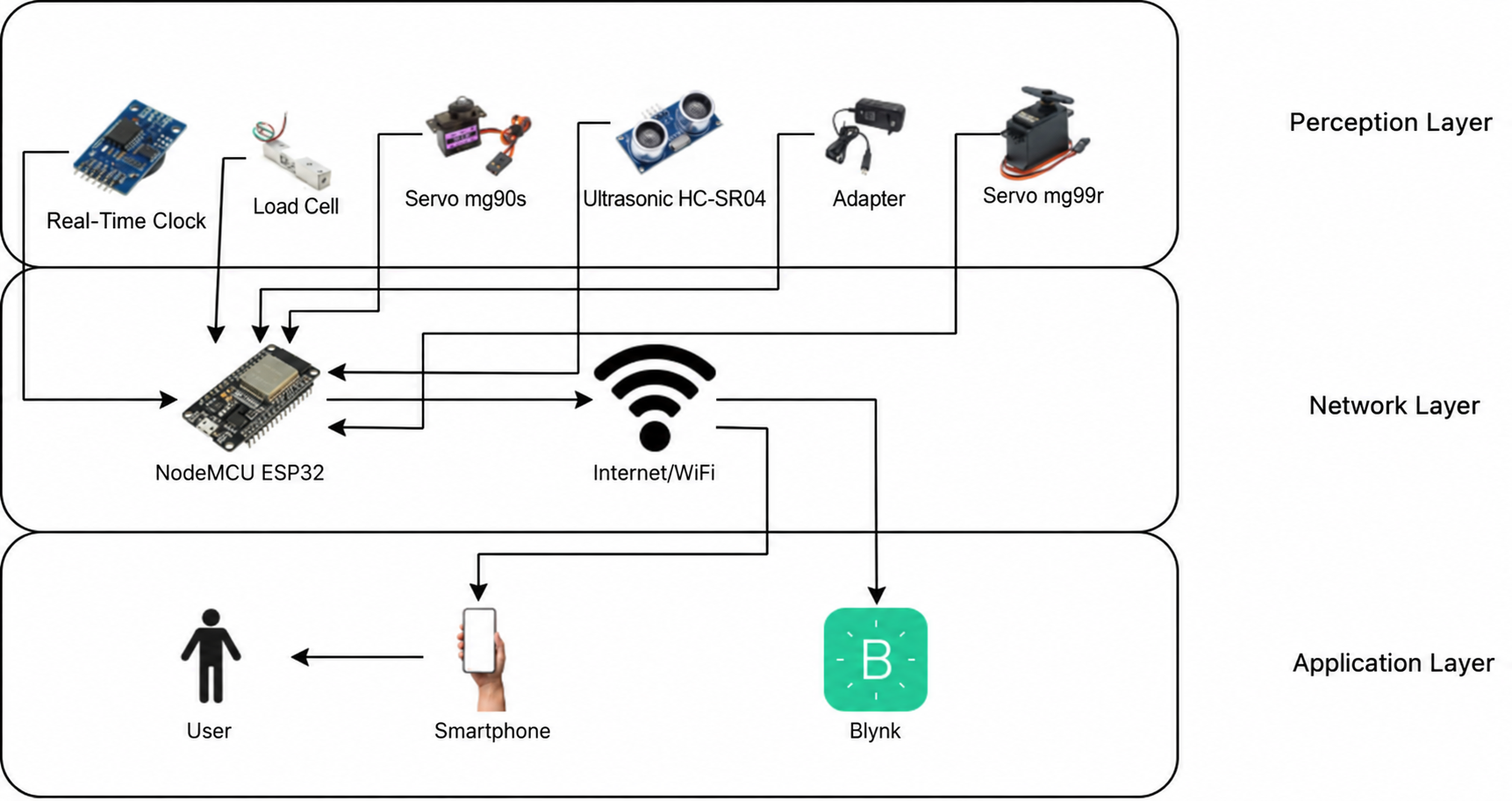
Uncontrolled feeding can reduce the efficiency of fish farming. This study develops an Internet of Things-based automatic fish feeding system using ESP32, integrated with a load cell sensor, an ultrasonic sensor, and an RTC module for scheduled feed dispensing and real-time monitoring through the Blynk application. The test results showed that the ultrasonic sensor had an error of 0%, while the load cell had an average error of 5.61%. Operational testing over 14 days resulted in feed dispensing ranging from 206 to 219 g per session. Compared with the manual method, which had an average error of 48.9%, the automatic system provided more consistent and measurable feed portions. These results indicate that an IoT-based system can improve precision in feed management for fish farmingReferences
[1] D. I. Bbi et al., “Pertumbuhan dan Kelangsungan Hidup Benih Ikan Nila,” J. Agrominansia, vol. 4, no. 1, pp. 61–70, 2019.
[2] I. Nur, I. Fajrul, K. Umar, Ridwang, and N. Afif, “Rancang Bangun System Monitoring dan Controlling Alat Pemberi Pakan Ikan dan Pengganti Air Otomatis,” J. Tek. Elektro UNISMUH, vol. 15, no. 2, pp. 57–66, 2023.
[3] V. Rahmadhani and W. Arum, “Literature Review Internet of Think (Iot): Sensor, Konektifitas Dan Qr Code,” J. Manaj. Pendidik. Dan Ilmu Sos., vol. 3, no. 2, pp. 573–582, 2022, doi: 10.38035/jmpis.v3i2.1120.
[4] A. I. Ulum, “Pengembangan alat pemberi pakan ikan otomatis berbasis iot (internet of things),” 2023, [Online]. Available: https://repository.unugiri.ac.id:8443/id/eprint/4409
[5] E. P. Setiawan and A. Herwanto, “Perancangan Sistem Pengendali Kebutuhan Akuarium Ikan Berbasis Internet of Things,” J. Mhs. Tek. Inform., vol. 8, no. 5, pp. 10580–10588, 2024.
[6] M. Maryam, M. Musyrifah, and M. F. Mansyur, “Pemberian Pakan Ikan Nila Otomatis Dan Mengecek Suhu Air Berbasis Internet of Things (Iot),” J. Inform. dan Tek. Elektro Terap., vol. 11, no. 3s1, 2023, doi: 10.23960/jitet.v11i3s1.3378.
[7] M. I. Nugraha and B. D. Cahyono, “Arduino-based Automatic Fish Feeding Device Prototype,” J. Comput. Sci. Adv., vol. 1, no. 5, pp. 265–275, 2024, doi: 10.70177/jsca.v1i5.641.
[8] A. Rachmansyah, R. Satra, and M. Aliyazid, “Perancangan Alat Pemberi Makan dan Monitoring Sisa Pakan Hewan Pemeliharaan Berbasis Microcontroller,” Bul. Sist. Inf. dan Teknol. Islam, vol. 3, no. 1, pp. 26–33, 2022.
[9] M. Sheilamita, S. Pieter, N. I. Siguntu, and E. V. Manullang, “SISTEM PEMBERIAN PAKAN IKAN OTOMATIS BERBASIS INTERNET OF THINGS,” J. Din., vol. 22, no. 2, pp. 46–54, 2025.
[10] D. T. Utomo, A. Suwardono, E. M. Indrawati, and M. D. M. Puspitasari, “Pemberi Pakan Ikan Gurame Otomatis Menggunakan ESP32 berbasis IoT-Telegram,” J. Nusant. Eng, vol. 8, no. 1, pp. 12–19, 2025.
[11] E. M. Indrawati, B. Suprianto, and U. T. Kartika, “Pemberi Pakan Ikan Otomatis berbasis IoT dengan FLC Berdasarkan Kualitas Air ( Suhu , PH , Kekeruhan ),” J. Sains dan Teknol., vol. 13, no. 3, pp. 383–394, 2024.
[12] R. S. Amelia, M. Iqbal, S. Rohman, and H. Darussyifa, “Perancangan dan Implementasi Sistem Pakan Ikan Otomatis ( SMART PAKAN ) Budidaya Ikan Bandeng Berbasis IoT dengan Aplikasi Blynk,” J. Profesi Ins., vol. 6, no. 2, 2025.